
Economizers in Tier Certified Data Centers (Keith Klesner)
Uptime Institute Journal · Keith Klesner
An Uptime Institute Journal article reviewing economizer types and how to apply them without breaking Tier III/IV objectives.
On this page
Overview
Keith Klesner's 2016 Uptime Institute Journal article reviews economizer types: direct air, direct air plus evaporative, indirect evaporative, pumped-refrigerant dry coolers and water-side economizers. It explains how to apply them without breaking Tier III/IV objectives. Uptime consultants observed that roughly one-third of new data centre designs include an economizer function.
Citing The Green Grid's 2011 survey, the article notes that 49% of large data centres used economizers and 24% were considering them. Direct-air rooftop economizer units report PUE around 1.30-1.60 and consume very little water. Outside-air units for mission-critical spaces must be able to run 100% recirculation during pollution or wildfire smoke events.
Commercial rooftop units adapted for 24x7 use need adequate filtration, full recirculation capability and well-tested control sequences across every operating mode. A DX unit with an air-side economizer can go from no power to full cooling in 120 seconds or less, with four operating modes; a chilled-water unit with wetted media may have nine modes, all of which must be tested.
Worst-case design conditions, not typical weather, govern Tier compliance. Most commercial HVAC ratings are at 95 F (35 C), and designs must be checked against the site's worst-case conditions. As a limitation, this is a journal article and offers no detailed calculation. Copyright belongs to Uptime Institute.
Key points
- Uptime consultants observed roughly one-third of new data centre designs include an economizer function.
- The Green Grid 2011 survey: 49% of large data centres used economizers and 24% were considering them.
- Direct-air rooftop economizer units report PUE around 1.30-1.60 and consume very little water.
- Outside-air units for mission-critical spaces must run 100% recirculation during pollution or wildfire smoke events.
- A DX unit with an air-side economizer can go from no power to full cooling in 120 s or less, with four operating modes.
- A chilled-water unit with wetted media may have nine modes, all of which must be tested.
- Most commercial HVAC ratings are at 35 C (95 F); designs must be checked against the site's worst-case conditions.
Using it in design
- Catalogue economizer units with operating modes, restart time and recirculation capability.
- For outside-air economizers, require filtration and a 100% recirculation mode.
- Check cooling capacity at the site's extreme design temperatures, not at the 35 C rating.
- Generate a commissioning test list covering every mode.
Monthly newsletter · free
Keep your reading list current
Once a month: new library sources, changes to Turkish regulations and upcoming data centre events.
SoSo CAD
Check cooling capacity alongside your design
Review zone heat loads, available capacity and the capacity balance after the largest unit is lost in SoSo CAD.
Request a demo
Who should read it
Mechanical designers selecting free cooling and economizers for Tier-targeted data centres.
Related standards
- ASHRAE 90.4
- Uptime Institute Tier Standard: Topology
Publication details
- Authors
- Keith Klesner
- Publisher
- Uptime Institute Journal
- Year
- 2016
- Document language
- English
- Source type
- Industry body
- Access
- Free to read
- Licence
- Copyright retained; citation only — the publisher’s terms apply to the original document
Citation
Keith Klesner (2016). Economizers in Tier Certified Data Centers (Keith Klesner). Uptime Institute Journal. https://journal.uptimeinstitute.com/implications-of-economizers-in-tier-certified-data-centers/
Events on this subject
Browse the events calendarAll content and rights belong to the respective authors and publishers. SoSo CAD provides only the citation, its own summary and a link to the source, and is not responsible for the sources' content.
Related sources
All sources on this topic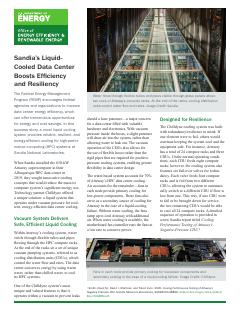
U.S. DOE FEMP 2021
Sandia's Liquid-Cooled Data Center Boosts Efficiency and Resiliency (FEMP success story, DOE/GO-102021-5582, July 2021)
Consider negative-pressure (vacuum) distribution as an option for reducing leak risk in direct liquid cooling; flexible hoses give layout flexibility.
- The system kept CPUs below 50 °C (122 °F); each CDU draws 3.4 kW at full load, about 1.6% of total system power.
U.S. DOE FEMP 2010
Operations & Maintenance Best Practices: A Guide to Achieving Operational Efficiency, Release 3.0 (August 2010)
Choose maintenance strategy by equipment criticality: predictive for critical equipment with random failures, preventive for equipment subject to wear, reactive for small non-critical items; build a master equipment list and priority matrix.
- Boiler combustion tuning and related O&M can yield fuel savings of 2% to 20%.
Beca 2026
Part 2: Designing next-generation data centres - Principals for efficiency and resilience
Let users set the cold-aisle supply temperature and recompute free-cooling hours from the site weather file.
- A PUE of about 1.4 is described as a common target; going lower needs more than conventional air cooling.
STULZ 2026
Liquid Cooling Whitepaper - End-to-End Cooling: The Key to Resilient AI Data Centers
In the liquid-cooling module size TCS flow at about 1.5 L/min/kW by default and store CDU approach temperature and external static pressure.
- Rack heat densities from about 125 kW today to beyond 500 kW.
TÜV NORD 2026
EN 50600 — data centre facilities and infrastructures (overview and certification)
In an 'EN 50600' standards profile, offer separate availability-class selectors for power, cooling and cabling (instead of a single Tier), plus a protection-class selector per room or zone
- Protection classes 1-4 for unauthorised access and other hazards; physical-security zoning required
arXiv preprint (Harvard University et al.) 2025
Electricity Demand and Grid Impacts of AI Data Centers: Challenges and Prospects
For AI-campus grid studies, use the default rack-density bands (7-10 kW traditional, 30-100+ kW AI).
- Cited EPRI shares: IT 40-50% of total load, cooling 30-40%, other facilities 10-30%; in AI data centers IT typically exceeds 60%.