
Divide and Conquer: Understanding the Impact of Modular Data Room Design Approach on PUE (Jorge A. Gil)
7x24 Exchange Magazine · Jorge A. Gil
An article modelling how splitting a 1 MW data room into PODs with dedicated power and cooling infrastructure improves part-load PUE during IT load ramp-up.
On this page
Overview
Jorge A. Gil's article in the Fall 2024 issue of 7x24 Exchange Magazine (p. 31) models how splitting a 1 MW data room into PODs, each with dedicated power and cooling infrastructure, improves part-load PUE during IT load ramp-up. It is a freely readable expert article. The starting point is that design PUE is reached only at high load, while in the early years of operation the infrastructure runs inefficiently at low load.
In a non-modular room the PUE curve divides into three zones: an inefficiency range at 0-50% of IT load, an 'efficiency limbo' at 50-70% and an efficiency range above 70%, with the best (design) PUE at 100% load. Activating PODs on demand keeps the infrastructure better loaded. The price is 'jump' PUE steps and more equipment to maintain and monitor.
In the case study, a 1,000 kW data room with a design PUE of 1.615 is compared as one room, four 250 kW PODs and eight 125 kW PODs. At 10%, 20% and 25% IT load, the PUE difference between the non-modular and 4-POD designs is 3.59, 1.79 and 1.38. With evenly distributed load, modular ramp-up can save up to 48% energy during early growth.
Activating a new POD creates a temporary 'jump PUE', for example when POD D is activated at 75% load. The article's limit is that it rests on one case study and specific assumptions, so the results should not be transferred numerically to other facilities but read as an indication of direction and size. The related document is ISO/IEC 30134-2 (PUE).
Key points
- Non-modular design PUE curve: inefficiency range 0-50% IT load, efficiency limbo 50-70%, efficiency range above 70%; best (design) PUE at 100% load.
- Case study: 1,000 kW data room, design PUE 1.615, compared as one room vs four 250 kW PODs vs eight 125 kW PODs.
- At 10%, 20% and 25% IT load the PUE difference between non-modular and 4-POD designs was 3.59, 1.79 and 1.38.
- Modular ramp-up can save up to 48% energy during early growth with evenly distributed load.
- Activating a new POD creates a temporary 'jump PUE' (for example when POD D is activated at 75% load).
- Downsides: more infrastructure to maintain, more monitoring and operational readiness needed.
- Related document: ISO/IEC 30134-2 (PUE).
Using it in design
- Compute and plot PUE versus IT load for phased designs, showing step changes when each POD or block is energized.
- Warn when a single-block design is expected to operate below 50% IT load for years.
- In that case, suggest modular phasing.
- Include the extra maintenance and monitoring burden of the modular option in the cost comparison.
Monthly newsletter · free
Keep your reading list current
Once a month: new library sources, changes to Turkish regulations and upcoming data centre events.
SoSo CAD
Compare the cost of design decisions
Evaluate equipment costs, energy expenses and total cost of ownership (TCO) using your inputs and assumptions in SoSo CAD.
Request a demo
Who should read it
Designers planning power and cooling phasing in data centres that grow in stages, and operations teams managing energy efficiency.
Related standards
- ISO/IEC 30134-2 (PUE)
Publication details
- Authors
- Jorge A. Gil
- Publisher
- 7x24 Exchange Magazine
- Year
- 2024
- Document number
- Fall 2024 issue, p. 31
- Document language
- English
- Source type
- Industry body
- Access
- Free to read
- Licence
- Copyright retained; citation only — the publisher’s terms apply to the original document
Citation
Jorge A. Gil (2024). Divide and Conquer: Understanding the Impact of Modular Data Room Design Approach on PUE (Jorge A. Gil). 7x24 Exchange Magazine. Fall 2024 issue, p. 31. https://www.7x24exchange.org/wp-content/uploads/2026/01/7x24_Exchange-2024_Fall_Magazine_sm_rem.pdf
Events on this subject
- Electricity Eurasia 2027
- ELECO 2026 Elektrik-Elektronik ve Biyomedikal Mühendisliği Konferansı
- 7x24 Exchange Spring Conference
All content and rights belong to the respective authors and publishers. SoSo CAD provides only the citation, its own summary and a link to the source, and is not responsible for the sources' content.
Related sources
All sources on this topic
Open Compute Project Foundation 2026
Introducing Power Compute Effectiveness (PCE), a Provisioned Capacity Allocation Metric for the New Data Center Era (October 2026)
Compute PCE automatically from the design model: utility/transformer capacity as P_facility, peak cooling electrical input at design ambient, UPS/transformer/busway losses and auxiliary panel loads, all on the declared redundancy basis.
- Motor horsepower converts at HP x 0.746; kVA ratings convert to kW at the declared power factor.

International Energy Agency 2025
Energy and AI (World Energy Outlook Special Report)
Use the IEA component split (servers about 60%, storage about 5%, network up to 5%, cooling 7-30%) to sanity-check modelled energy breakdowns.
- The 2035 range across cases is 700-1,700 TWh; the High Efficiency Case is 20% below the Base Case.
U.S. EPA / ENERGY STAR 2024
ENERGY STAR Program Requirements for Computer Servers, Version 4.0 (Partner Commitments, Eligibility Criteria, and Final Test Method Rev. April 2023)
Write ENERGY STAR Version 4.0 certification and the PSU efficiency steps (at 10% to 100% load points) into the server procurement specification; look especially at 10% and 20% load efficiency for redundant supplies that run lightly loaded.
- EffACTIVE = EXP(0.65 ln EffCPU + 0.30 ln EffMEMORY + 0.05 ln EffSTORAGE).
U.S. DOE FEMP / NREL 2024
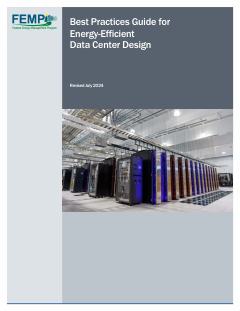
Best Practices Guide for Energy-Efficient Data Center Design (Revised July 2024)
Weigh the supply air setpoint against server fan energy: raise it in small steps within the ASHRAE recommended range so the most demanding inlet nears 80 °F, only after air management is in place, and control to IT inlet temperature rather than return temperature.
- Compute racks reached 60 kW in 2013, and recent liquid-cooled racks exceed 125 kW.
TÜV NORD 2026
EN 50600 — data centre facilities and infrastructures (overview and certification)
In an 'EN 50600' standards profile, offer separate availability-class selectors for power, cooling and cabling (instead of a single Tier), plus a protection-class selector per room or zone
- Protection classes 1-4 for unauthorised access and other hazards; physical-security zoning required
Socomec 2024
Data centre - How to ensure power availability, electrical safety and energy performance? (Expert advice & innovative solutions guide)
In the single-line editor, tag transfer devices as ATSE (IEC 60947-6-1) or STS with a transfer-time field, and suggest STS where the load needs under about 10 ms.
- Human error accounts for 22 % of unplanned outages.