
Evolution of Data Center Onsite Power Use
Cummins · Rich Scroggins
Cummins Bulletin 6511837 (Rich Scroggins, 2024) is a short white paper on how decarbonisation goals and grid constraints are pulling data-centre onsite generation away from pure emergency standby.
On this page
Overview
The paper places onsite assets on a chart of operating hours against carbon intensity. Today's diesel standby sits at low hours and high carbon. Low-carbon fuels such as HVO shift it right, and grid augmentation shifts it upward into an 'active standby' mode, meaning assets dispatched beyond emergency use but not as the primary supply.
The driver is market pressure. The paper cites sources estimating that data centres use 2-3% of world electricity, and notes that utilities in Northern Virginia and Dublin are restricting new data-centre connections because of capacity or distribution limits. In constrained areas grid interruptions can last up to several hours a day, and some utilities mandate demand-response participation.
The main barrier to active standby is criteria-emission (NOx) regulation. Listed enablers are in-cylinder improvements, aftertreatment, gas engines, BESS and later hydrogen and fuel cells. Prime-power operation is not expected where utility supply is sufficient.
Key points
- Data centres are estimated to use 2-3% of world electricity (sources cited in the paper).
- Utilities in Northern Virginia and Dublin are restricting new data-centre connections.
- Onsite power is mapped on operating hours versus carbon intensity; HVO moves it right, grid augmentation moves it upward.
- Grid interruptions in constrained areas can reach several hours a day; some utilities require demand response.
- Active standby is dispatch beyond emergency use without being primary supply; NOx rules are the main barrier.
- Prime-power operation is not expected where utility supply is adequate.
Using it in design
- Carry fuel compatibility (HVO/EN 15940), emissions tier/NOx and permitted annual run hours in the generator catalog.
- Add an operating-mode setting: emergency standby, active standby/demand response, prime.
- When active standby is chosen, require a rating with adequate run hours, aftertreatment and NOx compliance, and fuel logistics, and offer BESS as an alternative asset.
Monthly newsletter · free
Keep your reading list current
Once a month: new library sources, changes to Turkish regulations and upcoming data centre events.
SoSo CAD
Review your power design in SoSo CAD
Inspect supply paths, equipment loads and UPS failure scenarios in one model.
Request a demo
Who should read it
Decision makers and designers revisiting onsite generation strategy against grid constraints and carbon targets.
Related standards
- EN 15940
- IEEE 1547
Publication details
- Authors
- Rich Scroggins
- Publisher
- Cummins
- Year
- 2024
- Document number
- Bulletin 6511837
- Document language
- English
- Source type
- Manufacturer
- Access
- Free to read
- Licence
- Copyright retained; citation only — the publisher’s terms apply to the original document
Citation
Rich Scroggins (2024). Evolution of Data Center Onsite Power Use. Cummins. Bulletin 6511837. https://mart.cummins.com/imagelibrary/Asset/6511837_1124.pdf.ashx
Events on this subject
- ICCI 2027 – Uluslararası Enerji ve Çevre Fuarı ve Konferansı
- Datacenter Forum Stockholm
- Datacenter Forum Helsinki
All content and rights belong to the respective authors and publishers. SoSo CAD provides only the citation, its own summary and a link to the source, and is not responsible for the sources' content.
Related sources
All sources on this topic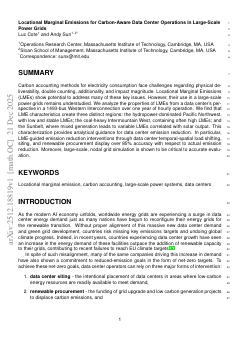
arXiv preprint (math.OC), MIT Operations Research Center 2025
Locational Marginal Emissions for Carbon-Aware Data Center Operations in Large-Scale Power Grids
In data-centre carbon accounting, consider hourly locational marginal emissions (LME) rather than an annual-average grid factor; the LME-based intensity (about 672 kgCO2/MWh) was about 3 times the average factor (202).
- Emission rates assumed in the simulated grid: coal 800 kgCO2/MWh, gas 450 kgCO2/MWh, wind/solar/nuclear/hydro 0.
arXiv preprint (cs.SE), Google 2024
Carbon accounting in the Cloud: a methodology for allocating emissions across data center users
In allocating carbon to data-centre users, give idle power to whoever holds the resource allocation and share dynamic power by actual usage; because an idle server draws about 45% of peak power, the idle share is large.
- Resources with equivalent busy power used to weight idle-power allocation: 1 Intel Skylake N1 CPU core = 20 GiB RAM = 1 TiB SSD = 6 TiB HDD.
European Commission (Official Journal of the European Union) 2024
Commission Delegated Regulation (EU) 2024/1364 of 14 March 2024 on the first phase of the establishment of a common Union rating scheme for data centres
Build the metering architecture to the regulation: meters on every supply input for total energy (grid and back-up generator separately) and at every UPS output for IT energy, with a system that retains measurement point and device records for at least 10 years.
- Data centre electricity demand is projected to reach 3.2% of total EU demand by 2030, a 28% increase over 2018.
Proceedings of the Twelfth ACM International Conference on Future Energy Systems (ACM) 2021
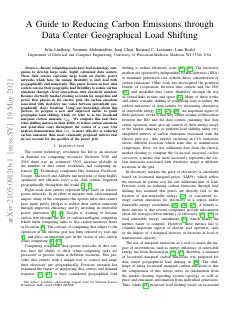
A Guide to Reducing Carbon Emissions through Data Center Geographical Load Shifting
For geographic load shifting, consider locational marginal carbon emissions (lambda-CO2) as the signal instead of LMP or regional average carbon intensity; it gave the largest reduction (-1.44%).
- Lambda-CO2 shifting saved about 0.14 t CO2 per MW shifted and still reduced generation cost by 0.27%; LMP shifting cut cost by 1.07% but saved less carbon.
IEEE Transactions on Power Systems (Institute of Electrical and Electronics Engineers (IEEE)) 2021
Carbon-Aware Computing for Datacenters
Consider shifting temporally flexible workloads (completable within 24 hours) to hours of lower carbon intensity and lower power peak as an option in data-centre grid-connection negotiation and power capacity planning.
- A piecewise-linear model of power versus CPU usage achieves daily MAPE below 5% for more than 95% of power domains.
Hitachi Energy 2025
Powering GenAI data centers at speed: A renewable energy hub approach from off-grid to grid-connected operation
Support phased supply scenarios (off-grid hub then grid) with PV, BESS and generator sizing in the site/energy module.
- 450 MW of PV needs roughly 2,700 acres.