
Strategies for Improving the Sustainability of Data Centers via Energy Mix, Energy Conservation, and Circular Energy
Sustainability (MDPI AG) · Matteo Manganelli, Alessandro Soldati et al.
This narrative review covers the physical-layer options for reducing data-centre energy use and environmental impact: power supply and continuity, computer-room cooling, lighting, low-power and wide-bandgap electronics, DC distribution, modular data centres, and metrics and standards.
CC BY 4.0 — share with attribution
On this page
Overview
ICT is increasingly permeating daily life and more of our data goes to the cloud; events like COVID-19 put an exceptional burden on ICT, which increases implementation and use of data centres and so energy use and environmental impact. The review first presents estimated energy use and emissions, then reviews strategies for energy efficiency and conservation; key elements are innovative cooling techniques, natural resources, automation, low-power electronics and equipment with extended thermal limits. Estimated data-centre energy split: cooling and servers about 43% each, storage drives 11% and network devices 3%; an alternative estimate is roughly 52% ICT, 38% cooling system and 10% other equipment.
On power, for an 800 kW load a 4 × 250 kW internally modular UPS runs at 80% load (small losses), a 5 × 250 kW modular-redundant UPS at 64%, and a 3 × 500 kW parallel-redundant UPS at 53% (high losses); specifying efficiency at 30% load is proposed. IGBT three-level UPS power stages reached about 96% efficiency, SiC transistors exceed 98% almost independently of load, and one SiC-based UPS is reported above 98% for any load above 30%. Only the continuous operating power (COP) generator rating is sufficient for Tier III or IV certification, implying an oversized generator; Tier III is listed at 99.982% availability (1.6 h/yr downtime) and Tier IV at 99.995% (0.4 h/yr).
Reviewed free-cooling studies report PUE of 1.10-1.16 and energy savings of 30%-40%, with some claiming COP up to 9-12 or savings up to 47%-49%; airside economisation needs outdoor air at least 5 °C colder than indoor air. Proper room-layout and ventilation design in large data centres costs an estimated 8%-10% of total cost and usually pays back through energy savings in two to three years; hot-aisle containment is reported as better than cold-aisle containment. White racking instead of black could cut the number of luminaires and lighting energy by as much as 37% each.
A Net Zero Energy Data Center (RenewIT) consumes net zero non-renewable primary energy from grid and district networks over its lifetime; the roadmap runs through efficient envelope, ICT, power distribution and cooling distribution, then reuse of ICT waste heat and renewables. Despite the 'circular' framing it treats circularity as energy reuse and gives no quantitative embodied-carbon or material life-cycle data, which is a limitation.
Key points
- Estimated data-centre energy split: cooling and servers about 43% each, storage drives 11% and network devices 3%; an alternative estimate is roughly 52% ICT, 38% cooling system and 10% other equipment.
- For an 800 kW load, a 4 × 250 kW internally modular UPS runs at 80% load, a 5 × 250 kW modular-redundant UPS at 64%, and a 3 × 500 kW parallel-redundant UPS at 53% (high losses); specifying efficiency at 30% load is proposed.
- IGBT three-level UPS power stages reached about 96% efficiency; SiC transistors exceed 98% almost independently of load; one SiC-based UPS is reported above 98% for any load above 30%.
- Free-cooling studies report PUE of 1.10-1.16 and energy savings of 30%-40%; airside economisation needs outdoor air at least 5 °C colder than indoor air.
- Proper room-layout and ventilation design in large data centres costs an estimated 8%-10% of total cost and usually pays back through energy savings in two to three years; hot-aisle containment is reported as better than cold-aisle containment.
- Only the continuous operating power (COP) generator rating is sufficient for Tier III or IV certification and implies an oversized generator; Tier III 99.982% (1.6 h/yr), Tier IV 99.995% (0.4 h/yr).
- White racking instead of black could cut the number of luminaires and lighting energy by as much as 37% each.
- CUE is defined as total CO2 emissions over ICT energy, or equivalently the CO2 emission factor × PUE.
Using it in design
- Calculate UPS load ratio (80% for 800 kW in a modular arrangement, 53% in parallel-redundant) and losses at design stage; consider specifying UPS efficiency at 30% load and compare a SiC-based power stage (above 98%).
- For a Tier III or IV target, set the generator rating on the continuous operating power (COP) basis and add to the cost calculation that this implies an oversized generator.
- Allocate 8%-10% of total cost to room layout and ventilation design and consider hot-aisle containment; payback is two to three years.
- For net-zero-energy targets, reduce load first (envelope, ICT, power and cooling distribution), then reuse waste heat and integrate renewables.
Monthly newsletter · free
Keep your reading list current
Once a month: new library sources, changes to Turkish regulations and upcoming data centre events.
SoSo CAD
Compare the cost of design decisions
Evaluate equipment costs, energy expenses and total cost of ownership (TCO) using your inputs and assumptions in SoSo CAD.
Request a demo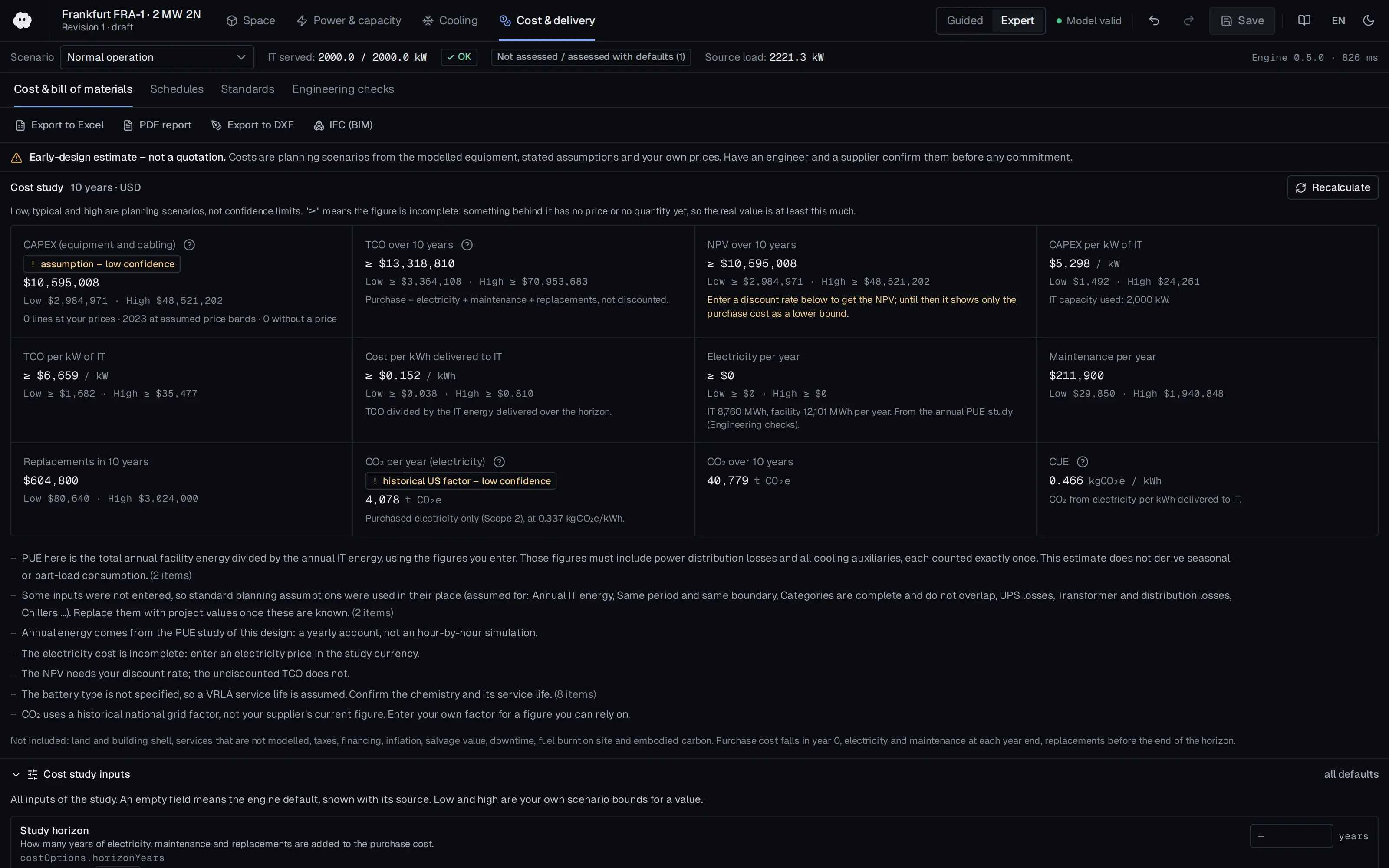
Who should read it
Designers and managers surveying physical-layer energy-saving options (power, cooling, lighting, electronics) for data centres.
Document contents
- 1. Introduction
- 2. Power Supply and Continuity (2.1 Tier Classification, 2.2 Power Losses, 2.3 UPS)
- 3. Energy Conservation of Computer Rooms (3.1 Location, room configuration, room temperature, airflow pattern and active cooling, innovative cooling systems, natural cold source, free cooling, liquid cooling; 3.2 Improvement of Lighting System: lighting control, light sources, other strategies)
- 4. Electronics and Other Strategies (4.1 Low-Power Servers, 4.2 The Little Box Challenge, 4.3 Direct-Current Power Supply, 4.4 Semiconductors, 4.5 Automation, Monitoring, and Robotization, 4.6 Modular Data Centers)
- 5. Regulatory Environment Governing Data Centers (5.1 Metrics: indicators, trends; 5.2 Regulations, 5.3 Certifications and Initiatives)
- 6. Net Zero Energy Data Center
- 7. Conclusions
Related standards
- ISO/IEC 30134 (PUE/CUE/WUE/ERF)
- EN 50600
- ISO 8528-1:2018
- IEC 62040-3
- ANSI/TIA-942-B
- ASHRAE TC 9.9 thermal guidelines
- ANSI/ASHRAE 90.4
- Uptime Institute Tier classification
Read the document
dc-sustainability-strategies-circular-2021.pdf
CC BY 4.0 — share with attribution
The document is provided unaltered because its licence permits redistribution.
Publication details
- Authors
- Matteo Manganelli; Alessandro Soldati; Luigi Martirano; Seeram Ramakrishna
- Publisher
- Sustainability (MDPI AG)
- Year
- 2021
- Volume
- 13
- Issue
- 11
- Pages
- 6114
- Document language
- English
- Source type
- Scientific
- Access
- Open licence — downloadable
- Licence
- CC BY 4.0 — share with attribution
- Licence evidence
- www.mdpi.com
Original licence note
Article p.1 states it is distributed under the Creative Commons Attribution (CC BY) license (http://creativecommons.org/licenses/by/4.0/).
Citation
Matteo Manganelli; Alessandro Soldati; Luigi Martirano; Seeram Ramakrishna (2021). Strategies for Improving the Sustainability of Data Centers via Energy Mix, Energy Conservation, and Circular Energy. Sustainability (MDPI AG). 13(11), 6114. https://doi.org/10.3390/su13116114
Events on this subject
- The smarter E Europe (Intersolar Europe, ees Europe, Power2Drive, EM-Power)
- Data Centre World Paris
- Data Center Nation Zurich
All content and rights belong to the respective authors and publishers. SoSo CAD provides only the citation, its own summary and a link to the source, and is not responsible for the sources' content.
Related sources
All sources on this topic
Sustainability (MDPI AG) 2026
Sustainable Grid Integration of AI Data Centers: Carbon-Aware Co-Optimization of Training Workloads and Battery Storage Under Renewable Uncertainty
Do not size behind-the-meter battery storage on an emission-reduction case; round-trip losses mean storage alone adds nothing and can raise emissions. Justify it with a concrete duty such as masking checkpoint dips.
- The modelled AI fleet drew about 627 MWh/day (about 152 t/day CO2); flexibility abated 39 t/day, about 26% of the fleet's own emissions.
Energies (MDPI AG) 2026
Smart Reuse of Waste Heat from Data Centres: Energy and Exergy Analysis for a District-Heating Network in Bulgaria
Set data-centre setpoints (air temperature, free-cooling threshold) together with waste-heat sales: warmer setpoints and more free cooling cut cooling electricity by about 45% but also cut recoverable heat to about 45%.
- Centralised DH heat pumps are cited as giving COP 3-5 for supply temperatures up to 70-80 °C.
Buildings (MDPI AG) 2025
Energy Performance Study of a Data Center Combined Cooling System Integrated with Heat Storage and Waste Heat Recovery System
Assess heat recovery from chilled-water return with a water-source heat pump and hot-water storage in annual-hour simulation; match the winter and summer outlet temperature difference (45 and 30 °C) to the user's need.
- Free natural-resource cooling covers about 28% of the cooling demand.
Open Compute Project Foundation 2026
Guidelines: Impact of Strategies on Data Center Energy Consumption, Carbon Footprint, and Water Consumption (March 2026)
Evaluate cooling and siting options on energy, carbon, site water and water scarcity together, not on PUE or WUE alone.
- Same example: emissions fall from 3,500 to 2,700 t CO2/yr with the carbon factor of 0.26 kg CO2/kWh.
European Commission JRC 2025
2025 Best Practice Guidelines for the EU Code of Conduct on Data Centre Energy Efficiency (JRC141521, EUR 40267)
Design the facility to operate within the ASHRAE Class A2 allowable range and require A2 operation within warranty in IT procurement; plan separate environmental zones (practice 5.3.4) for legacy equipment.
- IT equipment AC/DC power converters should be rated at 90% efficiency or better across expected load ranges.
Open Compute Project Foundation 2025
Reference Designs for Data Center Heat Reuse, Revision 1.0
Provide a heat-recovery-station block in the site layout with space sized from capacity (plate HX footprint, 10 m2 per MW for heat pumps, about 43 m3 per MW per 30 minutes of storage) and a demarcation boundary to the heat host.
- ORC heat-to-power converts less than 4% of the heat to electricity at these low temperatures.