
Energy Performance Study of a Data Center Combined Cooling System Integrated with Heat Storage and Waste Heat Recovery System
Buildings (MDPI AG) · Chaohui Zhou, Yue Hu et al.
A TRNSYS model of a chilled-water-cooled data centre in Guangzhou, China, combining natural-source free cooling, chillers with cooling towers, a water-source heat pump that recovers heat from the return chilled water into hot-water storage tanks, and rooftop PV.
CC BY 4.0 — share with attribution
On this page
Overview
The study proposes an integrated energy system for a data centre with different renewable energy sources and waste heat recovery, able to consider partial and unsteady IT load. The modelled data centre has 4 computer rooms and 2 equipment rooms, a computer-room area of 1867.4 m² and 740 racks, each 0.6 × 1.2 × 2.2 m with a maximum power of 4 kW. A full year was simulated and the integrated system compared with a conventional reference plant.
Free natural-resource cooling covers about 28% of the cooling demand. Against the reference case the integrated system saves 16.4% of energy, raises system COP from 3.88 to 4.64, lowers PUE from 1.36 to 1.30 and cuts electricity expenses by 23.45%. The water-source heat pump absorbs 3,575,709.597 kWh of heat from the data centre per year and provides 4,587,711.45 kWh of heating energy. Two 500 m³ hot-water tanks store recovered heat; in winter they consistently supply hot water at 45 °C, and in summer, with the heat pump off, outlet water stays at around 30 °C.
Rooftop PV generates about 370,000 kWh per year, about 8% of the data centre's total electricity use. The study is a useful template for annual-hour simulation of heat recovery from chilled-water return streams.
Limits: the site is a low-density air-cooled hall (at most 4 kW per rack), so results do not transfer directly to high-density AI racks. More heat can be recovered as heating demand increases; heat recovery and PV share were simulated for a single facility and climate.
Key points
- The modelled Guangzhou data centre has 4 computer rooms and 2 equipment rooms, a computer-room area of 1867.4 m² and 740 racks, each 0.6 × 1.2 × 2.2 m with a maximum power of 4 kW.
- Free natural-resource cooling covers about 28% of the cooling demand.
- Against the reference case the integrated system saves 16.4% of energy, raises system COP from 3.88 to 4.64, lowers PUE from 1.36 to 1.30 and cuts electricity expenses by 23.45%.
- The water-source heat pump absorbs 3,575,709.597 kWh of heat from the data centre per year and provides 4,587,711.45 kWh of heating energy.
- Two 500 m³ hot-water tanks store recovered heat; in winter they supply hot water at 45 °C, and in summer with the heat pump off outlet water stays at around 30 °C.
- Rooftop PV generates about 370,000 kWh per year, about 8% of the data centre's total electricity use.
Using it in design
- Assess heat recovery from chilled-water return with a water-source heat pump and hot-water storage in annual-hour simulation; match the winter and summer outlet temperature difference (45 and 30 °C) to the user's need.
- Verify the free natural-resource cooling share (here 28%) with climate data and report the PUE gain (1.36 to 1.30) separately from the heat recovery and PV contribution.
- Label results as low-density (at most 4 kW per rack) air-cooled hall results; do not transfer them directly to high-density racks.
Monthly newsletter · free
Keep your reading list current
Once a month: new library sources, changes to Turkish regulations and upcoming data centre events.
SoSo CAD
Compare the cost of design decisions
Evaluate equipment costs, energy expenses and total cost of ownership (TCO) using your inputs and assumptions in SoSo CAD.
Request a demo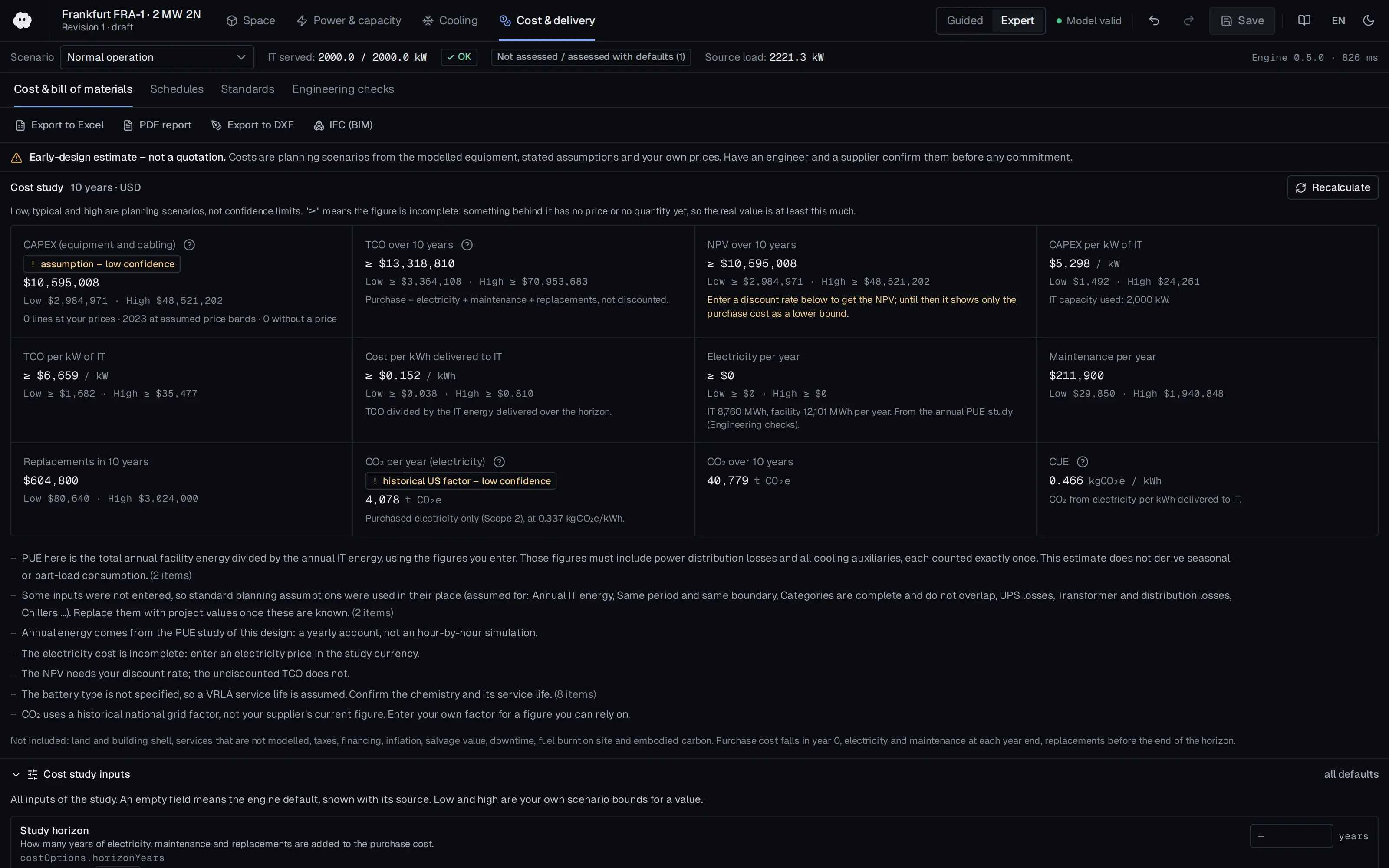
Who should read it
Engineers designing waste-heat recovery from chilled-water return and integrated energy systems.
Document contents
- 1. Introduction (1.1 Literature Reviews, 1.2 Research Gaps and New Contribution of This Study)
- 2. Methodology (2.1 Model of Data Center, 2.4 Simulation Model, 2.5 Model Validation)
- 3. Results and Discussion (3.1 System Energy Consumption, 3.2 System Cooling Capacity, 3.3 Waste Heat, 3.4 System Electricity Balance, 3.5 System Energy Efficiency)
- 4. Conclusions
Read the document
dc-cooling-heat-storage-waste-heat-2025.pdf
CC BY 4.0 — share with attribution
The document is provided unaltered because its licence permits redistribution.
Publication details
- Authors
- Chaohui Zhou; Yue Hu; Rujie Liu; Yuce Liu; Meng Wang; Huiheng Luo; Zhiyong Tian
- Publisher
- Buildings (MDPI AG)
- Year
- 2025
- Volume
- 15
- Issue
- 3
- Pages
- 326
- Document language
- English
- Source type
- Scientific
- Access
- Open licence — downloadable
- Licence
- CC BY 4.0 — share with attribution
- Licence evidence
- www.mdpi.com
Original licence note
PDF p.1 states the article is open access under the Creative Commons Attribution (CC BY 4.0) licence; MDPI publishes all articles under CC BY 4.0.
Citation
Chaohui Zhou; Yue Hu; Rujie Liu; Yuce Liu; Meng Wang; Huiheng Luo; Zhiyong Tian (2025). Energy Performance Study of a Data Center Combined Cooling System Integrated with Heat Storage and Waste Heat Recovery System. Buildings (MDPI AG). 15(3), 326. https://doi.org/10.3390/buildings15030326
Events on this subject
Browse the events calendarAll content and rights belong to the respective authors and publishers. SoSo CAD provides only the citation, its own summary and a link to the source, and is not responsible for the sources' content.
Related sources
All sources on this topic
Energies (MDPI AG) 2026
Smart Reuse of Waste Heat from Data Centres: Energy and Exergy Analysis for a District-Heating Network in Bulgaria
Set data-centre setpoints (air temperature, free-cooling threshold) together with waste-heat sales: warmer setpoints and more free cooling cut cooling electricity by about 45% but also cut recoverable heat to about 45%.
- Centralised DH heat pumps are cited as giving COP 3-5 for supply temperatures up to 70-80 °C.
Sustainability (MDPI AG) 2021
Strategies for Improving the Sustainability of Data Centers via Energy Mix, Energy Conservation, and Circular Energy
Calculate UPS load ratio (80% for 800 kW in a modular arrangement, 53% in parallel-redundant) and losses at design stage; consider specifying UPS efficiency at 30% load and compare a SiC-based power stage (above 98%).
- CUE is defined as total CO2 emissions over ICT energy, or equivalently the CO2 emission factor × PUE.
Open Compute Project Foundation 2026
Guidelines: Impact of Strategies on Data Center Energy Consumption, Carbon Footprint, and Water Consumption (March 2026)
Evaluate cooling and siting options on energy, carbon, site water and water scarcity together, not on PUE or WUE alone.
- Same example: emissions fall from 3,500 to 2,700 t CO2/yr with the carbon factor of 0.26 kg CO2/kWh.
European Commission JRC 2025
2025 Best Practice Guidelines for the EU Code of Conduct on Data Centre Energy Efficiency (JRC141521, EUR 40267)
Design the facility to operate within the ASHRAE Class A2 allowable range and require A2 operation within warranty in IT procurement; plan separate environmental zones (practice 5.3.4) for legacy equipment.
- IT equipment AC/DC power converters should be rated at 90% efficiency or better across expected load ranges.
Open Compute Project Foundation 2025
Reference Designs for Data Center Heat Reuse, Revision 1.0
Provide a heat-recovery-station block in the site layout with space sized from capacity (plate HX footprint, 10 m2 per MW for heat pumps, about 43 m3 per MW per 30 minutes of storage) and a demarcation boundary to the heat host.
- ORC heat-to-power converts less than 4% of the heat to electricity at these low temperatures.
European Commission 2024
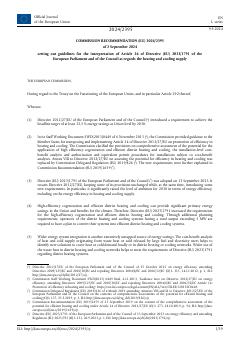
Commission Recommendation (EU) 2024/2395 of 2 September 2024 setting out guidelines for the interpretation of Article 26 of Directive (EU) 2023/1791 as regards heating and cooling supply requirements
When testing the 1 MW waste heat threshold, compute "total rated energy input" from rated capacity (for example utility connection or rated IT plus infrastructure), not modelled annual energy, and take the measurement point at the handover of electricity supply.
- CBA thresholds: thermal electricity generation 10 MW, industrial installation 8 MW, service facility 7 MW, data centre 1 MW.