
Preparing for the Worst: Compartmentalization in Data Center Capacity Planning
Data Center Knowledge · Chris Crosby
Chris Crosby's article arguing that, because no facility is 100% reliable, cloud-scale sites should be compartmentalized so that an incident stays contained.
On this page
Overview
In this 2018 piece in Data Center Knowledge, Chris Crosby argues that no facility is 100% reliable and that cloud-scale sites should therefore be compartmentalized so that a service-affecting incident stays contained. Compartmentalization means physically segmenting applications, hardware and network so that incidents cannot spread.
The author describes two layers: storage/compute clusters, and network nodes serving one or more data halls. On top of these comes inter-meshed connectivity between clusters, nodes and buildings. In the clusters example, a business unit is split into distinct 1 MW clusters to speed fault diagnosis. Each network node supports one or more halls and several clusters, and a cluster failure is contained within its node.
In a block-based design, each power block or hall group should have an independent MEP identity and its own fire zone. Each block needs multiple fibre manholes and multiple points of entry; mesh networking and compartmentalization are complementary. The article is qualitative, with a 1 MW block as its only numeric example. It shows neither the cost impact nor the reliability gain of compartmentalization quantitatively.
Key points
- Compartmentalization is physically segmenting applications, hardware and network so incidents cannot spread.
- Clusters example: a business unit is split into distinct 1 MW clusters to speed fault diagnosis.
- Each network node supports one or more halls and several clusters; a cluster failure is contained within its node.
- Each block or hall group should have an independent MEP identity and its own fire zone.
- Each block needs multiple fibre manholes and multiple points of entry.
- Mesh networking and compartmentalization are complementary.
- The article is qualitative; the only numeric example is a 1 MW block.
Using it in design
- Model the campus as power blocks with block-level MEP independence and fire zones.
- Check that each block has at least two diverse fibre entry paths.
- Provide a fault-domain view showing which halls and clusters are lost for a given block or node failure.
Monthly newsletter · free
Keep your reading list current
Once a month: new library sources, changes to Turkish regulations and upcoming data centre events.
SoSo CAD
Assess redundancy through scenarios
Compare normal operation and equipment failures in SoSo CAD, with supplied loads and capacity shortfalls in one view.
Request a demo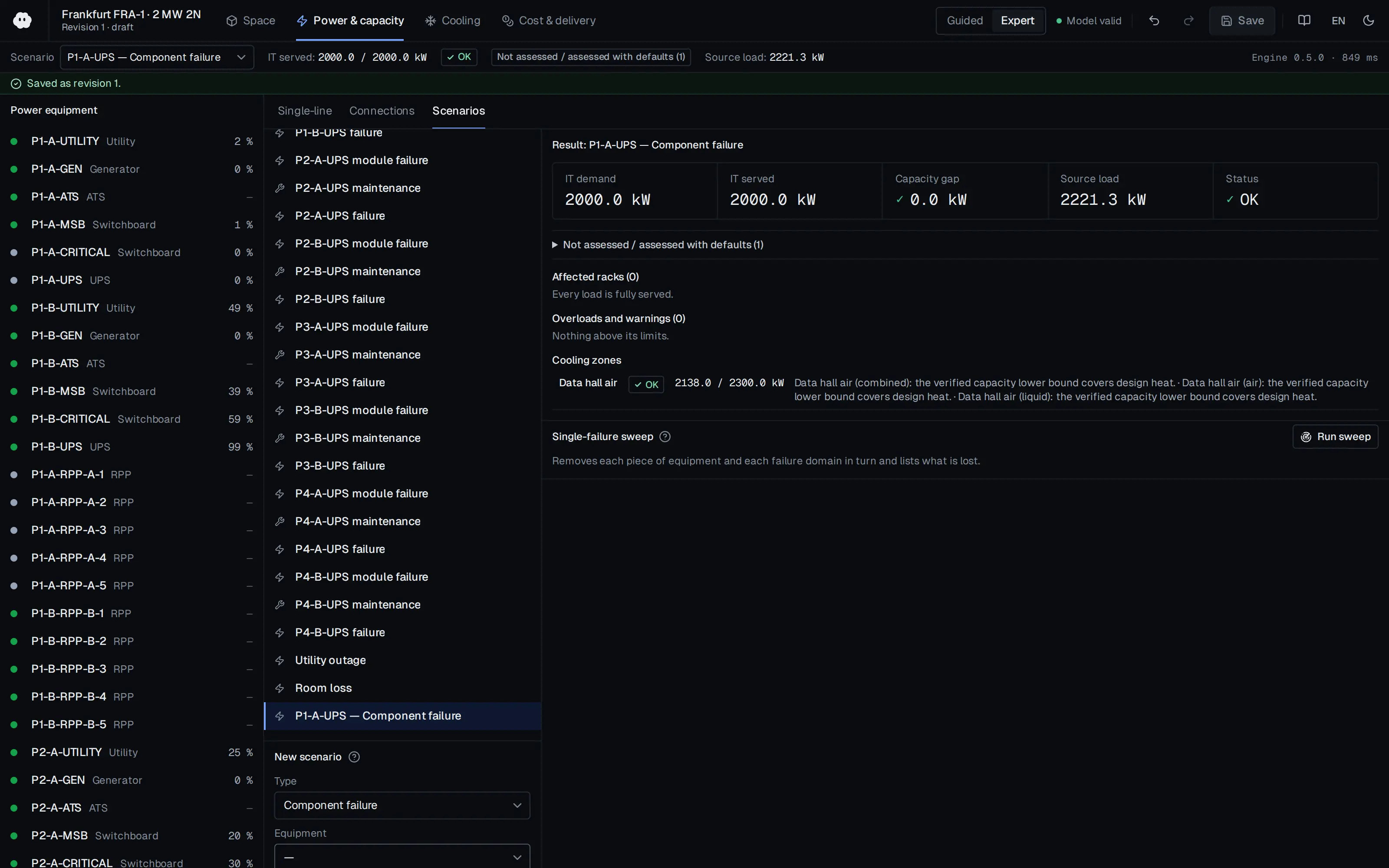
Who should read it
Architects, capacity planners and reliability engineers designing cloud-scale campuses and block-based data centres.
Publication details
- Authors
- Chris Crosby
- Publisher
- Data Center Knowledge
- Year
- 2018
- Document language
- English
- Source type
- Expert / community
- Access
- Free to read
- Licence
- Copyright retained; citation only — the publisher’s terms apply to the original document
Citation
Chris Crosby (2018). Preparing for the Worst: Compartmentalization in Data Center Capacity Planning. Data Center Knowledge. https://www.datacenterknowledge.com/data-center-site-selection/preparing-for-the-worst-compartmentalization-in-data-center-capacity-planning
Events on this subject
Browse the events calendarAll content and rights belong to the respective authors and publishers. SoSo CAD provides only the citation, its own summary and a link to the source, and is not responsible for the sources' content.
Related sources
All sources on this topicTELKODER - Telekomünikasyon Operatörleri Derneği 2021
12. Ulaştırma ve Haberleşme Şûrası – Haberleşme Çalışma Grubu Sektör Öngörü Raporu: Veri Merkezleri (TELKODER Görüşleri)
In benchmarking views, use the quoted regional PUE (about 1.6) as a Turkish baseline.
- Average PUE is quoted as 1.59 worldwide and 1.62 in Turkey's region (DCD 2020).
Data Center Knowledge 2014
The Ergonomic Data Center: Save Us from Ourselves
Add maintainability checks: service clearances on the access side of each unit.
- A 2014 opinion piece; it contains no numerical criteria.
CIGRE US National Committee, 2026 Grid of the Future Symposium (arXiv preprint) 2026
Comparative Analysis of Large Load Interconnection Requirements Across U.S. Transmission Entities
Design data-centre UPS and load control to the most restrictive entity's requirement: 6.0 s ride-through at 0.70-0.90 pu (CAISO), six fault-clearing attempts within 90 s (SPP), six 50-70 ms reclosings (Dominion), and the ban on constant-power control (SPP).
- MISO's proposal requires withstanding three voltage disturbances within 10 s and phase-angle jumps up to 25 degrees.
Open Compute Project Foundation 2026
Interface Specification Between Hyperscalers and Utility Grid for Disturbance Performance (Version 1.0.0)
For a new site, write the POI LVRT/HVRT envelope and the PFAPR requirement (90% within 2 s) as design criteria, and settle which voltage measurement (line-to-neutral or line-to-line) governs during protection coordination with the utility.
- In ERCOT NOGRR 282, cooling load is subtracted from the pre-fault load used to judge PFAPR.
arXiv preprint (Black & Veatch / University of Central Missouri) 2025
Enhancing Grid Resilience for Giga-Watt Scale Data Centers Using High Voltage Circuit Breaker Operated Braking Resistors
In gigawatt-scale data-centre interconnection studies, add the load-loss scenario from IT load transferring to UPS in a voltage dip (for example 5 × 200 MW with a 1:1 split giving 500 MW) to the grid frequency and voltage analysis.
- Data-centre plant sizes are cited as ranging between 500 MW and 2 GW.
CIGRE US National Committee, 2025 Grid of the Future Symposium (arXiv preprint) 2025
Best Practices for Large Load Interconnections: A North American Perspective on Data Centers
In a large-load interconnection application, verify the relevant entity's large-load threshold (10-75 MW) and ramp limit (Southern ≤20 MW/min) early; definitions differ widely between entities.
- Southern Company is the only entity in this review with a numeric ramp cap: ≤20 MW/min under normal operation.