
The Ergonomic Data Center: Save Us from Ourselves
Data Center Knowledge · Chris Crosby
A 2014 article by Chris Crosby arguing, from the observation that most outages stem from human error, that facilities should be designed to make mistakes harder.
On this page
Overview
This article is an opinion piece by Chris Crosby published in Data Center Knowledge in 2014. Its starting point is the observation that most outages are attributed to human error. Crosby therefore argues that facilities should be designed to reduce the opportunities for operator mistakes, in other words to make mistakes harder.
The author focuses on maintainability and lists concrete recommendations. He asks for front access to equipment such as CRAH units for maintenance. Colour-coded and labelled conduit throughout speeds troubleshooting. He suggests demanding detailed operating procedures, sequences of operation and settings at turnover rather than a few pages. These recommendations aim to strengthen the transfer of knowledge between design and operations.
Crosby also recommends setting explicit adjacency rules for the loading dock, storage and staging relative to the white space. The logistics flow should be planned so that it does not cause errors or confusion on the way to and from the server room. Settling these rules at design stage can prevent layout problems that are expensive to correct during operation.
The article contends that ergonomics deserves weight alongside headline metrics such as PUE. As a limit, being an opinion piece, it offers no new data or calculation to support this argument and contains no numerical criteria. It does, however, give a practical and clear rationale for making maintainability and the human factor an explicit criterion in design review checklists. This view shows that the article is an argument opening design priorities to debate, not a technical guide.
Key points
- Most outages are attributed to human error, so design should reduce opportunities for operator mistakes.
- Require front access to equipment such as CRAH units for maintenance.
- Colour-code and label conduit throughout to speed troubleshooting.
- Demand detailed operating procedures, sequences of operation and settings at turnover rather than a few pages.
- Set explicit adjacency rules for loading dock, storage and staging relative to the white space.
- Ergonomics deserves weight alongside headline metrics such as PUE.
- A 2014 opinion piece; it contains no numerical criteria.
Using it in design
- Add maintainability checks: service clearances on the access side of each unit.
- Define conduit and cable colour-and-label schemes as an export attribute.
- Set adjacency rules for dock, staging and white space.
- Generate sequence-of-operations and settings schedules as part of handover outputs.
Monthly newsletter · free
Keep your reading list current
Once a month: new library sources, changes to Turkish regulations and upcoming data centre events.
SoSo CAD
Assess redundancy through scenarios
Compare normal operation and equipment failures in SoSo CAD, with supplied loads and capacity shortfalls in one view.
Request a demo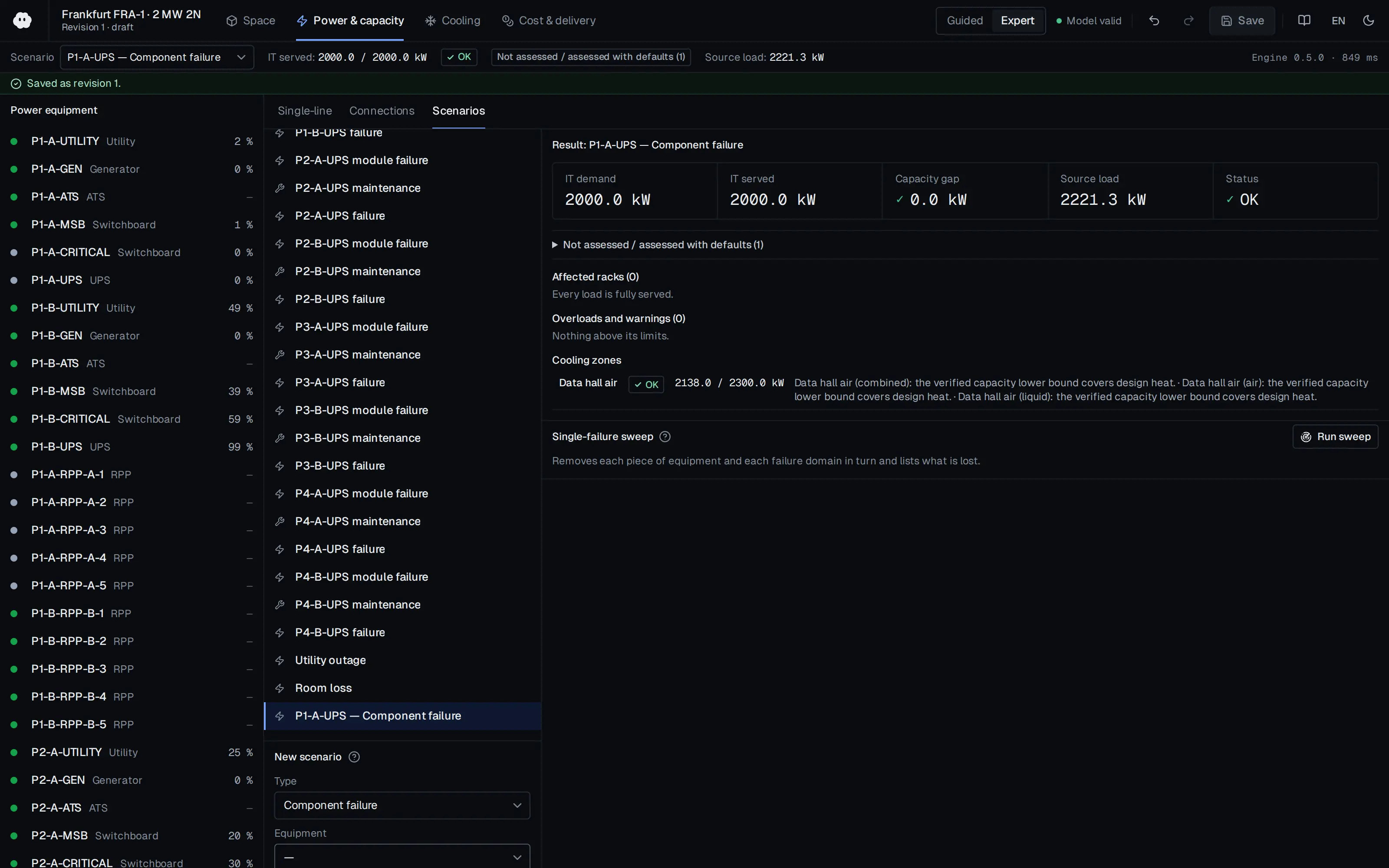
Who should read it
Designers, operations managers and commissioning teams who want to turn maintainability and human error into design criteria.
Publication details
- Authors
- Chris Crosby
- Publisher
- Data Center Knowledge
- Year
- 2014
- Document language
- English
- Source type
- Expert / community
- Access
- Free to read
- Licence
- Copyright retained; citation only — the publisher’s terms apply to the original document
Citation
Chris Crosby (2014). The Ergonomic Data Center: Save Us from Ourselves. Data Center Knowledge. https://www.datacenterknowledge.com/business/the-ergonomic-data-center-save-us-from-ourselves
Events on this subject
Browse the events calendarAll content and rights belong to the respective authors and publishers. SoSo CAD provides only the citation, its own summary and a link to the source, and is not responsible for the sources' content.