
Diesel Generators in the Data Center - When is the Bigger the Better?
Cummins · David Matuseski
Cummins Power Topic #6064 (David Matuseski, 2015) argues for pairing the largest practical generator sets with a paralleling architecture in data centres, backing the case with footprint, maintenance-cost and failure-probability figures.
On this page
Overview
The paper makes two linked claims. Larger sets cut footprint, installation and maintenance cost, and paralleling reduces stranded capacity and makes N+1 or N+2 redundancy easy. For a 10 MW outdoor plant, 3.5 MW sets need two fewer generators and about 1,500 ft2 (140 m2) less land than 2.0 MW sets.
Annual maintenance for 10 MW in Table 1 is $47,614 for 7 x 1500 kW, $43,940 for 5 x 2000 kW and $31,854 for 3 x 3500 kW. The author also cites an independent risk study of a 12 MW N+1 plant in which fewer, larger sets show a lower system failure probability, because the most probable failures involve auxiliary equipment rather than engines or alternators.
Three concurrently maintainable paralleling topologies are described. A segmented bus with tie breakers can isolate one gear section in an N+2 plant while keeping N, and bus-differential relaying removes the bus as a single point of failure. A dual bus gives each generator its own transfer arrangement. The 'three to make two' scheme parallels load buses A and B so any one generator or switchgear item can be maintained with N still available.
Key points
- At 10 MW outdoor, 3.5 MW sets save two generators and about 140 m2 versus 2.0 MW sets.
- Annual maintenance at 10 MW: $47,614 (7 x 1500 kW), $43,940 (5 x 2000 kW), $31,854 (3 x 3500 kW).
- An independent 12 MW N+1 risk study shows lower failure probability with fewer, larger sets.
- Most probable failures are in auxiliaries, not engines or alternators.
- Listed paralleling benefits: efficiency, reliability, redundancy, transient performance, scalability, serviceability.
- Segmented bus with tie breakers isolates a gear section in N+2 while keeping N.
- 'Three to make two' (N+1) parallels load buses A/B so any single generator or gear item can be serviced with N available.
Using it in design
- Compare candidate set sizes on count, footprint, install and maintenance cost for the target N+x, preferring fewer larger sets where the site allows.
- For segmented bus, dual bus and three-to-make-two templates, verify that removing any one generator or gear section leaves at least N.
- Direct reliability effort at auxiliaries such as fuel, cooling and controls, since those dominate the failure modes cited.
Monthly newsletter · free
Keep your reading list current
Once a month: new library sources, changes to Turkish regulations and upcoming data centre events.
SoSo CAD
Review your power design in SoSo CAD
Inspect supply paths, equipment loads and UPS failure scenarios in one model.
Request a demo
Who should read it
Electrical designers and decision makers sizing and choosing the topology of a data-centre standby generator plant.
Related standards
- Uptime Institute Tier Standard: Topology
Publication details
- Authors
- David Matuseski
- Publisher
- Cummins
- Year
- 2015
- Document number
- Power Topic #6064
- Document language
- English
- Source type
- Manufacturer
- Access
- Free to read
- Licence
- Copyright retained; citation only — the publisher’s terms apply to the original document
Citation
David Matuseski (2015). Diesel Generators in the Data Center - When is the Bigger the Better?. Cummins. Power Topic #6064. https://mart.cummins.com/imagelibrary/data/assetfiles/0056714.pdf
Events on this subject
Browse the events calendarAll content and rights belong to the respective authors and publishers. SoSo CAD provides only the citation, its own summary and a link to the source, and is not responsible for the sources' content.
Related sources
All sources on this topic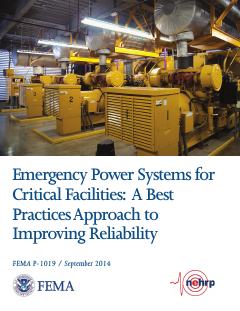
FEMA 2014
FEMA P-1019, Emergency Power Systems for Critical Facilities: A Best Practices Approach to Improving Reliability (September 2014)
At critical-facility data centers, place generators, ATS, fuel tanks and pumps above the greatest of BFE + 3 ft, DFE + 1 ft and 500-year elevation + 1 ft, and prefer elevation to dry floodproofing.
- Generators over 300 kW are almost exclusively diesel-fueled.
FEMA 2007
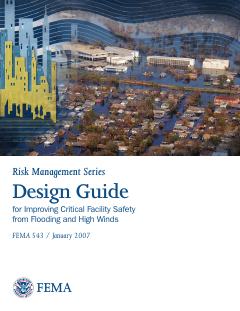
FEMA 543, Design Guide for Improving Critical Facility Safety from Flooding and High Winds (Risk Management Series, January 2007)
For site selection, look beyond the 100-year flood to the 500-year (0.2%) flood and the facility's occupancy category, and avoid flood hazard areas where possible.
- A freeboard of 1 to 3 feet above the flood elevation is often applied to critical facilities.
Uptime Institute 2026
Uptime Institute Annual Outage Analysis 2026 (8th annual) — press release (with 2025 findings)
Weight UPS, ATS/STS and generator failure modes highest in the reliability model
- About 1 in 10 outages has serious or severe impact
Huawei Digital Power 2022
Next-Generation Data Center Facility White Paper
Support CUE, WUE and a heat-reuse fraction next to PUE in reports.
- Above about 20 kW per rack liquid cooling becomes primary, with air as auxiliary.
Caterpillar 2021
Wet Stacking Prevention Technologies for Cat 3500 Diesel Generator Sets
Warn when planned monthly exercise or normal running load is under 30% of rating, and recommend load-bank testing or a reduced set count.
- Prolonged under-loading accelerates component wear (see LEXE0832).
Schneider Electric 2021
Why Cloud Computing is Requiring us to Rethink Resiliency at the Edge
In a portfolio/edge module let users model multiple sites with availability (or tier), headcount served and severity (1-5), compute series availability for dependent sites and rank sites by downtime x severity.
- Scorecard: annual downtime hours x severity (1-5), an FMECA-style ranking.