
Data Center Projects: System Planning
Schneider Electric · Neil Rasmussen
Schneider Electric WP 142 sets out a four-task planning sequence that turns a loosely stated business need into design requirements for detailed engineering.
On this page
Overview
The Plan phase has four tasks: establish key project parameters, develop the system concept, incorporate user preferences and constraints, and determine implementation requirements. Executives first agree six parameters: criticality, capacity (maximum IT load in kW), growth plan, efficiency, density (average and peak kW/rack plus floor space and uncertainty) and budget (capital cost). These are used to choose a reference-design-based system concept and a site before any detailed design.
The parameters interact: over-specifying kW capacity for possible expansion may exceed the budget and force a reduction in criticality. The site, whether room, building or site, should be decided by the end of the system-concept task, using a reference design to check compatibility with candidate locations quickly. Reference designs typically include electrical, mechanical and IT one-line diagrams, floor layouts, a bill of materials and expected system-level performance.
Preferences and constraints are kept apart. Preferences are adjustable desires, such as overhead power cabling or wide racks; constraints are hard conditions such as slab height, floor load capacity, columns, codes, a committed standard such as TIA 942, work rules or elevator weight capacity. Mismatches between preferences and the concept are resolved through small concept adaptations.
Implementation requirements split into standard requirements common to all projects and project requirements such as deadlines, resources, mandated vendors and procurement rules. The approach aims to prevent late rework caused by stakeholders discovering cost or performance consequences only after detailed design has started. The paper is qualitative and gives no numeric thresholds.
Key points
- Four Plan tasks: key parameters, system concept, preferences and constraints, implementation requirements.
- Six parameters: criticality, capacity (max IT kW), growth plan, efficiency, density (average and peak kW/rack, floor space, uncertainty), budget (capital cost).
- Parameters interact: over-specifying capacity for expansion may exceed budget and force lower criticality.
- The site (room, building or site) should be fixed by the end of the system-concept task, using a reference design for a quick compatibility check.
- Preferences are adjustable (overhead power cabling, wide racks); constraints are hard (slab height, floor load, columns, codes, TIA 942, work rules, elevator weight capacity).
- Implementation requirements split into standard (all projects) and project-specific (deadlines, resources, mandated vendors, procurement rules).
- Reference designs include electrical, mechanical and IT one-lines, floor layouts, a bill of materials and expected system-level performance.
Using it in design
- Build an intake wizard that makes the six parameters (criticality/Tier, IT kW, growth ramp with uncertainty, target PUE, average and peak kW/rack, capex budget) required before layout tools unlock, with live trade-offs between them.
- Filter reference-design templates by those parameters.
- Keep site constraints (slab-to-slab height, floor load kg/m2, column grid, delivery path and elevator capacity, mandated standards) as a structured list separate from editable preferences, and run rule checks against it.
- Record concept adaptations as tracked deviations from the chosen reference design.
Monthly newsletter · free
Keep your reading list current
Once a month: new library sources, changes to Turkish regulations and upcoming data centre events.
SoSo CAD
Assess redundancy through scenarios
Compare normal operation and equipment failures in SoSo CAD, with supplied loads and capacity shortfalls in one view.
Request a demo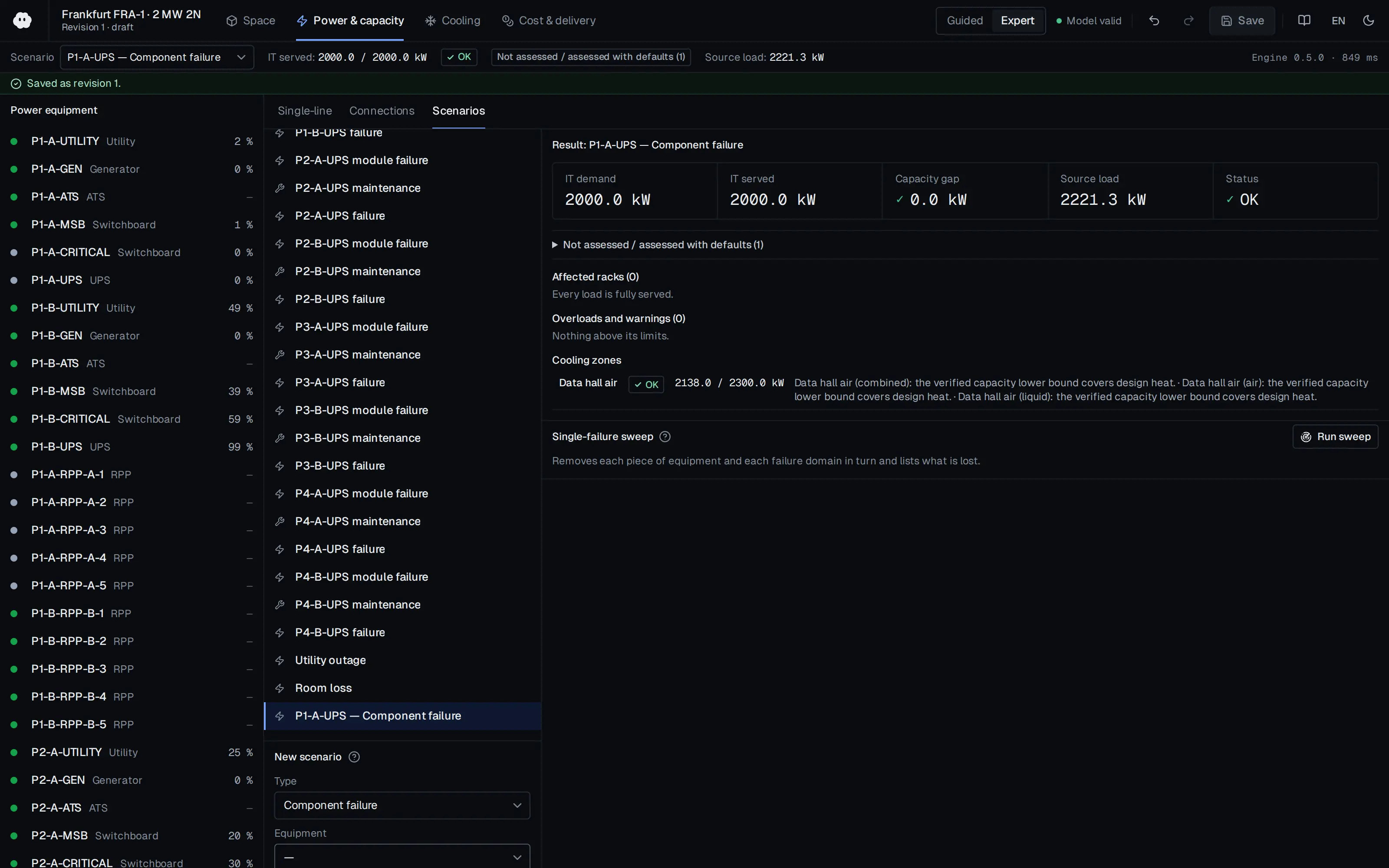
Who should read it
Planners, owner representatives and design teams running the scoping and concept stage of a data centre project.
Related standards
- ANSI/TIA-942
Publication details
- Authors
- Neil Rasmussen
- Publisher
- Schneider Electric
- Year
- 2013
- Document number
- WP 142
- Document language
- English
- Source type
- Manufacturer
- Access
- Free to read
- Licence
- Copyright retained; citation only — the publisher’s terms apply to the original document
Citation
Neil Rasmussen (2013). Data Center Projects: System Planning. Schneider Electric. WP 142. https://download.schneider-electric.com/files?p_Doc_Ref=SPD_SNIS-6QJGS2_EN
Events on this subject
Browse the events calendarAll content and rights belong to the respective authors and publishers. SoSo CAD provides only the citation, its own summary and a link to the source, and is not responsible for the sources' content.