
ENERGY STAR Product Specification for Data Center Storage: Test Method (Rev. April 2020)
U.S. Environmental Protection Agency (ENERGY STAR) · U.S. Environmental Protection Agency
A short ENERGY STAR test method used with the Version 2.x storage specification. It incorporates the SNIA Emerald 4.0.0 measurement procedure and fixes test conditions: ambient window, regional input voltage and frequency, power-analyzer capability and temperature-sensor logging and placement.
U.S. public domain — U.S. Government work; free to reuse
On this page
Overview
The document opens with a note that EPA coordinated with SNIA on the Emerald Version 4.0.0 test method and incorporated it into the testing protocol for the ENERGY STAR Version 2.0 data-centre storage specification. EPA changed no other element of the test method and understands that results from the previous Emerald method may be used to certify to Version 2.0. The method applies to all products eligible under the specification, with terms as defined in the eligibility criteria.
Test setup rests on three conditions: ambient temperature between 18 C and 28 C throughout, relative humidity between 15% and 80%, and input power per Tables 1 and 2. For products rated 1500 W or less, voltage tolerance is +/-1.0% and total harmonic distortion at most 2.0%; above 1500 W the figures are 5.0% and 5.0%. Supply options are 230 V or 115 V AC, with optional 100 V AC for the Japanese market, 208 V three-phase for North America and 400 V three-phase for Europe. Frequency tolerance is 1.0%: 50 or 60 Hz for 100 V, 60 Hz for 115 V, 50 or 60 Hz for 230 V and three-phase.
Instrument requirements are detailed. The power meter must report true RMS power and at least two of voltage, current and power factor, be calibrated within the past year to a NIST-traceable standard, and have an available current crest factor of at least 3 and a frequency response of at least 3.0 kHz. Resolution is 0.01 W below 10 W, 0.1 W for 10-100 W and 1.0 W above 100 W, with at least one measurement set per second. Uncertainty is at most 2% (95% confidence) from 0.5 W. The temperature sensor logs at least 4 samples a minute, measures no more than 50 mm in front of the main airflow inlet and has +/-0.5 C accuracy or better.
Test conduct refers to SNIA Emerald 4.0.0: pre-fill, conditioning, block-access active state, file-access active state, ready idle and capacity-optimization (COM) validation tests. Where a product ships with COMs, those that can be disabled must be off during pre-fill, conditioning, active-state and idle tests, then enabled after the idle test for COM validation. Products certified on block I/O capability take the block I/O active-state test, and those certified on file I/O take the file I/O active-state test. COM verification is run once with storage devices of the vendor's choice and need not be repeated with other devices.
Key points
- EPA updated the test method to incorporate SNIA Emerald Version 4.0.0; earlier Emerald results may still be used for Version 2.0 certification.
- Ambient temperature during testing must stay between 18 C and 28 C, relative humidity between 15% and 80%.
- For products rated 1500 W or less, voltage tolerance is +/-1.0% and THD at most 2.0%; above 1500 W it is 5.0% and 5.0%.
- Supply options: 230 V or 115 V AC, optional 100 V AC (Japan), 208 V three-phase (North America), 400 V three-phase (Europe); frequency tolerance 1.0%.
- Power meters must report true RMS, have a current crest factor of at least 3, a frequency response of at least 3.0 kHz, annual calibration and at least one reading per second.
- Power measurement uncertainty is at most 2% at 95% confidence for 0.5 W and above; resolution is 0.01 W below 10 W and 1.0 W above 100 W.
- Temperature sensors log at least 4 samples a minute, measure no more than 50 mm in front of the air inlet and have +/-0.5 C accuracy.
- COMs that can be disabled are turned off for pre-fill, conditioning, active-state and idle tests and enabled afterwards for COM validation.
Using it in design
- Record the test-condition envelope (18-28 C inlet, supply voltage) alongside certified storage power values so users know published watts correspond to a cool inlet; apply a temperature-uplift caveat when the design inlet setpoint is higher.
- Reuse the analyzer criteria (RMS, crest factor 3, 3.0 kHz, 2% uncertainty, annual calibration) in the commissioning module's metering checklist.
- For storage heat and power verification, plan inlet-air temperature measurement no more than 50 mm from the product inlet.
Monthly newsletter · free
Keep your reading list current
Once a month: new library sources, changes to Turkish regulations and upcoming data centre events.
SoSo CAD
Compare the cost of design decisions
Evaluate equipment costs, energy expenses and total cost of ownership (TCO) using your inputs and assumptions in SoSo CAD.
Request a demo
Who should read it
Laboratories running ENERGY STAR storage tests, manufacturers, and design or commissioning engineers interpreting the test conditions.
Document contents
- Overview
- Applicability
- Definitions
- Test Setup
- Input Power
- Ambient Temperature
- Relative Humidity
- Power Meter
- Temperature Sensor
- Test Conduct
- Guidance for Implementation of SNIA Emerald Power Efficiency Measurement Specification Version 4.0.0
- Test Procedures for All Products
- SUT Pre-fill Test
- SUT Conditioning Test
- Block I/O Active State Test
- File I/O Active State Test
- Ready Idle State Test
- COM Validation Test
Related standards
- SNIA Emerald V4.0.0
- ENERGY STAR Data Center Storage V2.1
Read the document
energystar-dc-storage-test-method-v2.pdf
U.S. public domain — U.S. Government work; free to reuse
The document is provided unaltered because its licence permits redistribution.
Publication details
- Authors
- U.S. Environmental Protection Agency
- Publisher
- U.S. Environmental Protection Agency (ENERGY STAR)
- Year
- 2020
- Document number
- Rev. Apr-2020
- Document language
- English
- Source type
- Government / public
- Access
- Open licence — downloadable
- Licence
- U.S. public domain — U.S. Government work; free to reuse
- Licence evidence
- www.copyright.gov
Original licence note
Work of the U.S. Environmental Protection Agency ENERGY STAR program (federal agency publication on energystar.gov); not subject to copyright under 17 U.S.C. 105.
Citation
U.S. Environmental Protection Agency (2020). ENERGY STAR Product Specification for Data Center Storage: Test Method (Rev. April 2020). U.S. Environmental Protection Agency (ENERGY STAR). Rev. Apr-2020. https://www.energystar.gov/sites/default/files/asset/document/Data%20Center%20Storage%20Version%202.0%20Draft%20Test%20Method.pdf
Events on this subject
- iMasons Climate Accord Summit
- Data Center World Middle East
- ELECO 2026 Elektrik-Elektronik ve Biyomedikal Mühendisliği Konferansı
All content and rights belong to the respective authors and publishers. SoSo CAD provides only the citation, its own summary and a link to the source, and is not responsible for the sources' content.
Related sources
All sources on this topic
U.S. Environmental Protection Agency (ENERGY STAR) 2024
ENERGY STAR Computer Servers SERT V2.0.8 Clarification Memo (September 25, 2024)
Store the SERT version alongside every imported server efficiency score so comparisons between catalogue entries stay traceable.
- The memo is posted on the Version 4.0 specification development site.
U.S. EPA / ENERGY STAR 2024
ENERGY STAR Program Requirements for Computer Servers, Version 4.0 (Partner Commitments, Eligibility Criteria, and Final Test Method Rev. April 2023)
Write ENERGY STAR Version 4.0 certification and the PSU efficiency steps (at 10% to 100% load points) into the server procurement specification; look especially at 10% and 20% load efficiency for redundant supplies that run lightly loaded.
- EffACTIVE = EXP(0.65 ln EffCPU + 0.30 ln EffMEMORY + 0.05 ln EffSTORAGE).
U.S. Environmental Protection Agency (ENERGY STAR) 2023
ENERGY STAR Program Requirements for Computer Servers: Final Draft Test Method (Rev. Jan-2023), Version 4.0
When importing server power data, keep the 25 ± 5 °C test ambient as metadata and warn that fan power rises at higher inlet set points.
- Ambient temperature during testing is 25 ± 5 °C and relative humidity 15% to 80%.
U.S. EPA / ENERGY STAR 2014
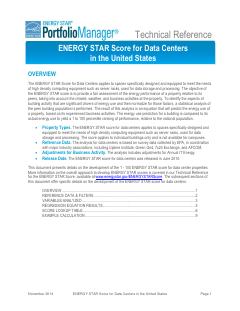
ENERGY STAR Score for Data Centers in the United States - Technical Reference (November 2014)
Design sub-metering for IT energy at the UPS output and feed it into monitoring with monthly records; this is a precondition for the score.
- The IT energy adjustment is capped at 0.4 source TBtu; larger sites receive the same adjustment.
U.S. EPA / ENERGY STAR 2007
Report to Congress on Server and Data Center Energy Efficiency, Public Law 109-431 (August 2, 2007)
Use it for historical context on PUE: knowing that 2.0 was the 2007 average starting point, compare your current target PUE values against that reference.
- Data center peak grid load was about 7 GW (about 15 baseload power plants), expected to reach 12 GW by 2011.
U.S. Environmental Protection Agency (ENERGY STAR) 2026
Data Centers for Utilities (ENERGY STAR)
In the cost model, attach utility incentive data (rebates) to measures such as efficient UPS, containment and economizers.
- A cited 2016 study put downtime cost at $9,000 per minute, driving risk-averse over-redundancy.