
Google Data Centers — Operating sustainably (energy and water)
Google's page on its data centre energy and water strategy; water cooling is chosen where it lowers energy and carbon, balanced against local water risk.
On this page
Overview
This Google page summarises its data centre energy and water strategy. The central principle is that water cooling is chosen where it lowers energy and carbon compared with air-cooled chillers, with the trade-off evaluated per campus and balanced against local water risk and the use of non-potable sources. The page also restates fleet PUE and the net-zero and 24/7 CFE goals.
Water metrics: 87% of 2025 freshwater withdrawal came from sources at low or medium depletion/scarcity risk. Water stewardship projects replenished about 7.7 billion gallons in 2025, roughly 78% of freshwater consumption. On energy, more than 240 agreements for about 35 GW of new clean energy were signed in 2010-2025, with over 12 GW contracted in 2025 alone. Withdrawal and replenishment are different quantities; the replenishment share is set against consumption, not withdrawal.
The climate target is to cut combined Scope 1, Scope 2 (market-based) and Scope 3 emissions by 50% versus 2019 by 2030. The figures are the company's statements and the 87% share is withdrawal-based, so it is not directly comparable with consumption-based WUE. The page illustrates that an evaporative cooling decision must weigh its PUE gain against its water cost. Related standards are ISO/IEC 30134-9 and the GHG Protocol.
Key points
- 87% of 2025 freshwater withdrawal from sources at low or medium depletion/scarcity risk.
- Water stewardship projects replenished about 7.7 billion gallons in 2025 (about 78% of freshwater consumption).
- More than 240 agreements for about 35 GW of new clean energy in 2010-2025; over 12 GW contracted in 2025.
- 2030 net-zero target: cut combined Scope 1, 2 (market-based) and 3 emissions 50% versus 2019.
- Water cooling is chosen where it reduces energy/carbon versus air-cooled chillers; trade-off evaluated per campus.
Using it in design
- In the cooling-selection UX present an explicit energy-versus-water trade-off (PUE versus WUE) per site, with a water-stress input (for example a WRI Aqueduct category).
- Default to non-evaporative cooling when the site is in high water stress unless the user overrides.
- When showing WUE, label whether it is withdrawal-based or consumption-based.
Monthly newsletter · free
Keep your reading list current
Once a month: new library sources, changes to Turkish regulations and upcoming data centre events.
SoSo CAD
Check cooling capacity alongside your design
Review zone heat loads, available capacity and the capacity balance after the largest unit is lost in SoSo CAD.
Request a demo
Who should read it
Designers balancing energy against water while choosing a cooling technology.
Related standards
- ISO/IEC 30134-9
- GHG Protocol
Publication details
- Authors
- Publisher
- Year
- 2026
- Document language
- English
- Source type
- Expert / community
- Access
- Free to read
- Licence
- Copyright retained; citation only — the publisher’s terms apply to the original document
Citation
Google (2026). Google Data Centers — Operating sustainably (energy and water). Google. https://datacenters.google/operating-sustainably/
Events on this subject
Browse the events calendarAll content and rights belong to the respective authors and publishers. SoSo CAD provides only the citation, its own summary and a link to the source, and is not responsible for the sources' content.
Related sources
All sources on this topic
Open Compute Project Foundation 2026
Guidelines: Impact of Strategies on Data Center Energy Consumption, Carbon Footprint, and Water Consumption (March 2026)
Evaluate cooling and siting options on energy, carbon, site water and water scarcity together, not on PUE or WUE alone.
- Same example: emissions fall from 3,500 to 2,700 t CO2/yr with the carbon factor of 0.26 kg CO2/kWh.
Open Compute Project Foundation 2023
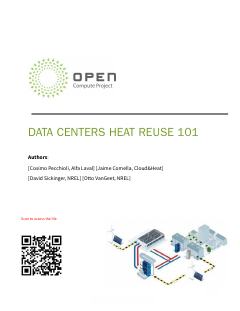
Data Centers Heat Reuse 101
A heat-reuse module should report recoverable heat (kW) and its temperature band by cooling technology (air, RDHx, DLC/immersion) and suggest compatible heat-host categories.
- Containerised/modular data centres can exceed 0.5 MW, a significant heat quantity for many local applications.
Lawrence Berkeley National Laboratory 2024
2024 United States Data Center Energy Usage Report (LBNL-2001637, December 2024)
Take AI rack and node power assumptions (3.4 to 12.2 kW per 8-GPU server, 20% idle) as a cross-check on IT load models, not as a substitute for vendor data.
- U.S. data centers used about 76 TWh (1.9% of U.S. electricity) in 2018 and 176 TWh (4.4%) in 2023.
Vertiv 2024
How Chilled Water Systems Meet Data Center Availability and Sustainability Goals
Add a TEWI calculation to cooling options (refrigerant GWP, charge kg, leak rate, life years, grid emission factor).
- Cooling accounts for roughly 25-35% of data-centre energy in many facilities.
Huawei Digital Power 2023
White Paper on the Top 10 Trends of Data Center Facilities
Show WUE alongside PUE in the metrics panel, with region-specific targets as policy presets.
- At 16 kW per rack, power-room area roughly equals IT space (1:1).
Nortek Air Solutions 2021
Finding Sustainable Solutions to Data Center Power and Water Use
Support peak pPUE (electrical sizing, with N-x units offline at ASHRAE N50/N20 extremes) separately from annual pPUE/WUE (energy) in the cooling plant model.
- Frankfurt: 20 MW colocation, 12 StatePoint units at N+2.