
Measuring IT Carbon Footprint: What is the Current Status Actually?
arXiv preprint (cs.SE); Skyworkz / Sustainable Digital Infrastructure Alliance (SDIA) · Tom Kennes
This position paper groups the difficulties of measuring IT greenhouse-gas emissions into four areas: software energy consumption, server overhead (PUE), the momentary grid energy mix, and embodied carbon.
CC BY 4.0 — share with attribution
On this page
Overview
Despite the EU Corporate Sustainability Reporting Directive pressing large enterprises to be more transparent about their GHG emissions, there are plenty of challenges ahead in measuring emissions from IT activities. For each area the paper reviews current tools (RAPL, IPMI, SPEC benchmarks, ElectricityMaps/WattTime data) and their limitations, and lists open research questions. Total IT carbon is defined as TotCarbon = (Es + Eo) × I + M, where Es is software energy, Eo server overhead energy, I the momentary energy-mix intensity and M embodied carbon; this is the GSF SCI formula without the functional unit R.
SDIA DEF model: Etot = Ecpu + Emem + EIO + Enet + beta_idle. Assuming TDP × N_CPU approximates CPU energy at full load, with fixed allocation factors alpha (summing to 1) and linear scaling, Ecpu = (Ucpu/Ucpu_max) × TDP × N_CPU and Emem = (Umem/Umem_max)(alpha...). The DEF model's fourth assumption takes idle consumption as zero; the paper itself raises this as an open question, noting that high idle power would favour powering off whole machines rather than spreading load.
Embodied carbon allocation: sum over objects of (manufacturing + repair/maintenance + end-of-life emissions) × (time consumed / usage-phase lifespan T); a dynamic version multiplies by a sharing factor f_c(tau, o_i) between 0 and 1 for each time step. Stated PUE limitations: it excludes IT equipment efficiency, meteorological conditions and waste-heat reuse, and is most meaningful at full IT capacity; complementary metrics listed are CUE, WUE, ERF, ITEE and OEM. Operational carbon over time is computed as PUE × sum over intervals of grid-mix intensity × energy, constrained by the granularity of energy-mix data (for example 30-minute updates); the paper discusses average versus marginal emission factors.
Limits: the paper contains no new measured data; its value lies in its accounting formulas and its discussion of scope, idle-time and shared-resource attribution problems. The DEF model is a rule of thumb for quick assessments, not a substitute for measurement.
Key points
- Total IT carbon is TotCarbon = (Es + Eo) × I + M, where Es is software energy, Eo server overhead energy, I the momentary energy-mix intensity and M embodied carbon; the GSF SCI formula without the functional unit R.
- SDIA DEF model: Etot = Ecpu + Emem + EIO + Enet + beta_idle; Ecpu = (Ucpu/Ucpu_max) × TDP × N_CPU.
- The DEF model's fourth assumption takes idle consumption as zero; the paper notes this as an open question and that high idle power would favour powering off whole machines rather than spreading load.
- Embodied carbon allocation: sum over objects of (manufacturing + repair/maintenance + end-of-life) × (time consumed / usage-phase lifespan T); a dynamic version multiplies by a sharing factor f_c between 0 and 1.
- PUE limitations: it excludes IT equipment efficiency, meteorological conditions and waste-heat reuse, and is most meaningful at full IT capacity; complementary metrics are CUE, WUE, ERF, ITEE and OEM.
- Operational carbon = PUE × sum over intervals of grid-mix intensity × energy, constrained by energy-mix data granularity (for example 30-minute updates); average versus marginal emission factors are discussed.
Using it in design
- Compute IT carbon as (Es + Eo) × I + M and allocate embodied carbon (M) for shared resources by time and resource share; define scope, idle-time and shared-resource attribution explicitly.
- For quick assessment use a rule of thumb based on CPU TDP and utilisation such as the DEF model, noting that idle consumption is assumed zero and that it does not replace measurement.
- Complement PUE with CUE, WUE, ERF and ITEE since it excludes IT efficiency, weather and heat reuse; document the choice of average versus marginal emission factor.
Monthly newsletter · free
Keep your reading list current
Once a month: new library sources, changes to Turkish regulations and upcoming data centre events.
SoSo CAD
Compare the cost of design decisions
Evaluate equipment costs, energy expenses and total cost of ownership (TCO) using your inputs and assumptions in SoSo CAD.
Request a demo
Who should read it
Sustainability and IT analysts choosing measurement methods for IT carbon-footprint accounting and Corporate Sustainability Reporting Directive compliance.
Document contents
- 1 Introduction
- 2 Four measurement areas (2.2 Existing Data and Tools, 2.5 Software energy consumption: 2.5.1 Empirical Estimations Of CPU Energy)
- 3 Server overhead (PUE)
- 4 Energy mix (4.2 Average vs Marginal)
- 5 Embodied carbon (5.5 Potential Improvements)
- 6 Conclusion
Related standards
- ISO/IEC 30134-2
- Green Software Foundation SCI specification
- EU Corporate Sustainability Reporting Directive
Read the document
it-carbon-footprint-measurement-status-2023.pdf
CC BY 4.0 — share with attribution
The document is provided unaltered because its licence permits redistribution.
Publication details
- Authors
- Tom Kennes
- Publisher
- arXiv preprint (cs.SE); Skyworkz / Sustainable Digital Infrastructure Alliance (SDIA)
- Year
- 2023
- Document number
- arXiv:2306.10049
- Document language
- English
- Source type
- Scientific
- Access
- Open licence — downloadable
- Licence
- CC BY 4.0 — share with attribution
- Licence evidence
- arxiv.org
Original licence note
arXiv OAI-PMH record for 2306.10049 gives license http://creativecommons.org/licenses/by/4.0/.
Citation
Tom Kennes (2023). Measuring IT Carbon Footprint: What is the Current Status Actually?. arXiv preprint (cs.SE); Skyworkz / Sustainable Digital Infrastructure Alliance (SDIA). arXiv:2306.10049. https://doi.org/10.48550/arXiv.2306.10049
Events on this subject
Browse the events calendarAll content and rights belong to the respective authors and publishers. SoSo CAD provides only the citation, its own summary and a link to the source, and is not responsible for the sources' content.
Related sources
All sources on this topic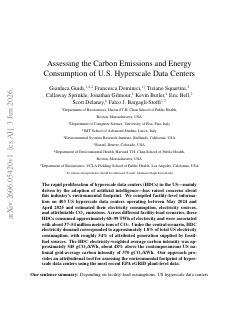
arXiv preprint (cs.AI), Harvard T.H. Chan School of Public Health 2026
Assessing the Carbon Emissions and Energy Consumption of U.S. Hyperscale Data Centers
In fleet or facility energy estimation, use capacity × 8,760 × facility-load coefficient (0.48-0.70, central 0.58) and report the range (67.7-98.6 TWh) explicitly.
- State-level intensities (central scenario): Virginia 535, Oregon 440, Iowa 645, Nebraska 740, Wyoming 1035 gCO2/kWh; Virginia had 142 HDCs, 21.0 TWh, 11.5 Mt.
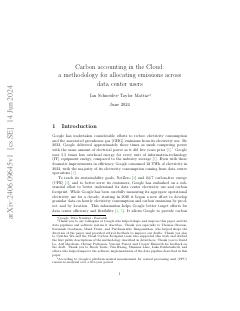
arXiv preprint (cs.SE), Google 2024
Carbon accounting in the Cloud: a methodology for allocating emissions across data center users
In allocating carbon to data-centre users, give idle power to whoever holds the resource allocation and share dynamic power by actual usage; because an idle server draws about 45% of peak power, the idle share is large.
- Resources with equivalent busy power used to weight idle-power allocation: 1 Intel Skylake N1 CPU core = 20 GiB RAM = 1 TiB SSD = 6 TiB HDD.
arXiv preprint 2026
The fallacy of sustainable Generative AI: limitations in EU environmental regulation of data centres and paths forward
For EU projects, add an EED compliance module that flags facilities of 500 kW and above as reportable.
- The second EU technical report suggests targets of PUE 1.3 for new data centres and WUE below 0.4 m3/MWh.
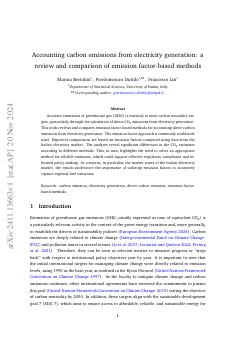
Applied Energy (Elsevier BV) 2025
Accounting carbon emissions from electricity generation: a review and comparison of emission factor-based methods
In data-centre carbon accounting, state the method (Tier 1, 2, 3) and factor source (IPCC or national) when choosing a grid emission factor; simple methods can underestimate generation emissions by about 73%.
- AEF for the North zone by Method 5 rose from 0.1627 tCO2/MWh in 2016 to 0.4709 in 2022, then fell to 0.3936 in 2023.
European Commission, DG Energy 2025
Assessment of the energy performance and sustainability of data centres in EU - First technical report (July 2025)
Compare your design PUE target with the real EU spread: 1.21 on average above 10 MW, 1.55 at 1-2 MW; set a realistic bound for your facility size.
- Rule of thumb cited: PUE below 1.2 excellent, 1.2-1.5 good, above 1.5 room for improvement.

European Commission JRC 2025
2025 Best Practice Guidelines for the EU Code of Conduct on Data Centre Energy Efficiency (JRC141521, EUR 40267)
Design the facility to operate within the ASHRAE Class A2 allowable range and require A2 operation within warranty in IT procurement; plan separate environmental zones (practice 5.3.4) for legacy equipment.
- IT equipment AC/DC power converters should be rated at 90% efficiency or better across expected load ranges.