
White Paper: OCP Ready Data Centers - Program Mission, Methodology, and Case Studies, Revision 1.0 (June 2022)
Open Compute Project Foundation · Dansie, M. (OCP Foundation), Coyle, R. (Distech Controls) et al.
The OCP Data Center Facility (DCF) white paper explaining the OCP-Ready certification for colocation facilities that can host Open Racks: its purpose, the site assessment methodology and case studies from certified operators.
CC BY-SA 4.0 — share with attribution under the same licence
On this page
Overview
The white paper explains the two purposes of the OCP-Ready program, running since 2019: it lets colocation solution providers (Colo SPs) self-audit their readiness to host Open Racks and IT gear, and it lets OCP users review the attributes of certified sites to judge whether a facility suits their racks. A facility that meets the requirements written by the Data Center Facility community can pursue recognition and certification from the OCP Foundation. The document also presents the certified estate, case studies and an outlook for 2022-2025.
Drivers are listed for both sides. For providers: vendor and system agnosticism (compatible with other certifications such as TIER), third-party certification, sustainability and ESG credentials, differentiation through lower total cost of ownership, and serving OCP users who want to move to production. For users: easy identification of suitable sites, certification needed for public-sector tenders and framework agreements, hosting for second-user (circular economy) hardware, lower PUE and WUE with WUE and CUE reporting, and standardization that avoids custom deployment requirements per site.
The assessment methodology rests on the OCP DCF team's Colo Facility Guidelines for Deployment of Open Racks and covers five infrastructure subsystems and three operational considerations. The subsystems are access, IT white space, power, cooling and cabling. Access checks that a fully crated rack can travel from the delivery vehicle through the dock to goods-in. Because populated Open Racks are heavy, white space has Acceptable, Optimum and Exception parameters for uniform, concentrated and rolling loads, plus floor clearance and ceiling height. Power requires 3-phase circuits and IEC or NEMA receptacles, and generator load-acceptance times where BBUs act as the UPS.
For cooling, a segregated hot aisle is the optimum design and cold-aisle containment the acceptable alternative. Cabling checks cover front routing of network connections, two or three containment levels for intra-pod, inter-pod and OOB cabling, and fibre types. Operational considerations are service (on-site spare OCP gear, PSU and BBU modules, remote hands), efficiency (OCP Critical Facility Operations Guidelines or BICSI 009-2019, plus PUE, WUE and CUE monitoring) and openness. Racks roll in fully configured, so power, network and containment must allow quick installation and removal.
The March 2022 table lists 11 certified sites with about 34,000 m2 of white space and 79.5 MW critical IT power, an average design PUE of 1.29 and average annualized PUE of 1.41. Design PUE runs from 1.07 at Hydro66 Hydrogrand 2 (WUE 0.059 L/kWh) to 1.6 at maincubes AMS01. The case studies are maincubes AMS01 (Amsterdam, at least 500 servers in a dense setup, European OCP Experience Center), Kao Data KLON-01 (100% renewable energy, SLA-backed PUE below 1.2 even at partial load, 2,500 kg service lifts) and Hydro66 (PUE 1.07, supplied by a 4,500 MW river hydro system). The outlook covers liquid-cooling facilities, metrics, OT security and Open Rack V3 alignment.
Key points
- The program, running since 2019, serves provider self-audit and lets users identify suitable facilities.
- The site assessment covers five subsystems (access, white space, power, cooling, cabling) and three operational considerations (service, efficiency, openness).
- Access checks follow a fully crated rack from the delivery vehicle through the dock to goods-in.
- White space defines Acceptable, Optimum and Exception parameters for uniform, concentrated and rolling loads, floor clearance and ceiling height.
- Power needs 3-phase circuits with IEC or NEMA receptacles; racks relying on BBUs as UPS need generator load-acceptance times.
- A segregated hot aisle is the optimum cooling design; cold-aisle containment is acceptable.
- March 2022 estate: about 34,000 m2 white space, 79.5 MW critical IT power, average design PUE 1.29, average annualized PUE 1.41.
- Design PUE ranges from 1.07 (Hydro66, WUE 0.059 L/kWh) to 1.6 (maincubes AMS01).
- Kao Data KLON-01 reports an SLA-backed PUE below 1.2 even at partial load and 2,500 kg service lifts; Civo runs 15 kW+ OCP Accepted racks there.
- Outlook 2022-2025: advanced-cooling facility recognition (ACF), efficiency and sustainability metrics, OT and security requirements, Open Rack V3 alignment.
Using it in design
- Offer an 'OCP Ready' compliance profile that checks the delivery path (dock, ramps, door heights), floor load classes (uniform, concentrated, rolling), 3-phase IEC/NEMA rack circuits, hot/cold-aisle containment and generator load-acceptance time relative to BBU autonomy.
- Check lift and door dimensions against crated, fully populated racks; the Kao Data case uses 2,500 kg lifts as a reference point.
- Report PUE, WUE and CUE in the same format as the certification, since certified sites publish these figures.
- Plan front-of-rack network routing and two to three containment levels for intra-pod, inter-pod and OOB cabling.
- Track the ACF subproject's requirements for liquid-cooled and Open Rack V3 deployments.
Monthly newsletter · free
Keep your reading list current
Once a month: new library sources, changes to Turkish regulations and upcoming data centre events.
SoSo CAD
Assess redundancy through scenarios
Compare normal operation and equipment failures in SoSo CAD, with supplied loads and capacity shortfalls in one view.
Request a demo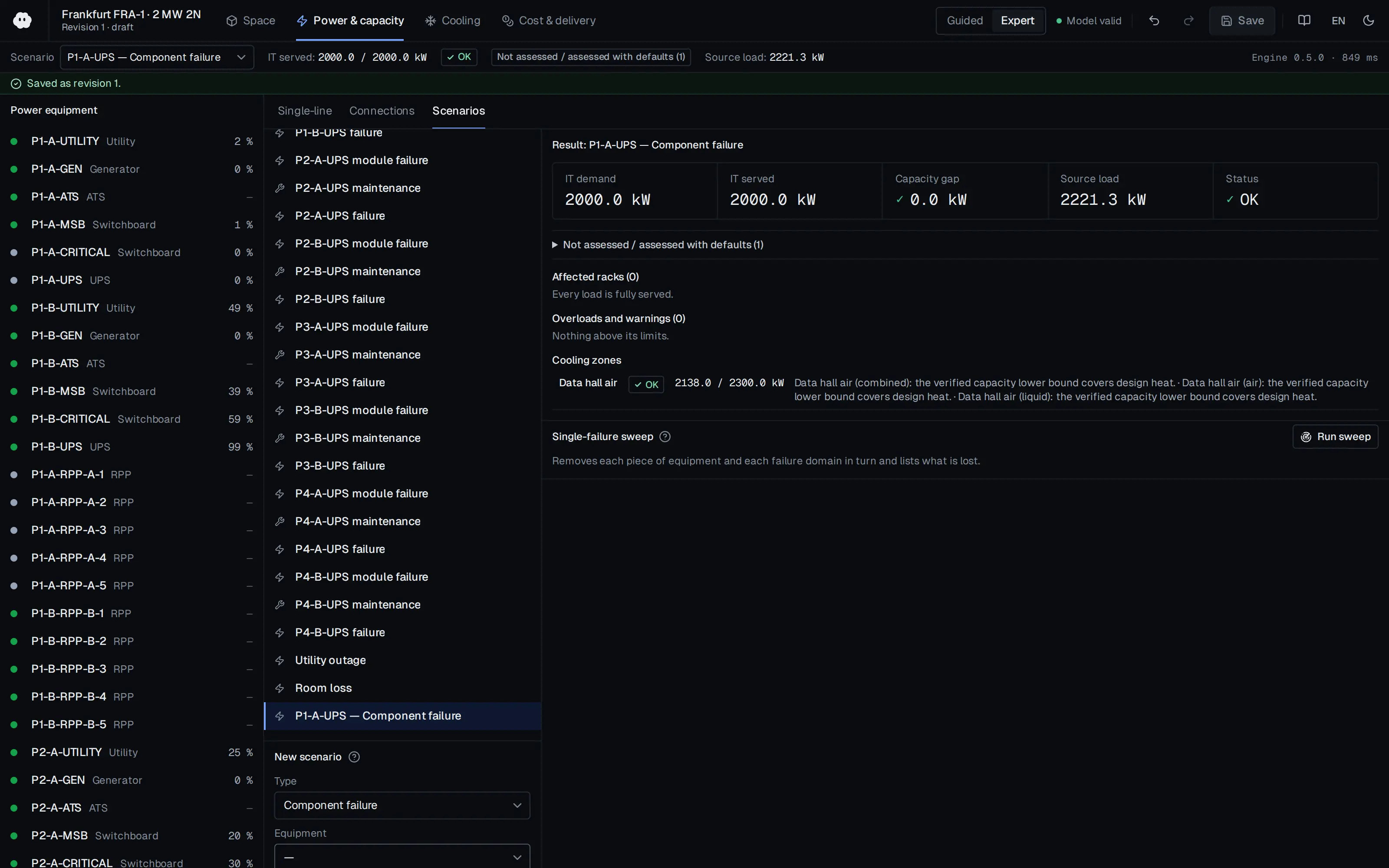
Who should read it
Colocation owners designing for Open Racks, operators seeking OCP-Ready recognition, and users looking for OCP-suitable facilities.
Document contents
- Executive Summary
- Definitions and List of Abbreviations
- Introduction
- Background
- Drivers: Colo Solution Provider
- Drivers: OCP User
- Attributes: Sub Systems
- Attributes: Operational Considerations
- Summary of OCP-Ready Facilities
- Key Parameters
- Case Study - maincubes AMS01
- Case Study - Kao Data KLON-01
- Case Study - Hydro66 Hydrogrand 2 - Hall1
- Outlook for 2022-2025
- Conclusion
- References
Related standards
- OCP Colocation Facility Guidelines for Deployment of Open Racks
- OCP Ready site assessment
- ISO/IEC 30134-2 (PUE)
Read the document
ocp-ready-program-methodology.pdf
CC BY-SA 4.0 — share with attribution under the same licence
The document is provided unaltered because its licence permits redistribution.
Publication details
- Authors
- Dansie, M. (OCP Foundation); Coyle, R. (Distech Controls); contributors Kao Data, maincubes, Hydro66
- Publisher
- Open Compute Project Foundation
- Year
- 2022
- Document number
- Rev 1.0
- Document language
- English
- Source type
- Industry body
- Access
- Open licence — downloadable
- Licence
- CC BY-SA 4.0 — share with attribution under the same licence
- Licence evidence
- www.opencompute.org
Original licence note
Page 5 (and page 28) states the work is licensed under a Creative Commons Attribution-ShareAlike 4.0 International License.
Citation
Dansie, M. (OCP Foundation); Coyle, R. (Distech Controls); contributors Kao Data, maincubes, Hydro66 (2022). White Paper: OCP Ready Data Centers - Program Mission, Methodology, and Case Studies, Revision 1.0 (June 2022). Open Compute Project Foundation. Rev 1.0. https://www.opencompute.org/documents/ocp-ready-data-centers-program-mission-methodology-and-case-studies-rev-1-0-pdf/
Events on this subject
Browse the events calendarAll content and rights belong to the respective authors and publishers. SoSo CAD provides only the citation, its own summary and a link to the source, and is not responsible for the sources' content.