
Power-Flexible AI Data Centers: A New Paradigm for Grid-Responsive Compute
arXiv preprint (Emerald AI / EPRI / National Grid / NVIDIA / Oracle; submitted to IEEE) · Chris Williams, Philip Colangelo et al.
This preprint describes a software architecture that links grid signals, workload scheduling and GPU power telemetry to control AI cluster power at fine granularity, and reports field results. The authors argue such capabilities could let data centers connect as flexible loads and so speed interconnection.
On this page
Overview
The work is a 2026 arXiv preprint (arXiv:2606.25098; DOI 10.48550/arXiv.2606.25098) submitted to IEEE. Its authors include teams linked to Emerald AI, EPRI, National Grid, NVIDIA and Oracle. The architecture links grid signals, workload scheduling and GPU power telemetry.
On a 130 kW NVIDIA Blackwell Ultra cluster in the UK, the system followed National Grid and EPRI dispatch events, including zero-notice emergency reductions, multi-hour curtailment and repeated dispatches, while preserving throughput for priority jobs. It achieved 100% compliance across 200+ distinct National Grid power events. In a surprise emergency dispatch the cluster reduced power by approximately 30% within 40 seconds; other tests achieved 40% reduction within approximately a minute.
Sustained curtailment tests requested 10%-40% reductions for two to ten hours; high-priority jobs kept nearly full throughput because flexible, lower-priority jobs were capped or delayed. In a second experiment, 10% of live inference traffic was migrated from an H100 cluster in Virginia to Illinois during a Dominion Energy winter peak event; a 375 W per-GPU limit with a 15-minute ramp-down and three-hour hold shifted about 3.1 kW to the Chicago cluster.
A prior field trial cited reduced AI cluster electricity consumption by 25% during peak demand while maintaining job service levels. The authors argue that such capabilities could let data centers connect as non-firm or flexible loads and so speed interconnection. The results rest on a small cluster and a limited set of experiments.
Key points
- Achieved 100% compliance across 200+ distinct National Grid power events on a 130 kW cluster of NVIDIA Blackwell Ultra GPUs.
- In a surprise emergency dispatch the cluster reduced power by about 30% within 40 seconds; other tests achieved 40% within about a minute.
- Sustained curtailment tests requested 10%-40% reductions for two to ten hours; high-priority jobs kept nearly full throughput.
- Migrated 10% of live inference traffic from Virginia to Illinois; a 375 W per-GPU limit with a 15-minute ramp-down and three-hour hold shifted about 3.1 kW to the Chicago cluster.
- A prior field trial cited reduced AI cluster electricity consumption by 25% during peak demand while maintaining service levels.
- The authors argue the capability could let data centers connect as flexible loads and speed interconnection.
Using it in design
- Add a 'flexible load' profile in the grid-connection module: committed reduction depth (%), response time (s), duration (h) and recovery, derived from the workload priority mix.
- Use it to evaluate non-firm or flexible interconnection options and to size how much firm capacity (plus UPS/BESS) is truly needed.
- Record requirements for GPU-level power-cap telemetry and a dispatch interface in the controls specification.
Monthly newsletter · free
Keep your reading list current
Once a month: new library sources, changes to Turkish regulations and upcoming data centre events.
SoSo CAD
Compare the cost of design decisions
Evaluate equipment costs, energy expenses and total cost of ownership (TCO) using your inputs and assumptions in SoSo CAD.
Request a demo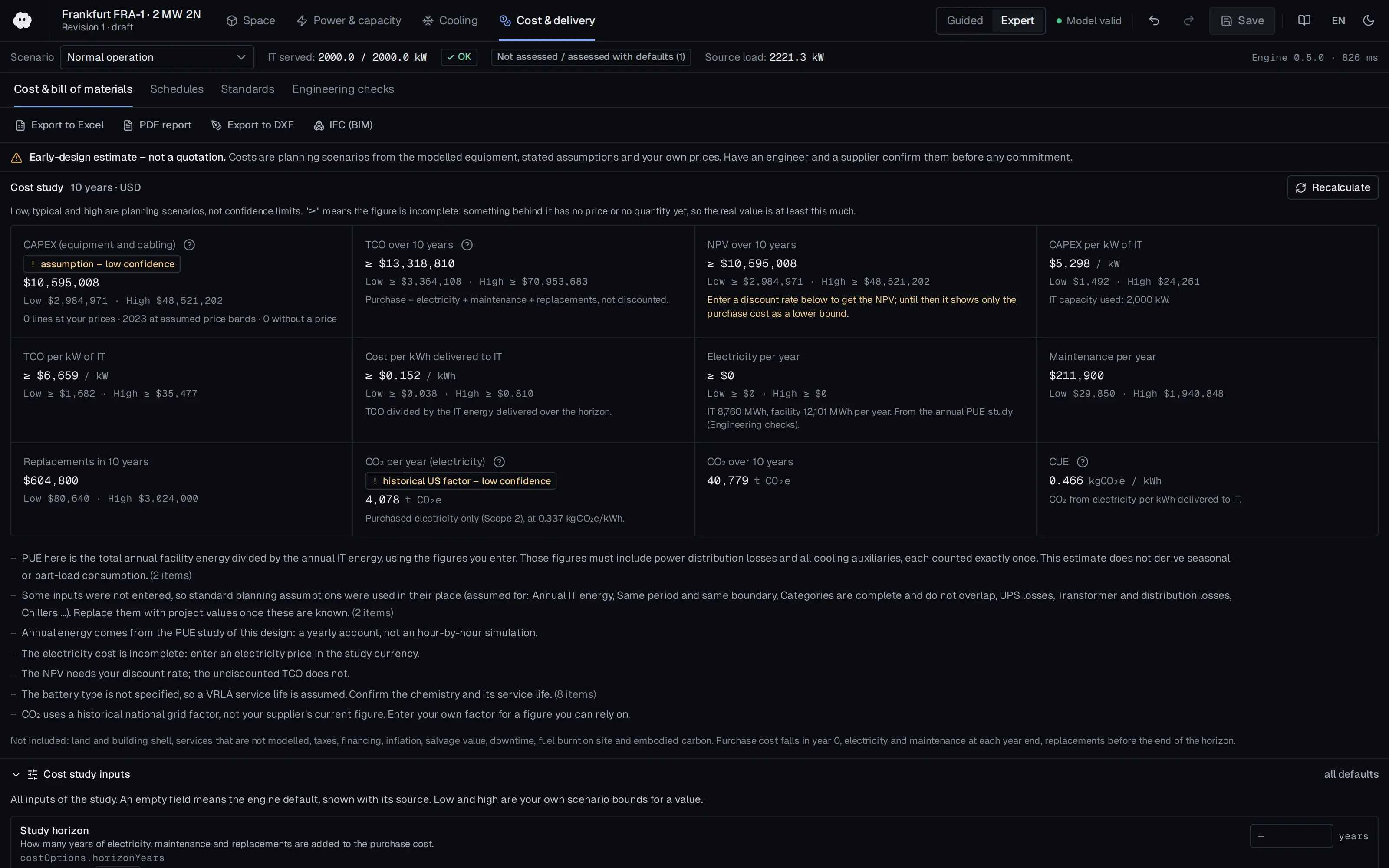
Who should read it
Electrical engineers designing grid interconnection and controls, AI infrastructure planners, and energy analysts.
Publication details
- Authors
- Chris Williams; Philip Colangelo; Ayse Coskun; Ethan Levine; Andy Neale; Ciaran Roberts; Shayan Sengupta; Nikhil Shirolkar; Varun Sivaram; Sarah Soares; Ethan Tiao; Scott Underwood; Daniel Wilson; Frank Sharp; Luke Wainwright; Harry Petty; Scott Wallace; Brandon Records
- Publisher
- arXiv preprint (Emerald AI / EPRI / National Grid / NVIDIA / Oracle; submitted to IEEE)
- Year
- 2026
- Document number
- arXiv:2606.25098
- Document language
- English
- Source type
- Scientific
- Access
- Free to read
- Licence
- arXiv distribution permission — reuse conditions remain with the rights holder
Original licence note
arXiv default non-exclusive distribution licence; citation only
Citation
Chris Williams; Philip Colangelo; Ayse Coskun; Ethan Levine; Andy Neale; Ciaran Roberts; Shayan Sengupta; Nikhil Shirolkar; Varun Sivaram; Sarah Soares; Ethan Tiao; Scott Underwood; Daniel Wilson; Frank Sharp; Luke Wainwright; Harry Petty; Scott Wallace; Brandon Records (2026). Power-Flexible AI Data Centers: A New Paradigm for Grid-Responsive Compute. arXiv preprint (Emerald AI / EPRI / National Grid / NVIDIA / Oracle; submitted to IEEE). arXiv:2606.25098. https://doi.org/10.48550/arXiv.2606.25098
Events on this subject
- Electricity Eurasia 2027
- ELECO 2026 Elektrik-Elektronik ve Biyomedikal Mühendisliği Konferansı
- Hannover Messe
All content and rights belong to the respective authors and publishers. SoSo CAD provides only the citation, its own summary and a link to the source, and is not responsible for the sources' content.