
TCO Analysis of a Traditional Data Center vs. a Scalable, Containerized Data Center
Schneider Electric · Wendy Torell
Schneider Electric WP 164 compares a traditional stick-built power and cooling plant with an equivalent built from prefabricated standard modules scaled with load, and finds about 30% savings over life.
On this page
Overview
The comparison rests on two equivalent facilities: a traditional stick-built power and cooling plant and one made of prefabricated, standardized facility modules. Waterfall charts attribute the savings to four causes: avoided over-build, modular scaling, higher-efficiency equipment and lower maintenance. The comparison is meaningful because both facilities are built to carry the same load, so the difference comes only from the build approach. The paper dates from 2023.
Prefabricated/modular power and cooling gives about 27.2% capex saving and about 31.6% opex saving, roughly 30% TCO overall. The example capex is about $53.2M traditional against about $38.7M modular. Most of the opex saving comes from modularity, meaning scaling with load. The capex gap in the example is about $14.5M (53.2 minus 38.7), consistent with the roughly 27% capex saving.
The paper stresses that the ability to add capacity later removes the incentive to over-provision on day one. If capacity can be added later, there is no reason to buy equipment up front for a peak load that may not arrive, and the over-build appears as its own savings item in the waterfall. The limit is that the percentages belong to one example facility; they suit a sanity check on your own project rather than a fixed multiplier.
Key points
- Prefabricated/modular facility power and cooling: about 27.2% capex and about 31.6% opex saving, about 30% TCO overall.
- Example capex: about $53.2M traditional versus about $38.7M modular.
- Modularity (scaling with load) drives most of the opex saving.
- Savings are attributed to avoided over-build, modular scaling, efficient equipment and lower maintenance.
- The paper dates from 2023; related standards are ISO/IEC 22237 and EN 50600-1.
Using it in design
- Offer 'traditional' versus 'prefabricated modular' build strategy as a design option.
- In TCO comparisons tie module-by-module deployment to the load ramp.
- Use the roughly 27%/32% capex/opex deltas only as sanity-check benchmarks, not as fixed multipliers.
Monthly newsletter · free
Keep your reading list current
Once a month: new library sources, changes to Turkish regulations and upcoming data centre events.
SoSo CAD
Assess redundancy through scenarios
Compare normal operation and equipment failures in SoSo CAD, with supplied loads and capacity shortfalls in one view.
Request a demo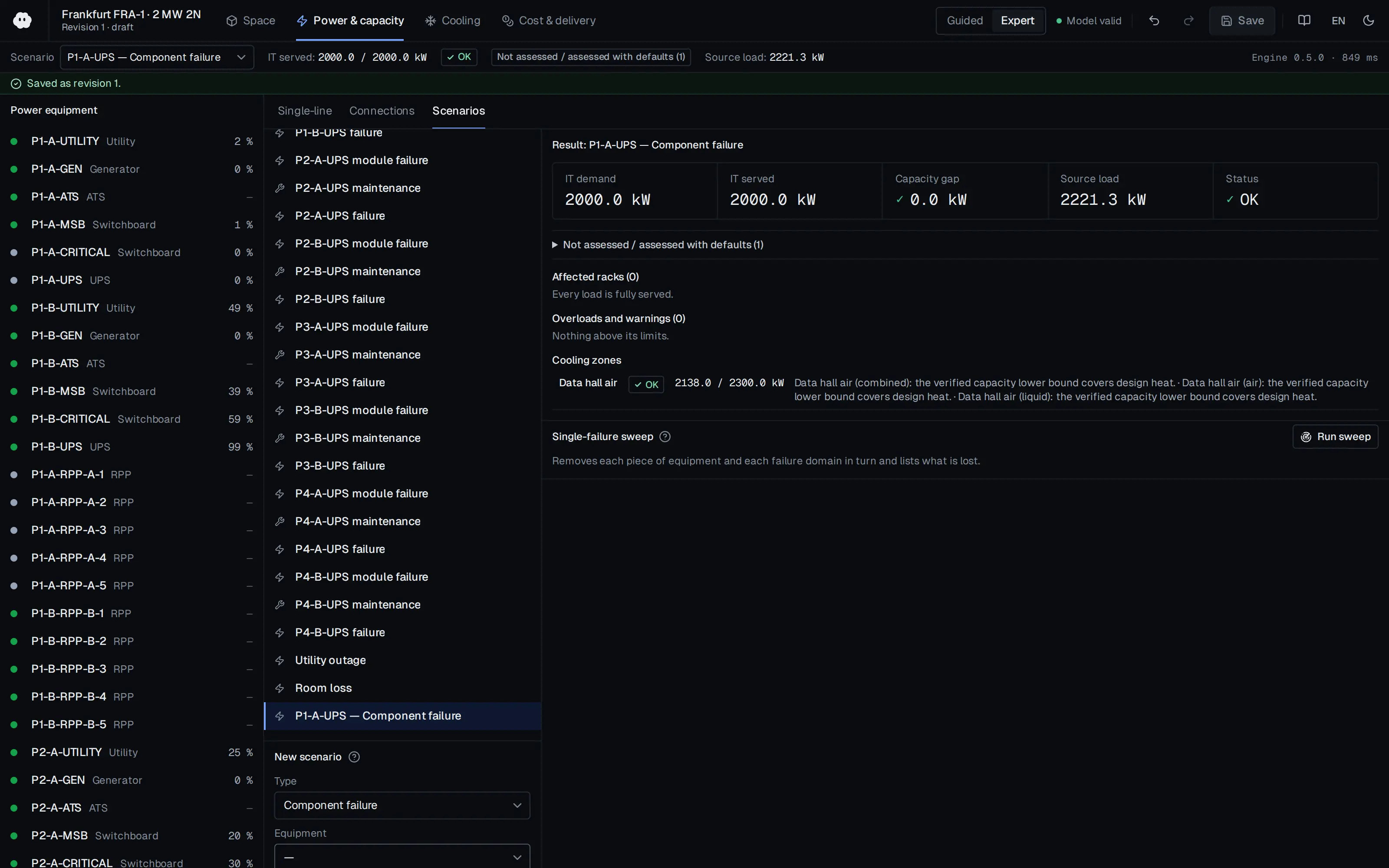
Who should read it
Investors and design teams choosing between traditional and modular build.
Related standards
- ISO/IEC 22237
- EN 50600-1
Publication details
- Authors
- Wendy Torell
- Publisher
- Schneider Electric
- Year
- 2023
- Document number
- WP 164
- Document language
- English
- Source type
- Manufacturer
- Access
- Free to read
- Licence
- Copyright retained; citation only — the publisher’s terms apply to the original document
Citation
Wendy Torell (2023). TCO Analysis of a Traditional Data Center vs. a Scalable, Containerized Data Center. Schneider Electric. WP 164. https://download.schneider-electric.com/files?p_Doc_Ref=SPD_WTOL-8NDS37_EN
Events on this subject
Browse the events calendarAll content and rights belong to the respective authors and publishers. SoSo CAD provides only the citation, its own summary and a link to the source, and is not responsible for the sources' content.
Related sources
All sources on this topicSchneider Electric 2013
Considerations for Owning versus Outsourcing Data Center Physical Infrastructure
Offer an option-compare calculator (airflow upgrade, add pod, facility module, new build, colocation) with inputs mirroring Appendix A-D: electricity price, cost of capital, escalation, kW/rack, PUE, colocation fees.
- Case 4 new build: $11/W capex, $26/W TCO, 5 years, 20% savings.
arXiv preprint (University of Alberta) 2026
To Defer or To Shift? The Role of AI Data Center Flexibility on Grid Interconnection
In large-load interconnection negotiation, present AI load flexibility (a deferral window of up to about 3 hours) as a lever for interconnection capacity and timing; returns diminish beyond 3 hours.
- In the IEEE 14-bus study, data centres on buses connected to congested lines benefit most from geographic load shifting.
arXiv preprint (math.OC), MIT Operations Research Center 2025
Locational Marginal Emissions for Carbon-Aware Data Center Operations in Large-Scale Power Grids
In data-centre carbon accounting, consider hourly locational marginal emissions (LME) rather than an annual-average grid factor; the LME-based intensity (about 672 kgCO2/MWh) was about 3 times the average factor (202).
- Emission rates assumed in the simulated grid: coal 800 kgCO2/MWh, gas 450 kgCO2/MWh, wind/solar/nuclear/hydro 0.
Proceedings of the Twelfth ACM International Conference on Future Energy Systems (ACM) 2021
A Guide to Reducing Carbon Emissions through Data Center Geographical Load Shifting
For geographic load shifting, consider locational marginal carbon emissions (lambda-CO2) as the signal instead of LMP or regional average carbon intensity; it gave the largest reduction (-1.44%).
- Lambda-CO2 shifting saved about 0.14 t CO2 per MW shifted and still reduced generation cost by 0.27%; LMP shifting cut cost by 1.07% but saved less carbon.
Huawei Digital Power 2022
Next-Generation Data Center Facility White Paper
Support CUE, WUE and a heat-reuse fraction next to PUE in reports.
- Above about 20 kW per rack liquid cooling becomes primary, with air as auxiliary.
Schneider Electric 2026
Benefits and Drawbacks of Prefabricated Modules for Data Centers
Offer a delivery-method option per subsystem (stick-built or prefabricated), defaulting to about 88 and 34 weeks with editable phase durations.
- Schedule: about 34 weeks modular versus 88 weeks traditional.