
Facility Operations Maturity Model for Data Centers
Schneider Electric · Jennifer Schafer, Patrick Donovan
This 2014 Schneider Electric white paper introduces the Facility Operations Maturity Model (FOMM), a framework for grading a data center O&M program, patterned on the IT Governance Institute maturity structure.
On this page
Overview
FOMM groups 26 elements under 7 core disciplines; each element is divided into sub-elements, and every sub-element is scored from 1 (initial/ad hoc) to 5 (optimized) against defined criteria. The levels are Initial/ad hoc, Repeatable but intuitive, Defined process, Managed and measurable, and Optimized.
What separates the levels is spelled out: Level 3 requires documentation and formal training, Level 4 adds monitoring, continuous improvement and limited automated tools, and Level 5 requires integrated automation. Formal training means purpose-specific written materials combined with oral presentation, demonstration or hands-on practice plus a written evaluation.
Reporting examples include goal-versus-actual charts, a risk chart by line of inquiry and an effort-versus-impact ranking. Risk is reported across three lines of inquiry: formal process, awareness and training, and field implementation. Immediate corrective plans are advised for any element at 60% risk or above.
The first assessment is ideally made during commissioning for new sites, then repeated at regular intervals (perhaps annually) or after major changes in personnel, process, budget or goals. The paper also recommends an independent assessor.
Key points
- 26 elements under 7 disciplines, each divided into sub-elements.
- Sub-elements are scored 1-5: Initial, Repeatable, Defined, Managed, Optimized.
- Level 3 requires documentation and formal training.
- Level 4 adds monitoring, continuous improvement and limited automated tools; Level 5 requires integrated automation.
- Three lines of inquiry: formal process, awareness and training, field implementation.
- Immediate corrective plans advised for any element at 60% risk or above.
- First assessment during commissioning, then annually or after major change.
Using it in design
- Add an optional O&M maturity self-assessment to the handover/operate module: 7 disciplines, 1-5 per sub-element, target versus actual.
- Warn that design redundancy may not be realized when the design targets a high-criticality class but the assessment is missing or below Level 3 for change or emergency management.
- Schedule the first assessment at commissioning and an annual reminder afterwards.
- Flag every element at 60% risk or above for corrective action.
Monthly newsletter · free
Keep your reading list current
Once a month: new library sources, changes to Turkish regulations and upcoming data centre events.
SoSo CAD
Assess redundancy through scenarios
Compare normal operation and equipment failures in SoSo CAD, with supplied loads and capacity shortfalls in one view.
Request a demo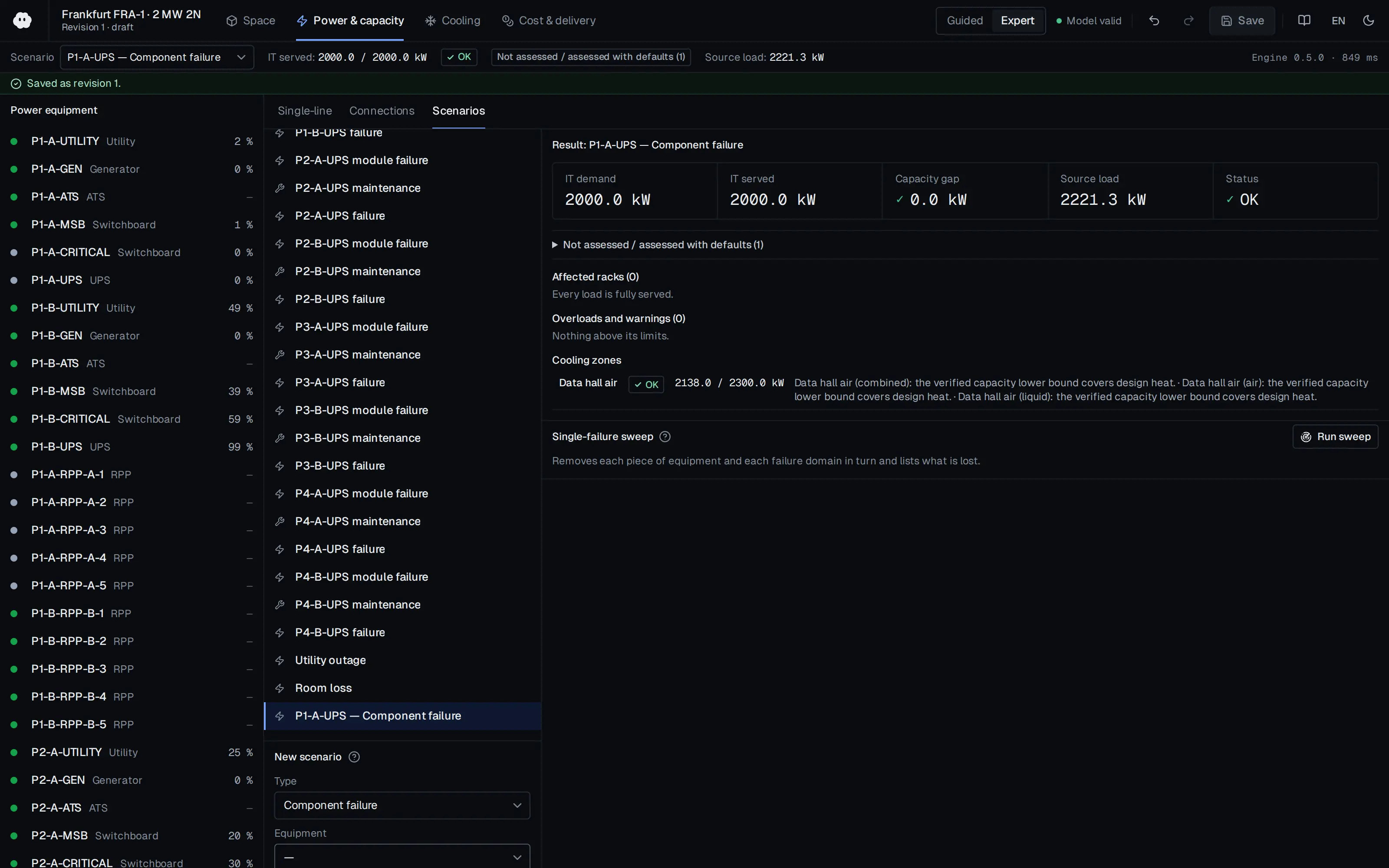
Who should read it
Owners and operations managers who want to measure operational maturity against design intent.
Related standards
- EN 50600-3-1
- Uptime Institute Tier Standard: Operational Sustainability
Publication details
- Authors
- Jennifer Schafer; Patrick Donovan
- Publisher
- Schneider Electric
- Year
- 2014
- Document number
- WP 197
- Document language
- English
- Source type
- Manufacturer
- Access
- Free to read
- Licence
- Copyright retained; citation only — the publisher’s terms apply to the original document
Citation
Jennifer Schafer; Patrick Donovan (2014). Facility Operations Maturity Model for Data Centers. Schneider Electric. WP 197. https://download.schneider-electric.com/files?p_Doc_Ref=SPD_PDON-96KPLV_EN
Events on this subject
Browse the events calendarAll content and rights belong to the respective authors and publishers. SoSo CAD provides only the citation, its own summary and a link to the source, and is not responsible for the sources' content.