
How Modern DCIM Helps Multi-Tenant Colocation Data Centers Be More Competitive
Schneider Electric · Patrick Donovan
Schneider Electric WP 290 (2023) explains how "DCIM 3.0" software helps colocation providers compete on resiliency, security, sustainability, tenant transparency and operational efficiency.
On this page
Overview
The evolution of DCIM is summarised as 1.0 (1990s, local UPS management), 2.0 (2000s, space planning, capacity management and PUE for centralized sites) and 3.0 (today, distributed IT, resiliency, security, sustainability and tenant transparency). As in WP 281 it covers monitoring and device management alongside planning and modelling (VM-to-power-path mapping, failure simulation); passing alarm data to third-party ticketing via APIs or an SNMP MIB is listed as a monitoring function that reduces outage risk and mean time to repair.
Colocation-specific features are tenant portals with rack elevations, power capacity reports and camera views; sustainability reporting per tenant, per site and portfolio-wide covering PUE (current and historical), subsystem energy (total, IT, losses), scope 2 carbon by subsystem from local emission factors, CUE, WUE and waste; and a floor-plan overlay showing the commercial status of racks and space. Default status labels are open (for sale), closed (in use), reserved (kept for customer) and internal (booked for internal use).
The pitfalls: a typical data centre can feed many tens of thousands of data points into a DCIM server, and overly broad thresholds lead to ignored alarms such as an unnoticed UPS fault. Energy and emissions are underreported if DCIM does not collect data from all cooling units, including redundant ones. Preferred tools support open protocols such as SNMP (SNMPv3) and BACnet plus APIs, and integrate with BMS, EPMS, ITAM and ticketing systems. Related standards are ISO/IEC 30134-2, 30134-8 and 30134-9, and the document takes a vendor perspective.
Key points
- DCIM 1.0: 1990s local UPS management; 2.0: 2000s space, capacity and PUE; 3.0: distributed IT, resiliency, security, sustainability, tenant transparency.
- Alarm data goes to ticketing via API or SNMP MIB, reducing outage risk and repair time.
- Sustainability reporting: PUE, subsystem energy, scope 2, CUE, WUE, waste, per tenant, site and portfolio.
- Commercial status labels: open, closed, reserved, internal.
- A typical data centre feeds many tens of thousands of data points; broad thresholds lead to ignored alarms.
- Energy and emissions are underreported if any cooling unit, including redundant ones, is not collected.
- Preferred: SNMPv3, BACnet and APIs; integration with BMS, EPMS, ITAM and ticketing.
Using it in design
- Add tenantId and commercialStatus (open, closed, reserved, internal) to racks, cages and floor zones, with a floor-plan overlay coloured by status and per-zone remaining power, cooling and ports.
- Check open U, network port, power, cooling and required redundancy (2N or UPS runtime) before allowing equipment placement.
- Give every cooling unit, including redundant ones, an energy meter point and flag unmetered units so PUE, CUE and WUE are not underreported.
- Export the asset/power-path model in a DCIM-importable form and list required device protocols (SNMPv3, BACnet, Modbus) in the BOM.
Monthly newsletter · free
Keep your reading list current
Once a month: new library sources, changes to Turkish regulations and upcoming data centre events.
SoSo CAD
Assess redundancy through scenarios
Compare normal operation and equipment failures in SoSo CAD, with supplied loads and capacity shortfalls in one view.
Request a demo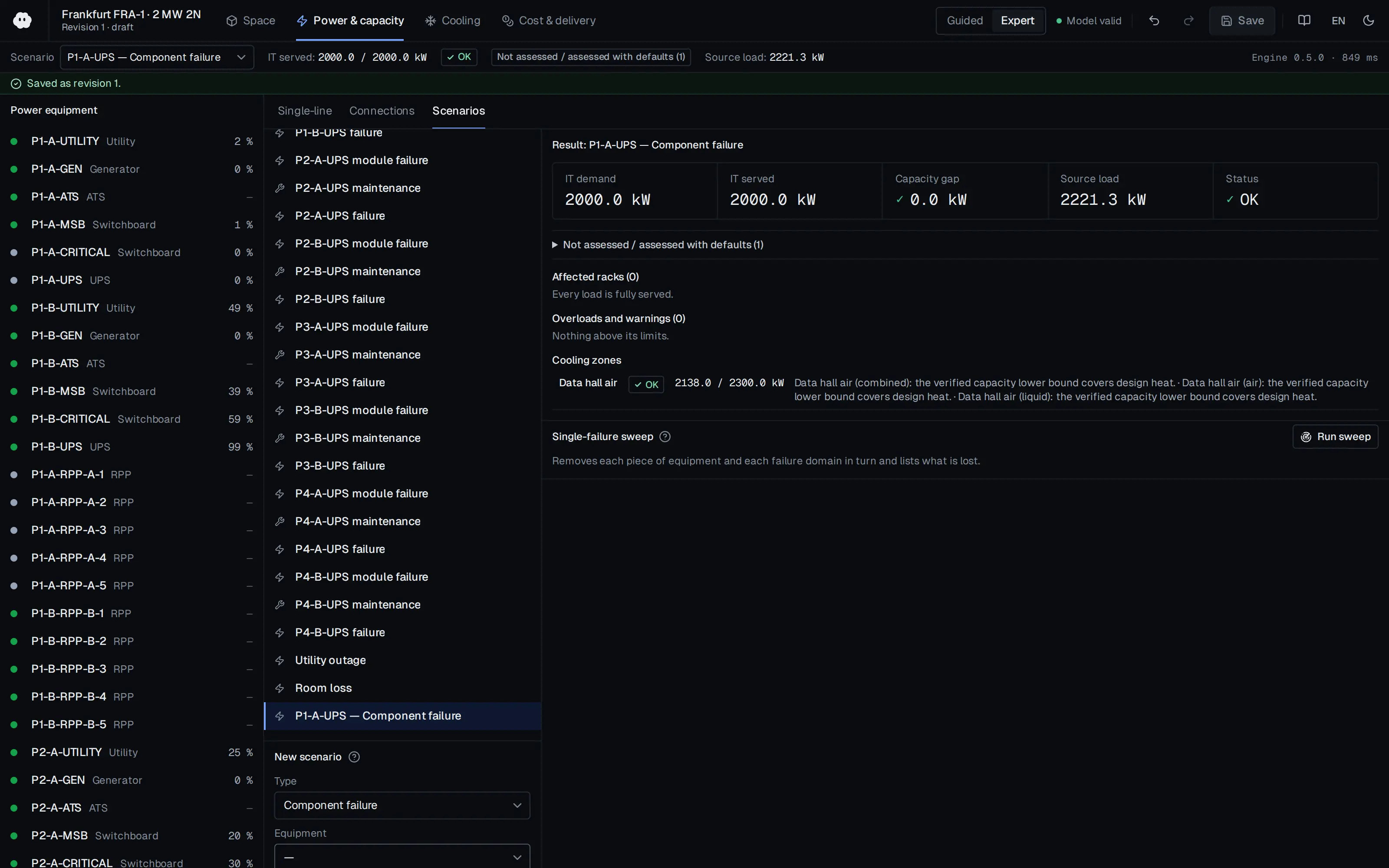
Who should read it
Colocation operators' product, operations and design teams, and engineers on projects that need tenant transparency.
Related standards
- ISO/IEC 30134-2
- ISO/IEC 30134-8
- ISO/IEC 30134-9
Publication details
- Authors
- Patrick Donovan
- Publisher
- Schneider Electric
- Year
- 2023
- Document number
- WP 290
- Document language
- English
- Source type
- Manufacturer
- Access
- Free to read
- Licence
- Copyright retained; citation only — the publisher’s terms apply to the original document
Citation
Patrick Donovan (2023). How Modern DCIM Helps Multi-Tenant Colocation Data Centers Be More Competitive. Schneider Electric. WP 290. https://download.schneider-electric.com/files?p_Doc_Ref=SPD_WP290_EN
Events on this subject
Browse the events calendarAll content and rights belong to the respective authors and publishers. SoSo CAD provides only the citation, its own summary and a link to the source, and is not responsible for the sources' content.
Related sources
All sources on this topicSchneider Electric 2026
How Modern DCIM Supports CIOs in Managing Distributed, AI-Driven IT Environments
Give every asset type, serial, rack/U location, network port, explicit A/B power path (rack PDU, UPS, PDU, switchgear) and cooling-unit dependency so the design exports as a DCIM digital twin.
- Integration via APIs or SNMP MIB; SNMPv3 recommended for multi-vendor data.
Schneider Electric 2023
3 Steps to Calculate Total Enterprise IT Energy Consumption Using DCIM
Model each meter point as a power-tree node with an aggregate flag so roll-ups never sum a parent and its child.
- Unmetered devices: 60% of manufacturer rating x assumed hours of use.
Schneider Electric 2022
Environmental Sustainability Management (ESM) Software for Colocation Data Centers
In the metering plan generator, confirm meters exist to produce the chosen maturity tier's metric set: total facility kWh, IT kWh for PUE, renewable kWh, site water m3 for WUE, reused energy for ERF.
- Over 40 countries require GHG reporting; a provider's Scope 1 and 2 emissions are a significant source of tenants' Scope 3.
National Institute of Standards and Technology 2025
NIST SP 800-88 Rev. 2: Guidelines for Media Sanitization
Add media sanitization to the facility's storage and server lifecycle plan at commissioning, and label media with the confidentiality category of the system.
- Cryptographic erase: at least 128 bits of security strength, key sanitization by ISO/IEC 19790 zeroization, ECB mode not allowed.
arXiv preprint (cs.SE), Google 2024
Carbon accounting in the Cloud: a methodology for allocating emissions across data center users
In allocating carbon to data-centre users, give idle power to whoever holds the resource allocation and share dynamic power by actual usage; because an idle server draws about 45% of peak power, the idle share is large.
- Resources with equivalent busy power used to weight idle-power allocation: 1 Intel Skylake N1 CPU core = 20 GiB RAM = 1 TiB SSD = 6 TiB HDD.
European Commission (Official Journal of the European Union) 2024
Commission Delegated Regulation (EU) 2024/1364 of 14 March 2024 on the first phase of the establishment of a common Union rating scheme for data centres
Build the metering architecture to the regulation: meters on every supply input for total energy (grid and back-up generator separately) and at every UPS output for IT energy, with a system that retains measurement point and device records for at least 10 years.
- Data centre electricity demand is projected to reach 3.2% of total EU demand by 2030, a 28% increase over 2018.