
NIST SP 800-88 Rev. 2: Guidelines for Media Sanitization
National Institute of Standards and Technology · Ramaswamy Chandramouli, Eric A. Hibbard
NIST's September 2025 guide to setting up an organisational media sanitization programme, so that data on storage media becomes inaccessible before disposal, reuse or loss of control. It bases sanitization decisions on the confidentiality of the information, not the media type.
U.S. public domain — U.S. Government work; free to reuse
On this page
Overview
The guide defines sanitization as a process that renders access to target data infeasible for a given level of effort. It stresses that distributed, cloud-based architectures mean data passes through many organisations, systems and media, which increases the number of parties responsible. As access control and encryption improve, attackers may turn to residual data on media that leaves an organisation insufficiently sanitized, so tracking media and effective techniques are critical.
Three methods are defined. Clear applies logical techniques to all user-addressable locations against simple, non-invasive recovery, and multi-pass overwriting is not needed. Purge makes recovery infeasible using state-of-the-art laboratory techniques and can leave the media reusable; it should be used instead of clear where possible. Destroy makes recovery infeasible and the media unusable. Degaussing is no longer a destroy technique and must not be used on flash/SSD; bending, cutting and drilling only partly damage media, and pulverizing or shredding should be avoided for anything but the lowest security categories.
Cryptographic erase (CE) rests on sanitizing encryption keys and may be the only purge option for logical/virtual storage. Its precondition is that no sensitive data was ever stored in plaintext on the media; per ISO/IEC 27040 the algorithm must provide at least 128 bits of security strength and random sources must have entropy at least equal to the key length. Zeroization per ISO/IEC 19790 is the recommended key sanitization technique. CE should not be trusted where keys were backed up or escrowed, and for data that must stay confidential for decades, future cryptographic weakness or quantum computing must be weighed.
Section 4 defines the programme: security categorization (low, moderate, high) revisited at least every three years or on significant change, media reuse, control of media, data protection level, the sanitization and disposal decision, verification, validation and documentation. A sample certificate of sanitization records manufacturer, model, serial number, method, technique, tool and version, and verifier details. Compared with Rev. 1 it shifts focus from hands-on decisions to establishing a programme and defers technology-specific detail to IEEE 2883, NSA specifications or an organisation-approved standard.
Key points
- Sanitization decisions follow the confidentiality of the information; media type only influences the technique.
- Three methods: clear, purge and destroy; purge is preferred over clear where possible.
- Multi-pass overwriting is not required; the old DoD 5220.22-M language is obsolete, and on overprovisioned SSDs such practices give very little protection.
- Degaussing must not be used for flash/SSD and is not currently a destroy technique; many degaussers lack force for high-coercivity media.
- Pulverize and shred should be avoided for anything but the lowest security categories.
- Cryptographic erase: at least 128 bits of security strength, key sanitization by ISO/IEC 19790 zeroization, ECB mode not allowed.
- CE requires that no sensitive data was ever stored in plaintext; backed-up or escrowed keys undermine trust in CE.
- The security categorization is revisited at least every three years or on significant change.
- Sanitization assurance splits into verification (checking the outcome) and validation (approving or rejecting effectiveness); a certificate of sanitization is completed afterwards.
- Full or representative sampling after clear or purge is not needed unless organisational policy requires it.
Using it in design
- Add media sanitization to the facility's storage and server lifecycle plan at commissioning, and label media with the confidentiality category of the system.
- Ask vendors for a Statement of Volatility and make ease of sanitization a purchasing criterion for servers and storage.
- For self-encrypting drives and CE designs, verify at design stage that key management and backup key copies can be sanitized.
- Contractually require media to be sanitized before leaving organisational control in lease returns and warranty exchanges.
- Design an asset-tracking record with manufacturer, model, serial number, method, technique, tool and version fields for sanitization evidence.
- If an on-site destruction area is planned, decide which method suits which security category rather than defaulting to shredding.
Monthly newsletter · free
Keep your reading list current
Once a month: new library sources, changes to Turkish regulations and upcoming data centre events.
SoSo CAD
Bring standards pre-checks into your project
Review model-based TS EN 50600 and Tier pre-checks, missing inputs and items requiring engineering review in SoSo CAD.
Request a demo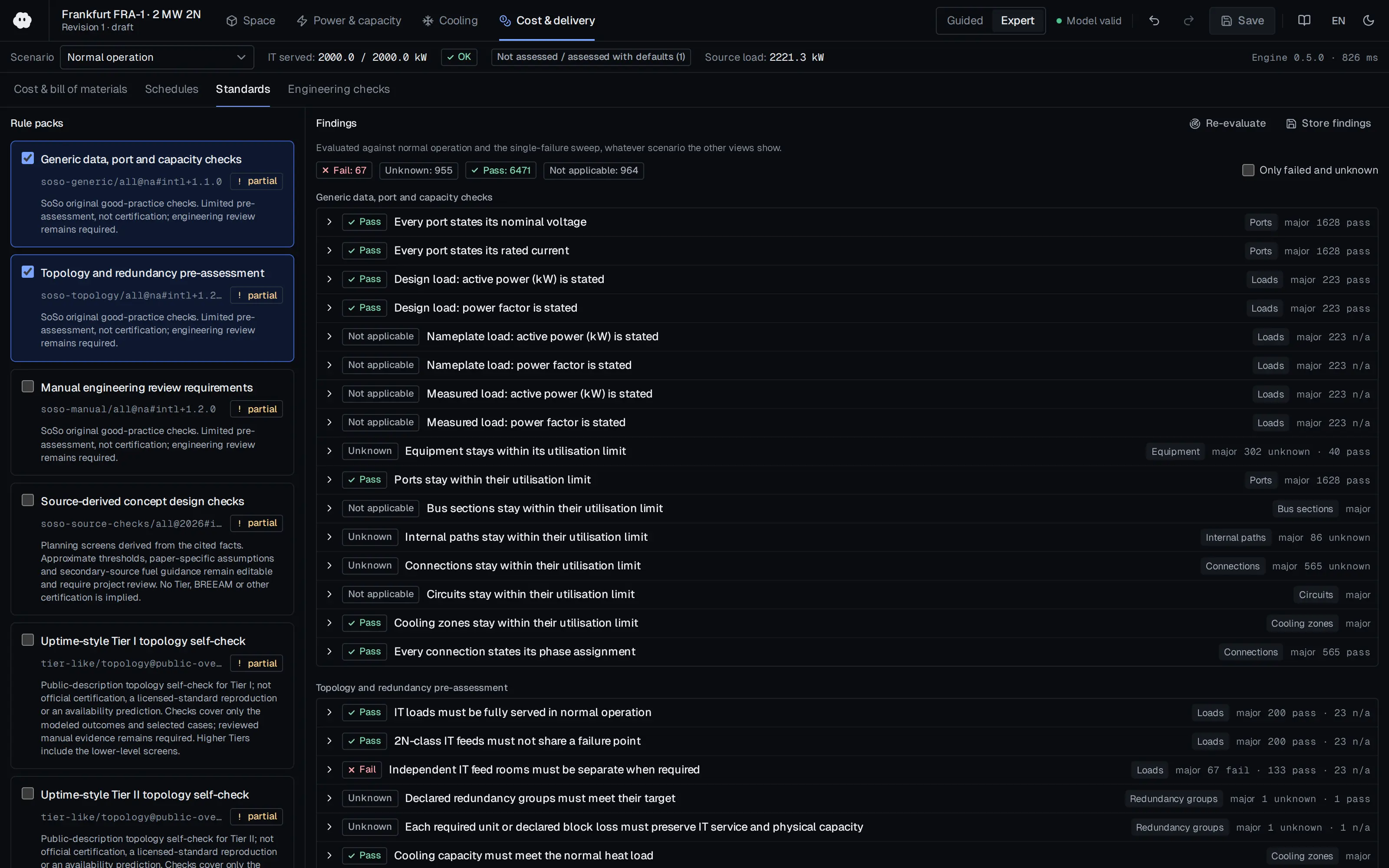
Who should read it
Information security managers, system owners, asset-management teams and data-centre operations staff.
Document contents
- Executive Summary
- 1. Introduction
- 2. Background
- 3. Summary of Sanitization Methods
- 3.1.1 Clear Sanitization Method
- 3.1.2 Purge Sanitization Method
- 3.1.3 Destroy Sanitization Method
- 3.2 Use of Cryptography and Cryptographic Erase
- 4. Media Sanitization Program
- 4.3 Sanitization and Disposition Decision (security categorization, reuse, control of media, data protection level)
- 4.5 Sanitization Assurance (verification and validation)
- 4.6 Documentation
- 4.7 Roles and Responsibilities
- Appendix B. Device-Specific Characteristics of Interest
- Appendix C. Sample Certificate of Sanitization Form
- Appendix D. Change Log
Related standards
- IEEE 2883
- NIST SP 800-53 MP-6
Read the document
nist-sp-800-88r2.pdf
U.S. public domain — U.S. Government work; free to reuse
The document is provided unaltered because its licence permits redistribution.
Publication details
- Authors
- Ramaswamy Chandramouli; Eric A. Hibbard
- Publisher
- National Institute of Standards and Technology
- Year
- 2025
- Document number
- NIST SP 800-88 Rev. 2
- Document language
- English
- Source type
- Expert / community
- Access
- Open licence — downloadable
- Licence
- U.S. public domain — U.S. Government work; free to reuse
- Licence evidence
- www.copyright.gov
Original licence note
NIST publication available free of charge via doi.org/10.6028; the front-matter authority/copyright statement says it is not subject to copyright in the United States (attribution appreciated); U.S. government work under 17 U.S.C. 105.
Citation
Ramaswamy Chandramouli; Eric A. Hibbard (2025). NIST SP 800-88 Rev. 2: Guidelines for Media Sanitization. National Institute of Standards and Technology. NIST SP 800-88 Rev. 2. https://doi.org/10.6028/NIST.SP.800-88r2
Events on this subject
Browse the events calendarAll content and rights belong to the respective authors and publishers. SoSo CAD provides only the citation, its own summary and a link to the source, and is not responsible for the sources' content.
Related sources
All sources on this topicSchneider Electric 2026
How Modern DCIM Supports CIOs in Managing Distributed, AI-Driven IT Environments
Give every asset type, serial, rack/U location, network port, explicit A/B power path (rack PDU, UPS, PDU, switchgear) and cooling-unit dependency so the design exports as a DCIM digital twin.
- Integration via APIs or SNMP MIB; SNMPv3 recommended for multi-vendor data.
Schneider Electric 2023
How Modern DCIM Helps Multi-Tenant Colocation Data Centers Be More Competitive
Add tenantId and commercialStatus (open, closed, reserved, internal) to racks, cages and floor zones, with a floor-plan overlay coloured by status and per-zone remaining power, cooling and ports.
- Preferred: SNMPv3, BACnet and APIs; integration with BMS, EPMS, ITAM and ticketing.
National Institute of Standards and Technology 2024
The NIST Cybersecurity Framework (CSF) 2.0
Create separate Organizational Profiles for a facility's IT, OT and building management systems (for example electrical and cooling SCADA/BMS) and state each Profile's scope.
- The Core has 22 Categories with Subcategories; the outcomes are not a checklist.
National Institute of Standards and Technology 2023
NIST SP 800-82 Rev. 3: Guide to Operational Technology (OT) Security
Zone the data centre's electrical (UPS, generator, ATS) and mechanical (cooling, HVAC) control systems as an OT network, separated from the corporate IT network by a DMZ.
- Network architecture should characterise, segment and isolate IT and OT devices, using the Purdue model, ISA-95 or an IIoT model, with a DMZ.
Frontiers in Toxicology (Frontiers Media SA) 2026
Toxicological and environmental evaluation of the two-phase immersion cooling fluid HFO-153-10mczz-E
When selecting a two-phase immersion fluid, add toxicology and occupational exposure limit (here WEEL 200 ppm) to the specification alongside boiling point (40-60 °C), dielectric strength, non-flammability and material compatibility.
- HFO-153-10mczz-E meets the OECD structural definition of a PFAS and falls in the short-chain PFAS category.
Scientific Reports (Springer Science and Business Media LLC) 2025
Maximizing waste heat recovery from a building-integrated edge data center
In a building-integrated edge data centre, distribute workload to servers so outlet temperatures are as high as possible (within standard limits); recoverable heat rose by up to 17.1% over random distribution.
- Compared with randomly distributed workloads, MOTA improves waste-heat recovery by up to 17.1%.