
NIST SP 800-82 Rev. 3: Guide to Operational Technology (OT) Security
National Institute of Standards and Technology · Keith Stouffer, Michael Pease et al.
NIST's September 2023 guide to securing operational technology (OT), such as industrial control systems, building automation and physical access control, while meeting OT's performance, reliability and safety requirements. It covers an OT cybersecurity programme, risk management, layered defence architecture and the SP 800-53 OT overlay.
U.S. public domain — U.S. Government work; free to reuse
On this page
Overview
The guide defines OT as programmable systems that interact with the physical environment or manage devices that do; examples are industrial control systems (ICS), building automation, transportation, physical access control and environment monitoring. OT differs from conventional IT because its logic directly affects the physical world, with risks to health and safety, the environment and production. OT security objectives typically prioritise integrity and availability, then confidentiality, with safety as an overarching priority. The document notes that adding IT solutions reduces OT's isolation and that wireless networking raises risk.
Its structure is: Section 2, an OT overview (SCADA, DCS, PLC-based topologies, building automation, physical access control, safety systems, industrial IoT) and a comparison of OT and IT security; Section 3, OT cybersecurity programme development (charter, business case, governance, cross-functional team, strategy, policies, training, maintenance tracking, incident response, recovery); Section 4, OT risk management and the RMF; Section 5, cybersecurity architecture; Section 6, applying the Cybersecurity Framework to OT. Appendix F gives the OT overlay for SP 800-53 Rev. 5 and control selection.
The architecture section recommends five layers of defence in depth: security management, physical, network, hardware and software security. In the network layer it advises characterising, segmenting and isolating IT and OT devices, using a model such as the Purdue model, ISA-95 levels or the three-tier IIoT architecture, with a DMZ as an enforcement boundary. Firewall rulesets should permit connections only between adjacent levels, so Purdue Level 4 devices cannot talk directly to Level 2, 1 or 0, and outbound rules from the control network should be as strict as inbound ones. A unidirectional gateway or data diode is an alternative.
Availability considerations include redundancy for critical components, protecting redundant communication to the same level as the primary, time-sequenced 'backup-in-depth' at local, facility and disaster levels, and primary and alternate power sources. The document stresses that monitoring and control systems for UPSs, generators, HVAC, fire alarms and cooling water plant are also vulnerable to cyber attack and can affect OT. Firewalls, patching, remote access, wireless, time synchronisation and incident response receive OT-specific recommendations.
Key points
- OT covers ICS, building automation, transportation, physical access control and environment monitoring systems.
- OT security usually prioritises integrity and availability, then confidentiality, with safety as the overarching priority.
- The OT cybersecurity programme should be part of OT safety and reliability programmes and the enterprise programme.
- The cross-functional team should at least include IT staff, a control engineer, a control system operator, a network and system security expert, a management member and a physical security member.
- Defence in depth has five layers: security management, physical, network, hardware and software security.
- Network architecture should characterise, segment and isolate IT and OT devices, using the Purdue model, ISA-95 or an IIoT model, with a DMZ.
- Firewall rules should permit connections only between adjacent levels; Level 4 devices must not talk directly to Level 2, 1 or 0; outbound rules from the control network should be as strict as inbound ones.
- Critical components should have redundant counterparts and fail without generating unnecessary traffic, with graceful degradation from normal to emergency to manual operation.
- Systems that manage UPSs, generators, HVAC, fire alarms and cooling water plant are also vulnerable and must be protected.
Using it in design
- Zone the data centre's electrical (UPS, generator, ATS) and mechanical (cooling, HVAC) control systems as an OT network, separated from the corporate IT network by a DMZ.
- Design firewall rules to allow connections only between adjacent levels and to restrict outbound traffic; evaluate a unidirectional gateway for critical control networks.
- Define primary and alternate power, redundant communication and graceful degradation modes (automatic, emergency, manual) as design requirements for BMS and SCADA.
- Plan local, facility and disaster-level backups of BMS and access control systems (configurations, firewall rules, ACLs) and tie restore testing to a schedule.
- Write OT-specific procedures for remote access, wireless and patching; apply patches after testing under field conditions.
- Use the SP 800-53 Rev. 5 OT overlay (Appendix F) as the starting point for control selection.
Monthly newsletter · free
Keep your reading list current
Once a month: new library sources, changes to Turkish regulations and upcoming data centre events.
SoSo CAD
Bring standards pre-checks into your project
Review model-based TS EN 50600 and Tier pre-checks, missing inputs and items requiring engineering review in SoSo CAD.
Request a demo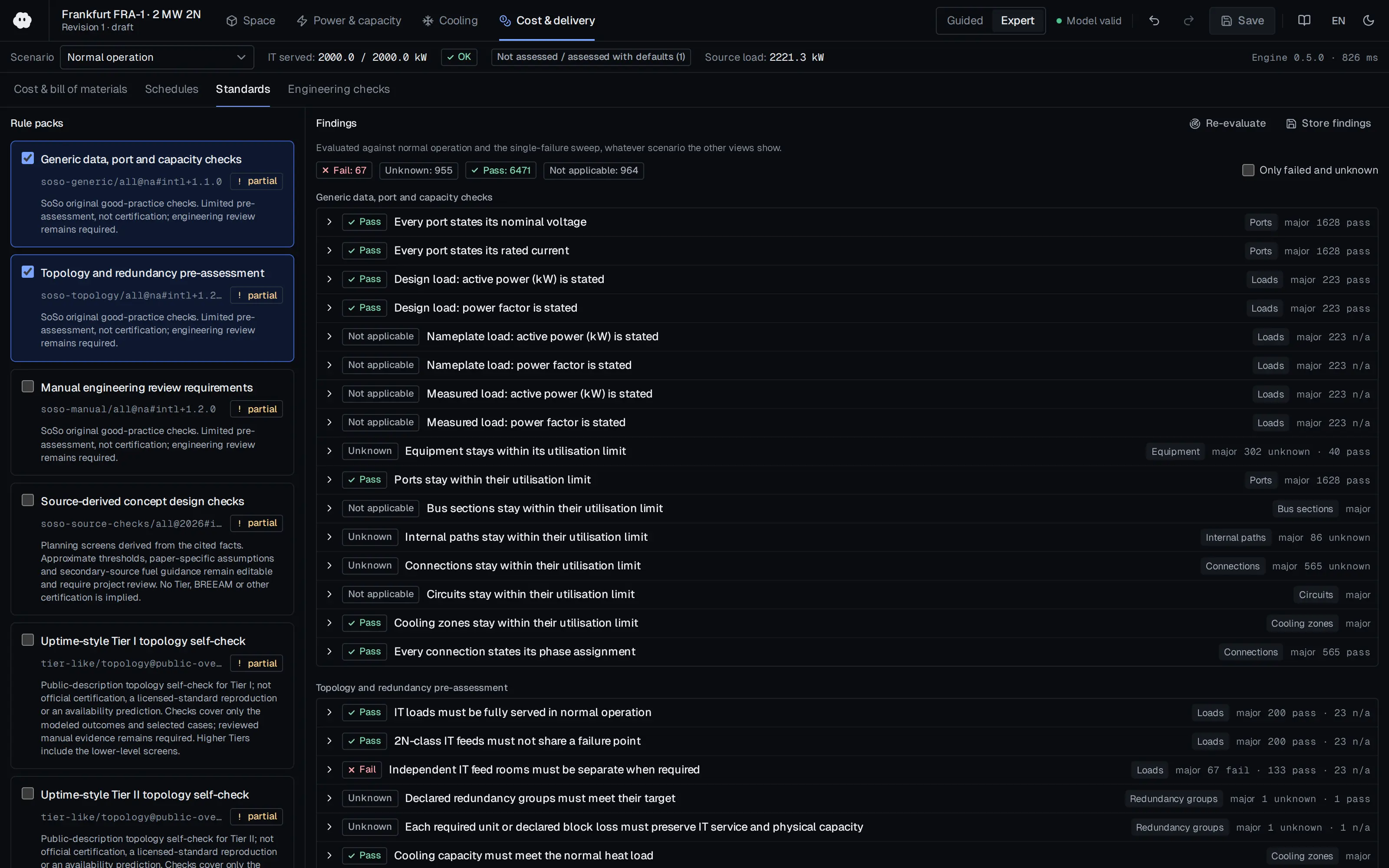
Who should read it
Engineers responsible for OT, ICS and building automation security, security managers, risk managers and system integrators.
Document contents
- Executive Summary
- 1. Introduction
- 2. OT Overview
- 2.3 OT System Operation, Architectures, and Components (SCADA, DCS, PLC, Building Automation Systems, Physical Access Control Systems, Safety Systems, IIoT)
- 2.4 Comparing OT and IT System Security
- 3. OT Cybersecurity Program Development
- 4. Risk Management for OT Systems
- 4.3 Applying the Risk Management Framework to OT Systems
- 5. OT Cybersecurity Architecture
- 5.2 Defense-in-Depth Architecture Capabilities (Layers 1-5)
- 5.3 Additional Cybersecurity Architecture Considerations
- 5.4 Cybersecurity Architecture Models
- 6. Applying the Cybersecurity Framework to OT
- Appendix C. Threat Sources, Vulnerabilities, and Incidents
- Appendix D. OT Security Organizations, Research, and Activities
- Appendix E. OT Security Capabilities and Tools
- Appendix F. OT Overlay
Related standards
- NIST SP 800-53 Rev. 5
- ISA/IEC 62443
- NIST CSF 2.0
Read the document
nist-sp-800-82r3.pdf
U.S. public domain — U.S. Government work; free to reuse
The document is provided unaltered because its licence permits redistribution.
Publication details
- Authors
- Keith Stouffer; Michael Pease; CheeYee Tang; Timothy Zimmerman; Victoria Pillitteri; Suzanne Lightman; Adam Hahn; Stephanie Saravia; Aslam Sherule; Michael Thompson
- Publisher
- National Institute of Standards and Technology
- Year
- 2023
- Document number
- NIST SP 800-82 Rev. 3
- Document language
- English
- Source type
- Expert / community
- Access
- Open licence — downloadable
- Licence
- U.S. public domain — U.S. Government work; free to reuse
- Licence evidence
- www.copyright.gov
Original licence note
NIST publication available free of charge via doi.org/10.6028; the front-matter authority/copyright statement says it is not subject to copyright in the United States (attribution appreciated); U.S. government work under 17 U.S.C. 105.
Citation
Keith Stouffer; Michael Pease; CheeYee Tang; Timothy Zimmerman; Victoria Pillitteri; Suzanne Lightman; Adam Hahn; Stephanie Saravia; Aslam Sherule; Michael Thompson (2023). NIST SP 800-82 Rev. 3: Guide to Operational Technology (OT) Security. National Institute of Standards and Technology. NIST SP 800-82 Rev. 3. https://doi.org/10.6028/NIST.SP.800-82r3
Events on this subject
- BICSI Japan Conference & Exhibition
- Gartner IT Infrastructure, Operations & Cloud Strategies Conference
- BICSI Saudi Arabia Conference & Exhibition
All content and rights belong to the respective authors and publishers. SoSo CAD provides only the citation, its own summary and a link to the source, and is not responsible for the sources' content.
Related sources
All sources on this topic
National Institute of Standards and Technology 2025
NIST SP 800-88 Rev. 2: Guidelines for Media Sanitization
Add media sanitization to the facility's storage and server lifecycle plan at commissioning, and label media with the confidentiality category of the system.
- Cryptographic erase: at least 128 bits of security strength, key sanitization by ISO/IEC 19790 zeroization, ECB mode not allowed.
National Institute of Standards and Technology 2024
The NIST Cybersecurity Framework (CSF) 2.0
Create separate Organizational Profiles for a facility's IT, OT and building management systems (for example electrical and cooling SCADA/BMS) and state each Profile's scope.
- The Core has 22 Categories with Subcategories; the outcomes are not a checklist.
Schneider Electric 2026
Cybersecurity Guidance for Data Center Power and Cooling Infrastructure Systems
Add an OT-network section to the design: each monitored device class carries a protocol list and an IEC 62443 certification flag.
- Vulnerability handling should follow ISO/IEC 30111.
Schneider Electric 2026
How Modern DCIM Supports CIOs in Managing Distributed, AI-Driven IT Environments
Give every asset type, serial, rack/U location, network port, explicit A/B power path (rack PDU, UPS, PDU, switchgear) and cooling-unit dependency so the design exports as a DCIM digital twin.
- Integration via APIs or SNMP MIB; SNMPv3 recommended for multi-vendor data.
Schneider Electric 2026
Calculating ROI of DCIM Monitoring for Distributed IT Sites
For multi-site designs add a monitoring-coverage check: every UPS, cooling unit, rack PDU and environmental sensor needs a network management interface, otherwise warn unmonitored device.
- Truck roll about $1,000 per dispatch (TSIA).
T.C. Cumhurbaşkanlığı Siber Güvenlik Başkanlığı 2026
Bilgi ve İletişim Güvenliği Rehberi - 3.6.2 Sistem Odası/Veri Merkezine Yönelik Güvenlik Tedbirleri (Information and Communication Security Guide - measures for system rooms/data centres)
Provide a Turkey public-sector compliance checklist mapping the measures to design objects: dedicated IT UPS, N+1 air conditioning with auto changeover, redundant feeds, generator fuel redundancy, room adjacency checks against wet areas.
- Water, power, humidity, temperature and smoke must be monitored with thresholds and alarms; monitoring must not be exposed externally (3.6.2.5).