
The NIST Cybersecurity Framework (CSF) 2.0
Original title The NIST Cybersecurity Framework (CSF) 2.0 (NIST CSWP 29)
National Institute of Standards and Technology
NIST's framework that helps organizations of any size, sector or maturity understand, assess, prioritize and communicate cybersecurity risk. It has three components: the Core, Profiles and Tiers.
U.S. public domain — U.S. Government work; free to reuse
On this page
Overview
CSWP 29, dated 26 February 2024, offers a taxonomy of high-level cybersecurity outcomes but does not say how to achieve them. It points instead to online resources: Informative References, Implementation Examples, Quick-Start Guides and Community Profiles. The earlier version was titled 'Framework for Improving Critical Infrastructure Cybersecurity'; version 2.0 gives greater weight to governance and supply chains. The framework applies to IT, the Internet of Things (IoT) and operational technology (OT), and to cloud, mobile and AI systems.
The Core is organised in six Functions: GOVERN, IDENTIFY, PROTECT, DETECT, RESPOND and RECOVER. These divide into 22 Categories and then Subcategories; GOVERN includes Organizational Context, Risk Management Strategy, Roles, Policy, Oversight and Cybersecurity Supply Chain Risk Management, while PROTECT includes identity and access control, data security, platform security and technology infrastructure resilience. The order or size of items in the Core implies neither sequence nor importance.
Organizational Profiles describe current and/or target posture in terms of Core outcomes. Five steps are suggested: scope the Profile, gather information, create it, analyse gaps between Current and Target Profiles and make an action plan, then implement the plan and update the Profile. A Community Profile is a shared baseline for a sector, technology or threat type and can serve as the basis for a Target Profile. Tiers characterise the rigor of risk governance and management as Partial (1), Risk Informed (2), Repeatable (3) and Adaptive (4).
Section 5 describes how the framework supports two-way communication among executives, managers and practitioners, and how it integrates with enterprise risk management (ERM) and programmes such as the NIST RMF, privacy and supply chain risk. The appendices contain the full Core, a notional illustration of Tiers and a glossary.
Key points
- The framework is meant for organizations of every size, sector and maturity, and its outcomes are sector-, country- and technology-neutral.
- The Core has six Functions: GOVERN, IDENTIFY, PROTECT, DETECT, RESPOND, RECOVER.
- GOVERN is new in 2.0 and informs prioritisation of the other five Functions; cybersecurity supply chain risk management is one of its Categories.
- The Core has 22 Categories with Subcategories; the outcomes are not a checklist.
- It covers IT, IoT and OT and cloud, mobile and AI systems.
- An Organizational Profile (current and/or target) drives a gap analysis and action plan in a repeatable cycle.
- Four Tiers: Partial (1), Risk Informed (2), Repeatable (3), Adaptive (4); moving up is encouraged when risks or mandates are greater or cost-benefit supports it.
- Informative References map Core outcomes to standards such as SP 800-53; Implementation Examples suggest action-oriented steps.
- A Target Profile can express requirements to suppliers, partners and other third parties.
Using it in design
- Create separate Organizational Profiles for a facility's IT, OT and building management systems (for example electrical and cooling SCADA/BMS) and state each Profile's scope.
- Translate gaps between Current and Target Profiles into design requirements such as access control, network segmentation and redundant power and communications.
- Pass the Target Profile to suppliers and integrators as a contract requirement (GV.SC).
- Use Informative References to map the framework's outcomes to a detailed control catalogue such as SP 800-53.
- Set a Tier as the security maturity goal when reporting implementation decisions to management.
Monthly newsletter · free
Keep your reading list current
Once a month: new library sources, changes to Turkish regulations and upcoming data centre events.
SoSo CAD
Bring standards pre-checks into your project
Review model-based TS EN 50600 and Tier pre-checks, missing inputs and items requiring engineering review in SoSo CAD.
Request a demo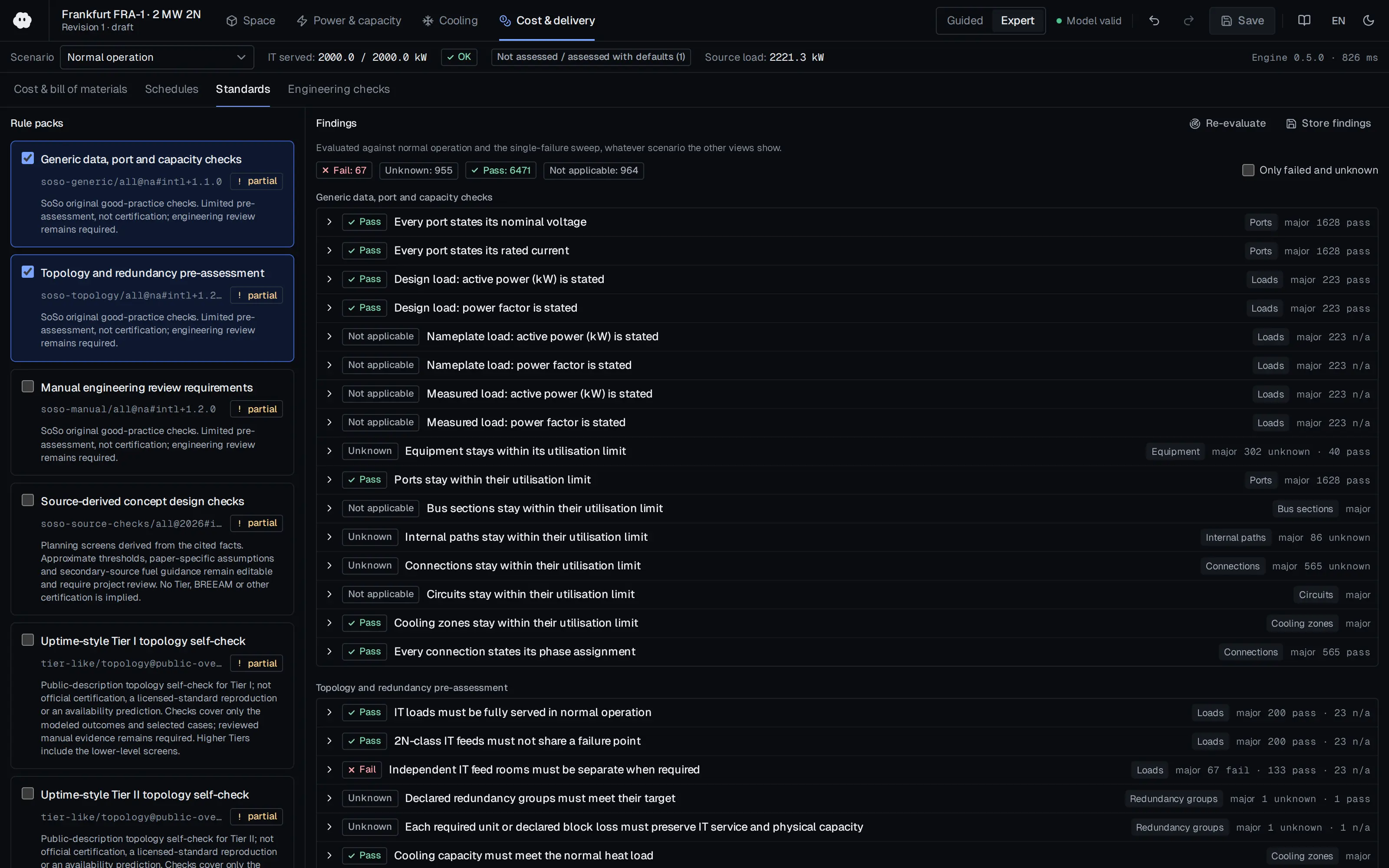
Who should read it
People who develop and lead cybersecurity programmes, plus executives, risk managers, acquisition professionals, auditors and policy makers.
Document contents
- Preface
- 1. Cybersecurity Framework (CSF) Overview
- 2. Introduction to the CSF Core
- 3. Introduction to CSF Profiles and Tiers
- 3.1 CSF Profiles
- 3.2 CSF Tiers
- 4. Introduction to Online Resources That Supplement the CSF
- 5. Improving Cybersecurity Risk Communication and Integration
- 5.1 Improving Risk Management Communication
- 5.2 Improving Integration with Other Risk Management Programs
- Appendix A. CSF Core
- Appendix B. CSF Tiers
- Appendix C. Glossary
Related standards
- NIST SP 800-53 Rev. 5
- ISO/IEC 27001
Read the document
nist-csf-2-0.pdf
U.S. public domain — U.S. Government work; free to reuse
The document is provided unaltered because its licence permits redistribution.
Publication details
- Authors
- National Institute of Standards and Technology
- Publisher
- National Institute of Standards and Technology
- Year
- 2024
- Document number
- NIST CSWP 29
- Document language
- English
- Source type
- Expert / community
- Access
- Open licence — downloadable
- Licence
- U.S. public domain — U.S. Government work; free to reuse
- Licence evidence
- www.copyright.gov
Original licence note
NIST publication available free of charge via doi.org/10.6028; the front-matter authority/copyright statement says it is not subject to copyright in the United States (attribution appreciated); U.S. government work under 17 U.S.C. 105.
Citation
National Institute of Standards and Technology (2024). The NIST Cybersecurity Framework (CSF) 2.0 (NIST CSWP 29). National Institute of Standards and Technology. NIST CSWP 29. https://doi.org/10.6028/NIST.CSWP.29
Events on this subject
Browse the events calendarAll content and rights belong to the respective authors and publishers. SoSo CAD provides only the citation, its own summary and a link to the source, and is not responsible for the sources' content.
Related sources
All sources on this topicKişisel Verileri Koruma Kurumu (KVKK) 2025
Kişisel Veri Güvenliği Rehberi (Teknik ve İdari Tedbirler)
When the 'personal data hosted' flag is set, require locked server rooms with access logging, fire and flood protection and segregated backup storage rooms in the layout checklist.
- The guide is dated April 2025 and published as KVKK Publication No. 72.
Kişisel Verileri Koruma Kurumu (KVKK) 2017
Kişisel Verilerin Silinmesi, Yok Edilmesi veya Anonim Hale Getirilmesi Hakkında Yönetmelik (Regulation on Deletion, Destruction or Anonymisation of Personal Data)
Implement scheduled purge or anonymisation jobs with a configurable interval not exceeding six months, including backups.
- Resmî Gazete 30224, 28.10.2017.
Türkiye Büyük Millet Meclisi 2016
Law No. 6698 on the Protection of Personal Data (KVKK)
Product/deployment: offer TR-region or on-prem hosting so Turkish customers avoid Article 9 transfers.
- The law was amended in 2024 by Law 7499.
National Institute of Standards and Technology 2025
NIST SP 800-88 Rev. 2: Guidelines for Media Sanitization
Add media sanitization to the facility's storage and server lifecycle plan at commissioning, and label media with the confidentiality category of the system.
- Cryptographic erase: at least 128 bits of security strength, key sanitization by ISO/IEC 19790 zeroization, ECB mode not allowed.
National Institute of Standards and Technology 2023
NIST SP 800-82 Rev. 3: Guide to Operational Technology (OT) Security
Zone the data centre's electrical (UPS, generator, ATS) and mechanical (cooling, HVAC) control systems as an OT network, separated from the corporate IT network by a DMZ.
- Network architecture should characterise, segment and isolate IT and OT devices, using the Purdue model, ISA-95 or an IIoT model, with a DMZ.
National Institute of Standards and Technology 2020
NIST SP 800-53 Rev. 5: Security and Privacy Controls for Information Systems and Organizations
In data-centre power design, set PE-9 requirements for physically separated redundant cabling paths and automatic voltage control on critical components, and define the separation distance as an organisational parameter.
- Baselines and tailoring guidance moved to SP 800-53B.