
NIST SP 800-53 Rev. 5: Security and Privacy Controls for Information Systems and Organizations
National Institute of Standards and Technology · Joint Task Force
NIST's September 2020 control catalogue that consolidates security and privacy controls in 20 families. The Physical and Environmental Protection (PE) and Contingency Planning (CP) families address data-centre topics directly, such as UPS, emergency power, cooling, fire and alternate processing sites.
U.S. public domain — U.S. Government work; free to reuse
On this page
Overview
Rev. 5 places security and privacy controls for all computing platforms, from general-purpose systems to cloud, mobile, IoT, industrial control and environmental control systems, in one catalogue. The objectives are to make systems more penetration-resistant, limit damage from attacks, make them cyber-resilient and survivable, and protect individuals' privacy. The most significant changes: controls are more outcome-based, with the responsible entity removed from the control statement; security and privacy controls are integrated; a new Supply Chain Risk Management family is added; control selection is separated from the controls; baselines and tailoring guidance move to SP 800-53B; and new state-of-the-practice controls, for example for cyber resiliency and secure design, are added.
Chapter 2 explains the structure. Controls fall into 20 families, each with a two-character identifier: AC, AT, AU, CA, CM, CP, IA, IR, MA, MP, PE, PL, PM, PS, PT, RA, SA, SC, SI and SR. Families hold base controls and control enhancements that add functionality or strength; 17 of the 20 families align with the FIPS 200 minimum security requirements, while PM, PT and SR address later federal mandates. Controls are tailored by organization-defined parameters ('Assignment' and 'Selection' values). The chapter also covers implementation approaches, the relation between security and privacy controls, and trustworthiness and assurance.
Chapter 3 gives control text, discussion and related controls for the families. The most directly relevant to data-centre design are in PE: PE-9 power equipment and cabling (physically separated redundant cabling paths, automatic voltage controls), PE-10 emergency shutoff, PE-11 emergency power (a UPS for orderly shutdown or transition to long-term alternate power), PE-13 fire protection, PE-14 environmental controls (maintaining and monitoring temperature, humidity, pressure and radiation levels), PE-15 water damage protection and PE-23 facility location (considering floods, fires, tornadoes, earthquakes and other hazards).
The CP family covers the contingency plan, testing, alternate storage site (CP-6), alternate processing site (CP-7), telecommunications services (CP-8), system backup (CP-9), recovery and reconstitution (CP-10) and safe mode (CP-12). CP-7 requires the alternate processing site to be geographically distinct from the primary, to allow resumption within a time consistent with recovery time and recovery point objectives, and to have controls equivalent to the primary site. Appendix C provides control summaries.
Key points
- Controls are organised in 20 families, and security and privacy controls share one catalogue.
- A new Supply Chain Risk Management (SR) family is added.
- Baselines and tailoring guidance moved to SP 800-53B.
- Control statements are outcome-based, with the responsible entity removed.
- 17 of the 20 families align with FIPS 200 minimum security requirements; PM, PT and SR address later federal mandates.
- Each family has a two-character identifier, with base controls and control enhancements.
- PE-9 protects power equipment and cabling; its enhancements are physically separated redundant cabling paths and automatic voltage controls.
- PE-11: a UPS enables orderly shutdown or transition to long-term alternate power; unlike a generator it gives near-instantaneous protection.
- PE-14 maintains and monitors temperature, humidity, pressure and radiation levels; PE-23 plans facility location around physical and environmental hazards.
- CP-7: the alternate processing site must be geographically distinct and have controls equivalent to the primary site.
Using it in design
- In data-centre power design, set PE-9 requirements for physically separated redundant cabling paths and automatic voltage control on critical components, and define the separation distance as an organisational parameter.
- Size the UPS and alternate power to PE-11, with either an orderly shutdown time or a long-term alternate power transition scenario.
- In site selection, record floods, fires, tornadoes and earthquakes in the risk strategy under PE-23 and identify a geographically distinct secondary site for CP-7.
- Define acceptable temperature and humidity levels and the monitoring frequency as parameters for PE-14.
- Place emergency shutoff (PE-10) devices where authorised personnel can reach them, protected against unauthorised activation.
- Use SP 800-53B for baseline selection together with the OT overlay for systems such as BMS and SCADA.
Monthly newsletter · free
Keep your reading list current
Once a month: new library sources, changes to Turkish regulations and upcoming data centre events.
SoSo CAD
Bring standards pre-checks into your project
Review model-based TS EN 50600 and Tier pre-checks, missing inputs and items requiring engineering review in SoSo CAD.
Request a demo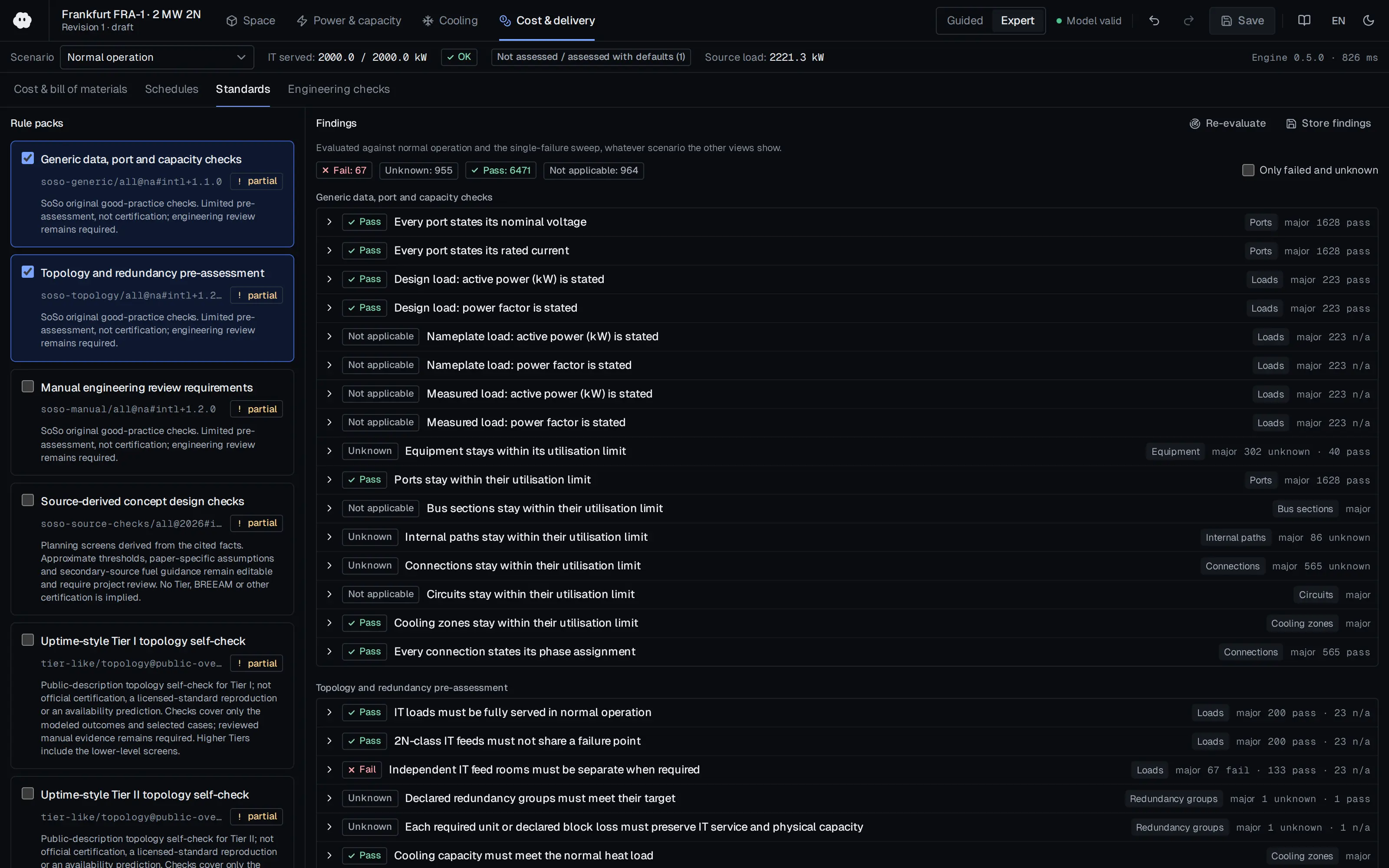
Who should read it
Information security and privacy engineers, system architects, risk managers, auditors and engineers who design physical infrastructure.
Document contents
- Executive Summary
- Chapter One: Introduction
- 1.1 Purpose and Applicability
- 1.3 Organizational Responsibilities
- Chapter Two: The Fundamentals
- 2.1 Requirements and Controls
- 2.2 Control Structure and Organization
- 2.3 Control Implementation Approaches
- 2.4 Security and Privacy Controls
- 2.5 Trustworthiness and Assurance
- Chapter Three: The Controls
- 3.1 Access Control (AC)
- 3.3 Audit and Accountability (AU)
- 3.5 Configuration Management (CM)
- 3.6 Contingency Planning (CP)
- 3.8 Incident Response (IR)
- 3.11 Physical and Environmental Protection (PE)
- 3.18 System and Communications Protection (SC)
- 3.20 Supply Chain Risk Management (SR)
- Appendix C. Control Summaries
Related standards
- NIST SP 800-53B
- FedRAMP
- NIST CSF 2.0
Read the document
nist-sp-800-53r5.pdf
U.S. public domain — U.S. Government work; free to reuse
The document is provided unaltered because its licence permits redistribution.
Publication details
- Authors
- Joint Task Force
- Publisher
- National Institute of Standards and Technology
- Year
- 2020
- Document number
- NIST SP 800-53 Rev. 5
- Document language
- English
- Source type
- Expert / community
- Access
- Open licence — downloadable
- Licence
- U.S. public domain — U.S. Government work; free to reuse
- Licence evidence
- www.copyright.gov
Original licence note
NIST publication available free of charge via doi.org/10.6028; the front-matter authority/copyright statement says it is not subject to copyright in the United States (attribution appreciated); U.S. government work under 17 U.S.C. 105.
Citation
Joint Task Force (2020). NIST SP 800-53 Rev. 5: Security and Privacy Controls for Information Systems and Organizations. National Institute of Standards and Technology. NIST SP 800-53 Rev. 5. https://doi.org/10.6028/NIST.SP.800-53r5
Events on this subject
- Electricity Eurasia 2027
- The smarter E Europe (Intersolar Europe, ees Europe, Power2Drive, EM-Power)
- ELECO 2026 Elektrik-Elektronik ve Biyomedikal Mühendisliği Konferansı
All content and rights belong to the respective authors and publishers. SoSo CAD provides only the citation, its own summary and a link to the source, and is not responsible for the sources' content.
Related sources
All sources on this topicNFPA 2025
NFPA 72, National Fire Alarm and Signaling Code
In the fire module (US profile), place detectors per room type.
- Current edition is 2025; the next edition is 2028.
BICSI 2024
ANSI/BICSI 002-2024, Data Center Design and Implementation Best Practices (overview page)
Offer BICSI classes as an alternate standards profile alongside Uptime/TIA/EN, with an F1~Tier I/Rated-1/Class 1 ... F4~Tier IV/Rated-4/Class 4 table labelled 'conceptual equivalence only'
- A 2010 draft used F0-F5; current editions use F0-F4
IEC 2024
Low-voltage electrical installations - Part 4-42: Protection for safety - Protection against thermal effects
When cable routes cross fire-compartment boundaries, require a fire-stopping element and warn if it is missing.
- Edition 4 published 2024-11-22, 64 pages.
Telecommunications Industry Association 2024
ANSI/TIA-942 Telecommunications Infrastructure Standard for Data Centers — TIA overview page
In a 'TIA-942' standards profile, let users pick a rating per discipline (for example electrical Rated-3, mechanical Rated-3, telecom Rated-2)
- 'Tier' terminology replaced by 'Rated 1-4' after an agreement with Uptime; the schemes are not interchangeable
T.C. Cumhurbaşkanlığı / Bakanlar Kurulu 2007
Regulation on the Fire Protection of Buildings (Binaların Yangından Korunması Hakkında Yönetmelik)
In the TR profile, default IT-room suppression to a TS ISO 14520 clean-agent design with damper-close interlocks.
- Accredited oxygen-reduction systems may be used in normally unoccupied enclosed spaces such as IT system rooms (Article 98(6)).
National Institute of Standards and Technology 2024
The NIST Cybersecurity Framework (CSF) 2.0
Create separate Organizational Profiles for a facility's IT, OT and building management systems (for example electrical and cooling SCADA/BMS) and state each Profile's scope.
- The Core has 22 Categories with Subcategories; the outcomes are not a checklist.