
Maximizing waste heat recovery from a building-integrated edge data center
Scientific Reports (Springer Science and Business Media LLC) · Mustafa Kuzay, Ender Demirel et al.
Researchers from DS Technologies, RISE and Empa studied a single-rack, air-cooled edge data centre in Empa's NEST demonstrator building in Switzerland, where in-rack cooling coils feed low- and medium-temperature building heat networks.
CC BY 4.0 — share with attribution
On this page
Overview
Small data centres can be integrated into the energy systems of commercial and tertiary buildings to capture waste heat generated by servers, mitigate environmental impacts and enhance energy efficiency. The study introduces a methodology for maximising waste heat capture from the cooling coils by optimising workload distribution in an edge data centre of air-cooled servers. The maximisation of outlet temperatures algorithm (MOTA) was developed using a validated fast thermal evaluation approach. The pilot data centre is hosted in Empa's NEST modular research building, a mixed-use vertical energy district used in the EU projects ECO-Qube and HEATWISE.
Cooling-system parameters (air and water flow rates, coil effectiveness) were characterised experimentally. A validated multi-region CHT numerical model of the room and coil was built, with heat transfer through the coil modelled by the effectiveness-NTU method. The fast thermal evaluation (FTE) server outlet-temperature predictor had a mean bias of 1.06 °C (95% CI 0.64-1.48 °C), with Bland-Altman limits of agreement of -0.84 to 2.97 °C.
Compared with randomly distributed workloads, MOTA improves waste-heat recovery by up to 17.1%. Optimising coil water flow rate reduces the cooling load transferred to the cooling system by up to 53.2%. Higher return-air temperatures from MOTA widen the supply/return air difference, improve cooling unit efficiency and reduce the heat-pump temperature boost needed for domestic use.
Limits: validation was on a single-rack, homogeneous, air-cooled micro data centre under fixed conditions, so applicability to large heterogeneous clusters and direct-to-chip cooling is not established.
Key points
- The pilot data centre is hosted in Empa's NEST modular research building, a mixed-use vertical energy district used in the EU projects ECO-Qube and HEATWISE.
- The fast thermal evaluation (FTE) server outlet-temperature predictor had a mean bias of 1.06 °C (95% CI 0.64-1.48 °C), with Bland-Altman limits of agreement of -0.84 to 2.97 °C.
- Compared with randomly distributed workloads, MOTA improves waste-heat recovery by up to 17.1%.
- Optimising coil water flow rate reduces the cooling load transferred to the cooling system by up to 53.2%.
- Higher return-air temperatures from MOTA widen the supply/return air difference, improve cooling unit efficiency and reduce the heat-pump temperature boost needed for domestic use.
- Validation was on a single-rack, homogeneous, air-cooled micro data centre under fixed conditions; applicability to large heterogeneous clusters and direct-to-chip cooling is not established.
Using it in design
- In a building-integrated edge data centre, distribute workload to servers so outlet temperatures are as high as possible (within standard limits); recoverable heat rose by up to 17.1% over random distribution.
- Optimise the in-rack coil water flow rate; the cooling load transferred to the cooling system fell by up to 53.2%.
- Use the finding that higher return-air temperature reduces heat-pump temperature boost in building hot-water design, and treat results as valid for a single-rack homogeneous air-cooled layout.
Monthly newsletter · free
Keep your reading list current
Once a month: new library sources, changes to Turkish regulations and upcoming data centre events.
SoSo CAD
Compare the cost of design decisions
Evaluate equipment costs, energy expenses and total cost of ownership (TCO) using your inputs and assumptions in SoSo CAD.
Request a demo
Who should read it
Engineers designing waste-heat recovery and workload placement in building-integrated edge data centres.
Document contents
- Introduction
- Results (cooling coil characterisation, multi-region CHT model validation, FTE predictor, waste-heat recovery with MOTA, coil water flow optimisation)
- Discussion
- Methods (experimental setup, effectiveness-NTU method, OpenFOAM CHT model, MOTA algorithm)
Related standards
- ASHRAE TC 9.9 thermal guidelines
Read the document
edge-dc-building-waste-heat-recovery-2025.pdf
CC BY 4.0 — share with attribution
The document is provided unaltered because its licence permits redistribution.
Publication details
- Authors
- Mustafa Kuzay; Ender Demirel; Cagatay Yilmaz; Binod Prasad Koirala; Philipp Heer
- Publisher
- Scientific Reports (Springer Science and Business Media LLC)
- Year
- 2025
- Volume
- 15
- Issue
- 1
- Pages
- 38724
- Document language
- English
- Source type
- Scientific
- Access
- Open licence — downloadable
- Licence
- CC BY 4.0 — share with attribution
- Licence evidence
- doi.org
Original licence note
Article states it is open access under a Creative Commons Attribution (CC BY / CC BY 4.0) licence (verified in PDF text).
Citation
Mustafa Kuzay; Ender Demirel; Cagatay Yilmaz; Binod Prasad Koirala; Philipp Heer (2025). Maximizing waste heat recovery from a building-integrated edge data center. Scientific Reports (Springer Science and Business Media LLC). 15(1), 38724. https://doi.org/10.1038/s41598-025-22498-x
Events on this subject
Browse the events calendarAll content and rights belong to the respective authors and publishers. SoSo CAD provides only the citation, its own summary and a link to the source, and is not responsible for the sources' content.
Related sources
All sources on this topic
Journal of Engineering Research and Sciences (Journal of Engineering Research and Sciences) 2026
CFD Analysis of Data Center Hall Cooling Performance under Normal and Failure Modes with Control Strategies and Airflow Leakages
Do thermal verification of failure mode (two ACUs offline) with realistic air leakage (cabinet gaps, HAC panel joints); a leak-free model can comply while the leaky model exceeds 32 °C.
- The grid study selected 7,288,454 cells with the standard k-epsilon model and wall functions.
Frontiers in Toxicology (Frontiers Media SA) 2026
Toxicological and environmental evaluation of the two-phase immersion cooling fluid HFO-153-10mczz-E
When selecting a two-phase immersion fluid, add toxicology and occupational exposure limit (here WEEL 200 ppm) to the specification alongside boiling point (40-60 °C), dielectric strength, non-flammability and material compatibility.
- HFO-153-10mczz-E meets the OECD structural definition of a PFAS and falls in the short-chain PFAS category.
Applied System Innovation (MDPI AG) 2026
Proactive Cooling Control Algorithm for Data Centers Based on LSTM-Driven Predictive Thermal Analysis
For predictive cooling control, plan at least one inlet and one outlet temperature sensor per rack; below that, prediction error rose by about 22%.
- The LSTM uses a 60 min input window and a 30 min prediction horizon, with a reported RMSE of 0.25 and R² of 0.985.
European Commission JRC 2025
2025 Best Practice Guidelines for the EU Code of Conduct on Data Centre Energy Efficiency (JRC141521, EUR 40267)
Design the facility to operate within the ASHRAE Class A2 allowable range and require A2 operation within warranty in IT procurement; plan separate environmental zones (practice 5.3.4) for legacy equipment.
- IT equipment AC/DC power converters should be rated at 90% efficiency or better across expected load ranges.
arXiv preprint (math.OC), MIT Operations Research Center 2025
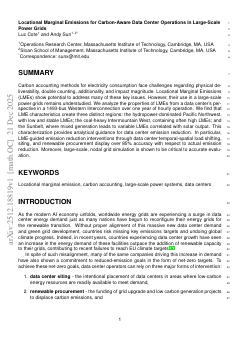
Locational Marginal Emissions for Carbon-Aware Data Center Operations in Large-Scale Power Grids
In data-centre carbon accounting, consider hourly locational marginal emissions (LME) rather than an annual-average grid factor; the LME-based intensity (about 672 kgCO2/MWh) was about 3 times the average factor (202).
- Emission rates assumed in the simulated grid: coal 800 kgCO2/MWh, gas 450 kgCO2/MWh, wind/solar/nuclear/hydro 0.
National Institute of Standards and Technology 2025
NIST SP 800-88 Rev. 2: Guidelines for Media Sanitization
Add media sanitization to the facility's storage and server lifecycle plan at commissioning, and label media with the confidentiality category of the system.
- Cryptographic erase: at least 128 bits of security strength, key sanitization by ISO/IEC 19790 zeroization, ECB mode not allowed.