
Energy management in tall buildings: the Sabancı Center case (Yüksek Binalarda Enerji Yönetimi; Sabancı Center Örneği)
Original title Yüksek Binalarda Enerji Yönetimi; Sabancı Center Örneği (Energy management in tall buildings: the Sabancı Center case)
TMMOB Makina Mühendisleri Odası (MMO) · Eser Çizer
Eser Çizer's TESKON 2007 paper describes 14 years of energy management at Sabancı Center in Istanbul, a mixed office tower that also hosts the Akbank and Sabancı Telekom IT centres.
On this page
Overview
The paper was presented at the VIII. National Installation Engineering Congress (TESKON 2007, Izmir) and appears in the proceedings book of the Chamber of Mechanical Engineers (MMO) (p. 851). The author, Eser Çizer, reports 14 years of energy management experience at Sabancı Center in Istanbul. The building is a mixed-use office tower that also houses the IT (bilgi işlem) centres of Akbank and Sabancı Telekom. The most instructive parts for data centres are the free-cooling experience.
The free cooling planned in the design could not initially be run because the bank's water-cooled mainframes were fed from the same primary circuit. It started only in 2001, after IT moved to air-cooled equipment. The system runs 24 hours a day from 15 October to 15 March, which allows the chillers to be switched off. Chilled water supplied to the IT centres was raised from 14 C to 16 C in 2001, then lowered to 13 C in 2005 and 12 C in 2006 as IT loads grew.
On UPS, experience showed that IT-centre UPSs should be independent of building-wide UPSs; oversized shared UPSs ran at low load and low efficiency. Replacing the UPSs was expected to save about 170,000 kWh per year with a payback of about 2.5 years. The paper is an early Turkish operator account of mixed-use buildings with embedded IT rooms. Because it rests on a single building and 2007 technology, the numbers are specific to that building and cannot be applied directly to today's equipment; yet the constraints created by shared circuits and shared UPSs can still be read as a valid design lesson.
Key points
- Free cooling planned in the design could not run initially because water-cooled mainframes were fed from the same primary circuit; it started in 2001 after IT moved to air-cooled equipment.
- Free cooling runs 24 h a day from 15 October to 15 March, allowing chillers to be switched off.
- Chilled water to the IT centres was raised from 14 C to 16 C in 2001, then lowered to 13 C (2005) and 12 C (2006) as IT loads grew.
- IT-centre UPSs should be independent of building-wide UPSs; oversized shared UPSs ran at low load and efficiency.
- Replacing the UPSs was expected to save about 170,000 kWh/yr with a payback of about 2.5 years.
- The source is an early Turkish operator account of mixed-use buildings with embedded IT rooms.
- The values belong to a single building and 2007 technology.
Using it in design
- Warn when IT and comfort loads share one UPS or one chilled-water primary loop, since that blocks independent temperature reset and free cooling.
- Model UPS efficiency at actual (not nameplate) load and highlight low-load operation.
- In mixed-use buildings, treat IT room cooling as a secondary loop or independent system separate from the main cooling loop.
- Keep the IT chilled-water setpoint as a design parameter that can be reset as load grows.
- For UPS renewal in existing buildings, run an energy-saving and payback analysis based on the load profile.
Monthly newsletter · free
Keep your reading list current
Once a month: new library sources, changes to Turkish regulations and upcoming data centre events.
SoSo CAD
Assess redundancy through scenarios
Compare normal operation and equipment failures in SoSo CAD, with supplied loads and capacity shortfalls in one view.
Request a demo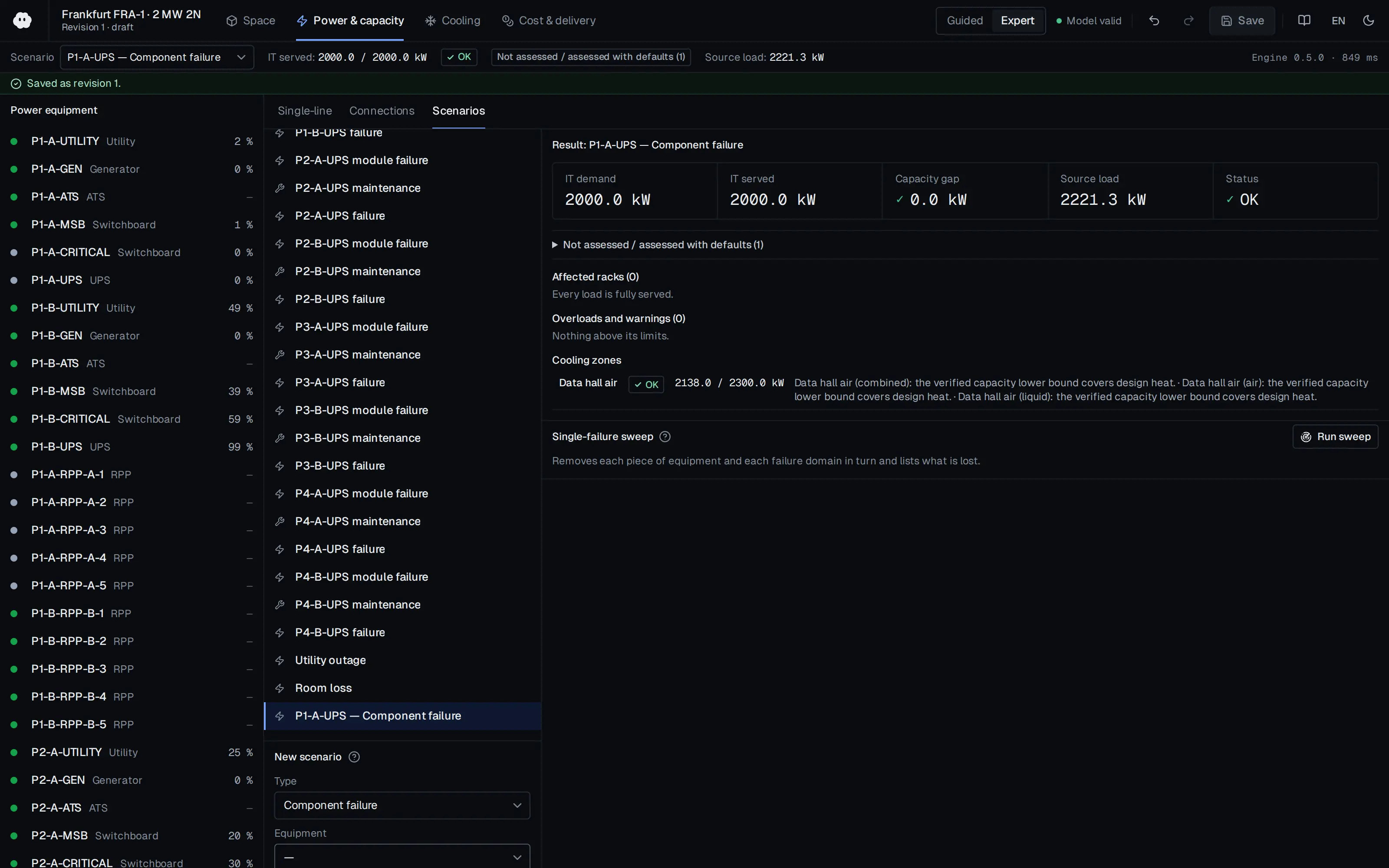
Who should read it
Mechanical and electrical engineers and building energy managers who design or operate IT rooms inside mixed-use buildings.
Publication details
- Authors
- Eser Çizer
- Publisher
- TMMOB Makina Mühendisleri Odası (MMO)
- Year
- 2007
- Document number
- TESKON 2007 Bildiriler Kitabı, s. 851
- Event
- VIII. Ulusal Tesisat Mühendisliği Kongresi (TESKON 2007), İzmir
- Document language
- English
- Source type
- Industry body
- Access
- Free to read
- Licence
- Copyright retained; citation only — the publisher’s terms apply to the original document
Citation
Eser Çizer (2007). Yüksek Binalarda Enerji Yönetimi; Sabancı Center Örneği (Energy management in tall buildings: the Sabancı Center case). TMMOB Makina Mühendisleri Odası (MMO). TESKON 2007 Bildiriler Kitabı, s. 851. VIII. Ulusal Tesisat Mühendisliği Kongresi (TESKON 2007), İzmir. http://www.mmoteskon.org/wp-content/uploads/teskonkitaplar/teskon2007/teskon2007.pdf
Events on this subject
Browse the events calendarAll content and rights belong to the respective authors and publishers. SoSo CAD provides only the citation, its own summary and a link to the source, and is not responsible for the sources' content.
Related sources
All sources on this topic
IEEE Transactions on Cloud Computing (Institute of Electrical and Electronics Engineers (IEEE)) 2026
Coordinated Cooling and Compute Management for AI Datacenters
Design AI-hall cooling control together with workload management: when GPU count and tensor parallelism, DVFS and supply air temperature and airflow were optimised jointly, cooling energy fell by 31.2%.
- Cooling is cited as contributing approximately 45-50% of total energy consumption in AI data centres.
Buildings (MDPI AG) 2026
Load-Adaptive Operational Control of an Indirect Evaporative Cooling System for Coordinated Energy and Water Use in a Modular Data Center in a Cold Region
In IEC control, stage airflow to follow load rate and spray to follow room temperature, and prefer a low fresh/return air ratio.
- Going from load rate 0.7 to 1.0 raised annual electricity by 16.2% but water by 74.8% and WUE by 70.6%.
Applied System Innovation (MDPI AG) 2026
Proactive Cooling Control Algorithm for Data Centers Based on LSTM-Driven Predictive Thermal Analysis
For predictive cooling control, plan at least one inlet and one outlet temperature sensor per rack; below that, prediction error rose by about 22%.
- The LSTM uses a 60 min input window and a 30 min prediction horizon, with a reported RMSE of 0.25 and R² of 0.985.
Building Simulation (Springer Science and Business Media LLC) 2024
Energy performance analysis of multi-chiller cooling systems for data centers concerning progressive loading throughout the lifecycle under typical climates
Calculate cooling plant efficiency from the lifecycle-average COP reflecting progressive IT load ramp rather than the design-point COP (in Beijing 2.9 lower than design).
- Free-cooling hours at PLR 1 ranged from 5921 h in Ulanqab to only 158 h in Hong Kong.
Sustainability (MDPI AG) 2021
Strategies for Improving the Sustainability of Data Centers via Energy Mix, Energy Conservation, and Circular Energy
Calculate UPS load ratio (80% for 800 kW in a modular arrangement, 53% in parallel-redundant) and losses at design stage; consider specifying UPS efficiency at 30% load and compare a SiC-based power stage (above 98%).
- CUE is defined as total CO2 emissions over ICT energy, or equivalently the CO2 emission factor × PUE.
European Commission JRC 2018
2018 Best Practice Guidelines for the EU Code of Conduct on Data Centre Energy Efficiency - Version 9.1.0 (JRC110666, EUR 29103 EN)
Keep the 2018 edition practices as a selectable compliance baseline for projects designed in 2018.
- 5.4.1.8 (value 5): investigate free cooling in all new builds and retrofits.