
Deployment Models at the Edge
Uptime Institute Intelligence · T. Rahkonen
Uptime Institute Intelligence's 12-page Briefing Report 115 covers deployment models for edge facilities and IT; only information from public pages was used.
On this page
Overview
The report is a 12-page briefing by T. Rahkonen, published by Uptime Institute Intelligence in October 2023 as UII Briefing Report 115. Its subject is deployment models for edge facilities and the IT they host. The report sits behind a registration form or an Uptime Intelligence subscription, so only facts from the public landing page and press release are used here.
The most visible finding on the landing page concerns workload character: 60% of workloads deployed at edge facilities are hybrid applications that rely on a central location. In many cases the edge therefore works not as a standalone mini data centre but as a layer that complements central infrastructure. That context shapes the resiliency and connectivity the edge actually needs. Small edge data centres are in the range of tens to hundreds of kW, and demand has fallen below initial expectations. According to the key points, high site-level resiliency expectations hold back smaller far-edge data centres because of opex and capex. At the same time, most workloads tolerate the added latency of metropolitan and regional facilities.
A regulatory dimension is included too: performance thresholds in regulation may cause some older edge sites to be scaled down or closed. Since the full report content was not seen, no comment can be made on its method or detailed figures. For designers its relevance lies in setting scale and resiliency expectations realistically for edge projects, planning remote monitoring from the start, and recognising that regulatory thresholds may put older sites at risk.
Key points
- Published as UII Briefing Report 115 in October 2023; 12 pages.
- 60% of workloads deployed at edge facilities are hybrid applications relying on a central location.
- Small edge data centres are tens to hundreds of kW.
- Demand for edge data centres is below initial expectations.
- High site-level resiliency expectations hold back smaller far-edge sites because of opex and capex.
- Most workloads tolerate the added latency of metropolitan and regional facilities.
- Regulatory performance thresholds may cause some older edge sites to be scaled down or closed.
Using it in design
- Size edge templates in the tens-to-hundreds of kW range.
- Plan remote monitoring as a default; do not assume on-site staff at small sites.
- Factor the edge site's dependence on a central location into connectivity and redundancy decisions.
- Do not assume high site-level resiliency at every edge node; assess the workload's latency tolerance first.
Monthly newsletter · free
Keep your reading list current
Once a month: new library sources, changes to Turkish regulations and upcoming data centre events.
SoSo CAD
Assess redundancy through scenarios
Compare normal operation and equipment failures in SoSo CAD, with supplied loads and capacity shortfalls in one view.
Request a demo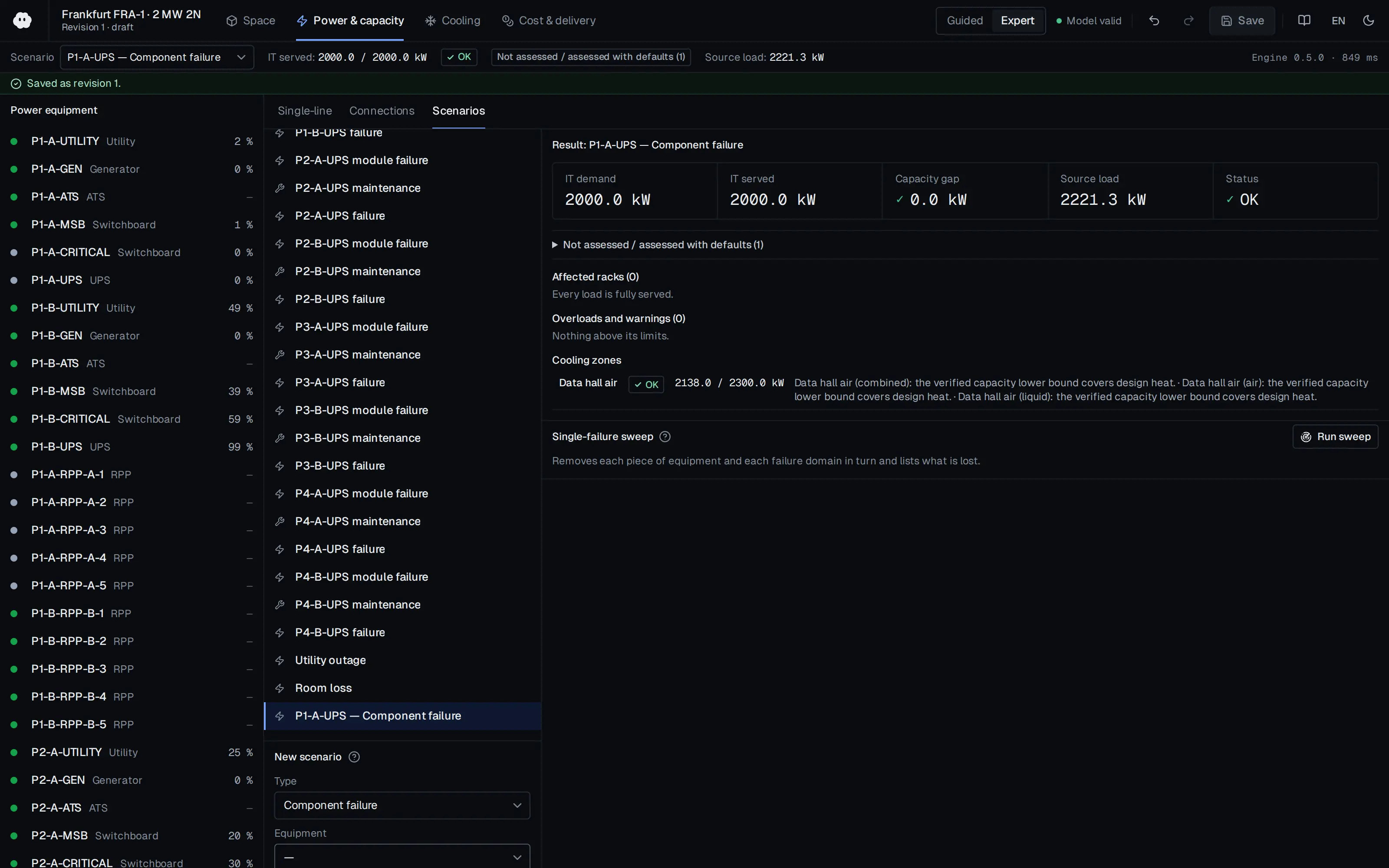
Who should read it
Architects planning edge infrastructure, facility designers and managers scoping edge investments.
Publication details
- Authors
- T. Rahkonen
- Publisher
- Uptime Institute Intelligence
- Year
- 2023
- Document number
- UII Briefing Report 115
- Document language
- English
- Source type
- Industry body
- Access
- Citation only
- Licence
- Copyright retained; citation only — the publisher’s terms apply to the original document
Original licence note
Report behind a registration form (or Uptime Intelligence subscription); copyright Uptime Institute. Facts taken only from the public landing page / press release. Citation only.
Citation
T. Rahkonen (2023). Deployment Models at the Edge. Uptime Institute Intelligence. UII Briefing Report 115. https://uptimeinstitute.com/resources/research-and-reports/deployment-models-at-the-edge
Events on this subject
Browse the events calendarAll content and rights belong to the respective authors and publishers. SoSo CAD provides only the citation, its own summary and a link to the source, and is not responsible for the sources' content.
Related sources
All sources on this topicUptime Institute Journal (Uptime Institute) 2020
Why ASHRAE is concerned about edge data centers
Add a vestibule or airlock option to the edge enclosure template.
- ASHRAE published an edge data center Technical Bulletin in October 2020.
arXiv preprint (University of Alberta) 2026
To Defer or To Shift? The Role of AI Data Center Flexibility on Grid Interconnection
In large-load interconnection negotiation, present AI load flexibility (a deferral window of up to about 3 hours) as a lever for interconnection capacity and timing; returns diminish beyond 3 hours.
- In the IEEE 14-bus study, data centres on buses connected to congested lines benefit most from geographic load shifting.

arXiv preprint (math.OC), MIT Operations Research Center 2025
Locational Marginal Emissions for Carbon-Aware Data Center Operations in Large-Scale Power Grids
In data-centre carbon accounting, consider hourly locational marginal emissions (LME) rather than an annual-average grid factor; the LME-based intensity (about 672 kgCO2/MWh) was about 3 times the average factor (202).
- Emission rates assumed in the simulated grid: coal 800 kgCO2/MWh, gas 450 kgCO2/MWh, wind/solar/nuclear/hydro 0.

Open Compute Project Foundation 2022
White Paper: OCP Ready Data Centers - Program Mission, Methodology, and Case Studies, Revision 1.0 (June 2022)
Offer an 'OCP Ready' compliance profile that checks the delivery path (dock, ramps, door heights), floor load classes (uniform, concentrated, rolling), 3-phase IEC/NEMA rack circuits, hot/cold-aisle containment and generator load-acceptance time relative to BBU autonomy.
- Design PUE ranges from 1.07 (Hydro66, WUE 0.059 L/kWh) to 1.6 (maincubes AMS01).
Proceedings of the Twelfth ACM International Conference on Future Energy Systems (ACM) 2021
A Guide to Reducing Carbon Emissions through Data Center Geographical Load Shifting
For geographic load shifting, consider locational marginal carbon emissions (lambda-CO2) as the signal instead of LMP or regional average carbon intensity; it gave the largest reduction (-1.44%).
- Lambda-CO2 shifting saved about 0.14 t CO2 per MW shifted and still reduced generation cost by 0.27%; LMP shifting cut cost by 1.07% but saved less carbon.
Data Center Knowledge 2026
Liquid Cooling Retrofits: Hard, but Sometimes Worth It (Christopher Tozzi)
Add a retrofit check comparing liquid-cooled rack weight (default up to about 3,000 lb / 1,360 kg) with the raised-floor rating.
- Fully loaded AI racks with liquid cooling can exceed 3,000 lb, which raised floors may not support without reinforcement.