
Myths and Misconceptions Regarding the Uptime Institute's Tier Certification System
Uptime Institute Journal
A 2017 Uptime Institute Journal true/false list that corrects common misunderstandings of Uptime Tiers.
On this page
Overview
This article is a true/false list correcting common misunderstandings of Uptime Tiers, published in the Uptime Institute Journal in 2017. Its core message is that Tiers are outcome-based, not component counts. Component count does not determine Tier; the system is performance-based, not a checklist, and N-counting shorthand is misleading. Expected downtime per year was removed from the Tier Standard in 2009 and was never part of the Tier definitions.
It also clarifies electrical sources: only the engine-generator plant is treated as a reliable source, the number of utility feeds does not change Tier, and generators need not run continuously but must be rated to carry the load. Tier III requires active/active distribution from UPS output downward, with both rack feeds live, while mechanical loops may be active/inactive. Tier II allows concurrent maintenance of capacity components (gensets, UPS, chillers, pumps) but not of paths (switchboards, panels, ATS, transformers, cables, pipes).
Rack-mounted ATSs are an accepted concession for single- or odd-corded IT, but the rack must still have two independent feeds, and ductwork must also meet the Tier objective. EPOs mandated by code do not prevent compliance, but Tier III needs a maintainable EPO and Tier IV a Fault Tolerant EPO; DRUPS (typically 10-30 s ride-through) can be used. The article is a freely accessible expert piece; only the record's summary and key facts were used here and the full text was not read.
Key points
- Component count does not determine Tier; Tiers are performance-based, not a checklist, and N-counting shorthand is misleading.
- Expected downtime per year was removed from the Tier Standard in 2009 and was never part of the Tier definitions.
- Only the engine-generator plant is treated as a reliable source; the number of utility feeds does not change Tier; generators need not run continuously but must be rated to carry the load.
- Tier III requires active/active distribution from UPS output downward (both rack feeds live); mechanical loops may be active/inactive.
- Tier II allows concurrent maintenance of capacity components (gensets, UPS, chillers, pumps) but not of paths (switchboards, panels, ATS, transformers, cables, pipes).
- Rack-mounted ATSs are an accepted concession for single- or odd-corded IT, but the rack must still have two independent feeds; ductwork must also meet the Tier objective.
- EPOs mandated by code do not prevent compliance; Tier III needs a maintainable EPO and Tier IV a Fault Tolerant EPO; DRUPS (typically 10-30 s ride-through) can be used.
Using it in design
- Evaluate the Tier checker on topology, with paths and components removed one at a time, not on component counts.
- For Tier III and IV, require both rack feeds to be active below the UPS.
- Allow rack ATS only for single-corded loads with dual upstream feeds.
- Never display downtime minutes per year as a Tier attribute.
Monthly newsletter · free
Keep your reading list current
Once a month: new library sources, changes to Turkish regulations and upcoming data centre events.
SoSo CAD
Assess redundancy through scenarios
Compare normal operation and equipment failures in SoSo CAD, with supplied loads and capacity shortfalls in one view.
Request a demo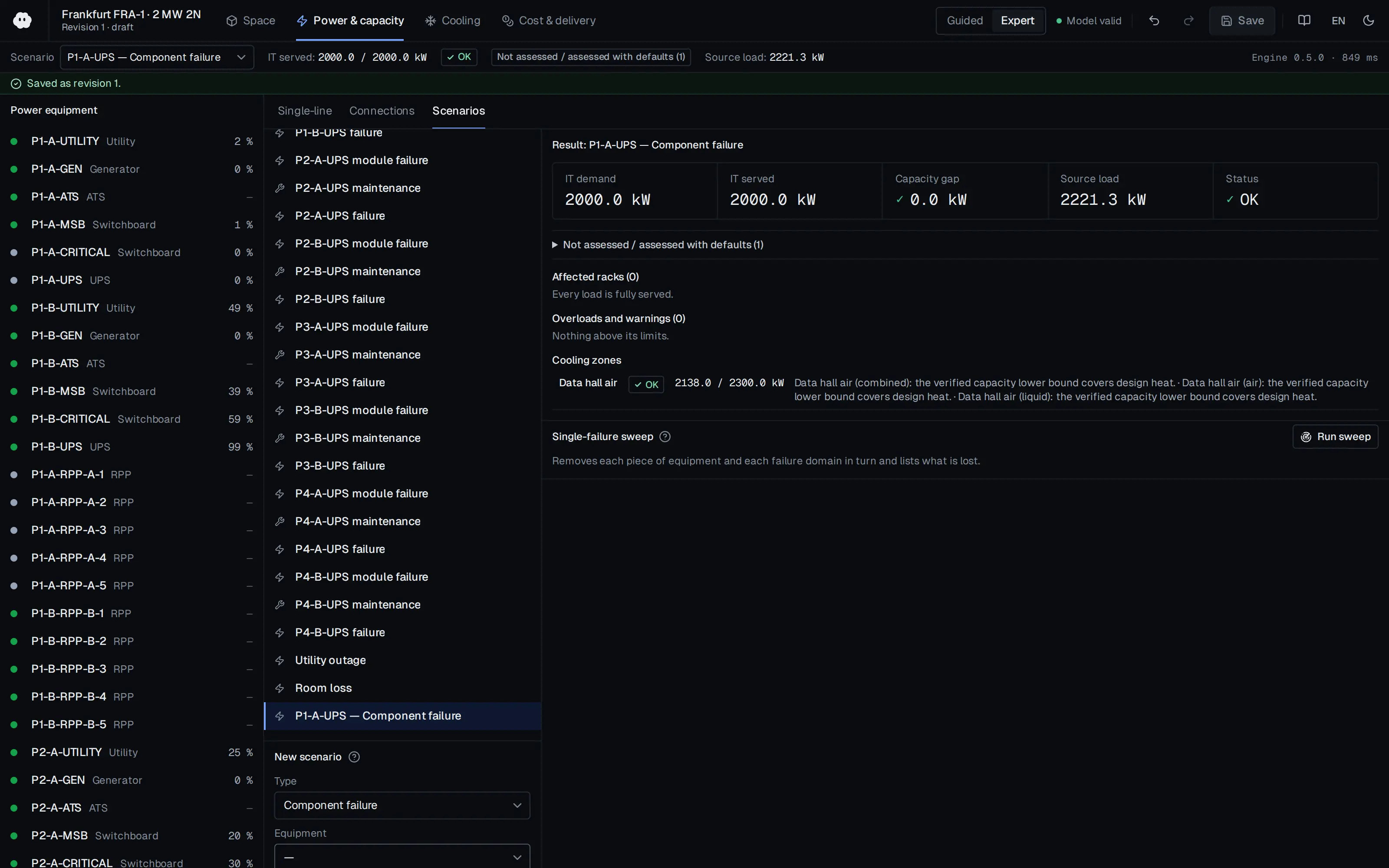
Who should read it
Electrical and reliability engineers who design to Uptime Tiers, evaluate Tier claims or prepare for Tier certification.
Related standards
- Uptime Institute Tier Standard: Topology
- ANSI/TIA-942
Publication details
- Authors
- Uptime Institute Journal
- Publisher
- Uptime Institute Journal
- Year
- 2017
- Document language
- English
- Source type
- Industry body
- Access
- Free to read
- Licence
- Copyright retained; citation only — the publisher’s terms apply to the original document
Citation
Uptime Institute Journal (2017). Myths and Misconceptions Regarding the Uptime Institute's Tier Certification System. Uptime Institute Journal. https://journal.uptimeinstitute.com/myths-and-misconceptions-regarding-the-uptime-institutes-tier-certification-system/
Events on this subject
- Electricity Eurasia 2027
- ELECO 2026 Elektrik-Elektronik ve Biyomedikal Mühendisliği Konferansı
- ICCI 2027 – Uluslararası Enerji ve Çevre Fuarı ve Konferansı
All content and rights belong to the respective authors and publishers. SoSo CAD provides only the citation, its own summary and a link to the source, and is not responsible for the sources' content.
Related sources
All sources on this topicUptime Institute 2026
Uptime Institute Annual Outage Analysis 2026 (8th annual) — press release (with 2025 findings)
Weight UPS, ATS/STS and generator failure modes highest in the reliability model
- About 1 in 10 outages has serious or severe impact
Uptime Institute 2018
Tier Standard: Topology
For Tier III/IV targets, accept only generator ratings flagged 'continuous' or unlimited-hours in the sizing module
- Minimum 12 hours of on-site fuel at N design load is the baseline; many sites choose 24-72 h
Open Compute Project Foundation 2026
Clean Backup Power Technology Requirements, Base Specification Version 0.3 (effective Apr 22, 2026)
Extend the generator catalogue with technology type (diesel, HVO, gas, H2 ICE, PEM fuel cell), emissions factor relative to the 1742 lb/MWh baseline, start time, block-load capability and NFPA 110 level.
- Overload 110% for 60 s and 150% for 3 s; transient voltage response to ISO 8528-5 G3; steady-state frequency within +/-0.5%.
Energies (MDPI AG) 2023
Reliability Assessment of the Configuration of Dynamic Uninterruptible Power Sources: A Case of Data Centers
When choosing among DRUPS or UPS configurations, first screen with the graph-based method to identify the best candidates, then do the detailed RBD calculation for that candidate only.
- Single system: λ = 3.10 × 10^-6 1/h, A = 0.999949, MTBF 306,600 h (35 years).
U.S. DoD (UFC) 2023
UFC 3-540-01 Engine-Driven Generator Systems for Prime and Standby Power Applications (1 August 2014, Change 3, 26 January 2023)
Include transient and steady-state loads, transformer inrush, motor starting and UPS load in the generator sizing study, and calculate UPS charging load using the minimum charging current allowed while on generator.
- Harmonic analysis is required when switching power supplies make up 25% or more of the system load.
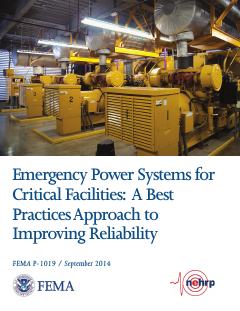
FEMA 2014
FEMA P-1019, Emergency Power Systems for Critical Facilities: A Best Practices Approach to Improving Reliability (September 2014)
At critical-facility data centers, place generators, ATS, fuel tanks and pumps above the greatest of BFE + 3 ft, DFE + 1 ft and 500-year elevation + 1 ft, and prefer elevation to dry floodproofing.
- Generators over 300 kW are almost exclusively diesel-fueled.