
Tier Standard: Topology
Uptime Institute
The normative Uptime document that defines the four Tier classifications through redundant capacity components and distribution paths. Its widely cited generator and fuel-storage provisions drive design at the higher Tiers.
On this page
Overview
Tier Standard: Topology separates four Tier classifications by increasing numbers of redundant capacity components and distribution paths, and includes the performance confirmation tests used to determine compliance. A separate commentary gives example configurations. The document is free to download but requires agreeing to terms through a form, so this page relies on the public abstract and widely published requirements; the full text was not read. The most quoted provisions concern the engine generator. For Tier III and IV the generator is treated as the primary power source and must have no limit on consecutive run hours at N demand.
That means a continuous rating, or a prime or standby rating derated so that no runtime limit applies. In other words, the kVA figure on the nameplate is not enough; the rating class it is quoted under decides Tier compliance. On fuel, the widely published baseline is at least 12 hours of on-site storage at N design load, with many sites choosing 24-72 hours. For Tier III the fuel system (tanks, pumps, piping) must itself be concurrently maintainable; for Tier IV it must be fault tolerant and compartmentalized.
A fuel path with a single pump or a single fill point therefore cannot reach Tier III. The limit of the source is access: because it needs registration, the full text was not used and the fuel hours and generator provisions come from secondary sources. Treat these values as defaults until confirmed against a licensed copy or Uptime. The document should be read together with Uptime's separate Operational Sustainability standard, since topology alone does not guarantee operating outcomes.
Key points
- Four classifications differ by increasing redundant capacity components and distribution paths; performance confirmation tests are included
- Engine generators are the primary power source for Tier III/IV
- Generators must have no limit on consecutive run hours at N demand (continuous rating, or derated prime/standby with no runtime limit)
- Minimum 12 hours of on-site fuel at N design load is the baseline; many sites choose 24-72 h
- Tier III: the fuel system (tanks, pumps, piping) must be concurrently maintainable
- Tier IV: the fuel system must be fault tolerant and compartmentalized
- Download is free but needs a form; abstract and widely published requirements were used
Using it in design
- For Tier III/IV targets, accept only generator ratings flagged 'continuous' or unlimited-hours in the sizing module
- If the user picks ISO 8528 'standby' or 'prime', require a derating factor or flag non-compliance
- Default fuel autonomy to 12 h at N load, with 24/48/72 h presets
- Check the fuel topology for N+1 pumps and two fill paths when Tier III is the intent
Monthly newsletter · free
Keep your reading list current
Once a month: new library sources, changes to Turkish regulations and upcoming data centre events.
SoSo CAD
Assess redundancy through scenarios
Compare normal operation and equipment failures in SoSo CAD, with supplied loads and capacity shortfalls in one view.
Request a demo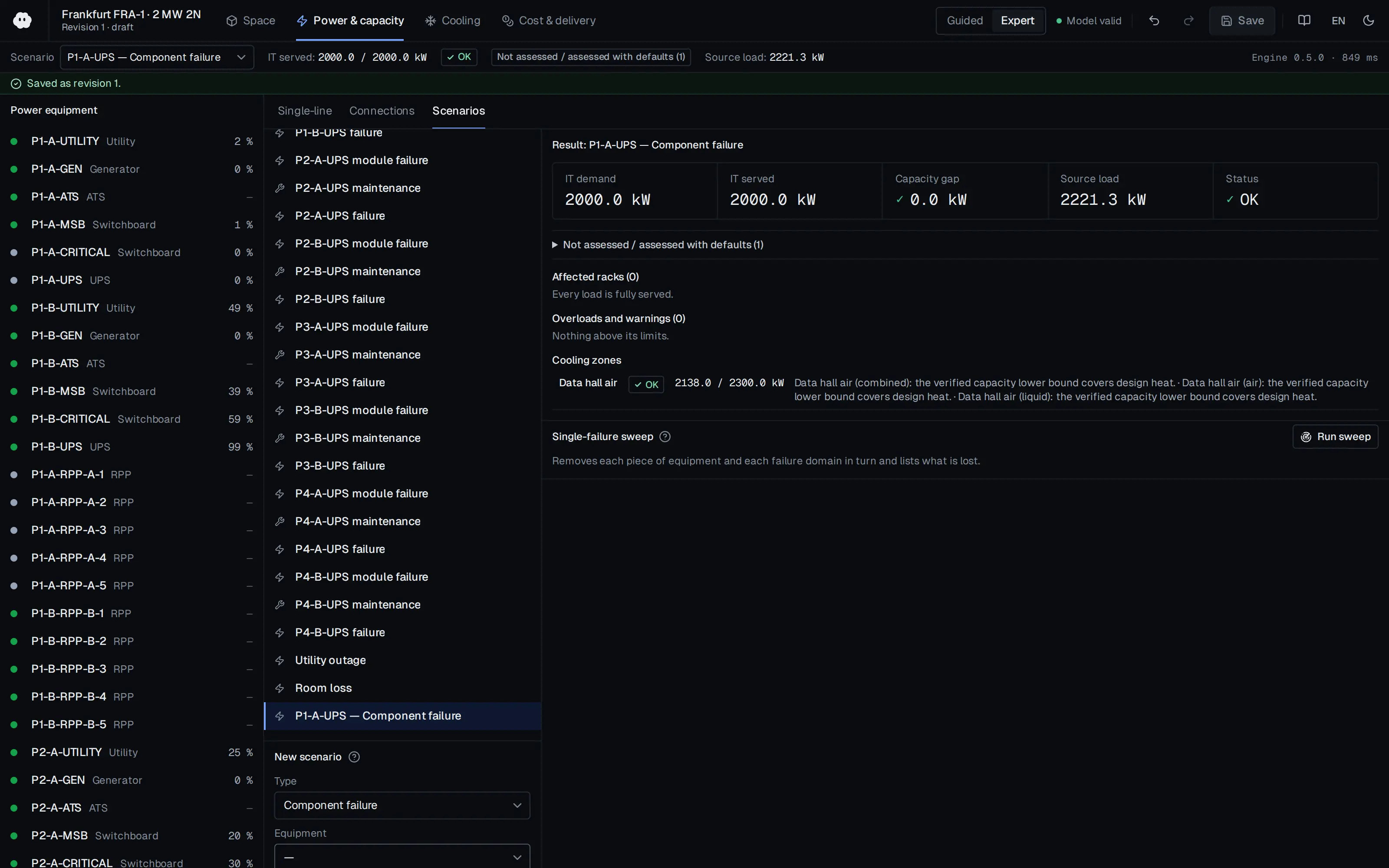
Who should read it
Electrical design engineers, consultants specifying generators and fuel systems, and owners of Tier-targeted projects.
Related standards
- ISO 8528-1
- NFPA 110
- TIA-942
- ANSI/BICSI 002
Publication details
- Authors
- Uptime Institute
- Publisher
- Uptime Institute
- Year
- 2018
- Document language
- English
- Source type
- Industry body
- Access
- Citation only
- Licence
- Copyright retained; citation only — the publisher’s terms apply to the original document
Citation
Uptime Institute (2018). Tier Standard: Topology. Uptime Institute. https://uptimeinstitute.com/publications/asset/tier-standard-topology
Events on this subject
Browse the events calendarAll content and rights belong to the respective authors and publishers. SoSo CAD provides only the citation, its own summary and a link to the source, and is not responsible for the sources' content.
Related sources
All sources on this topic
Headquarters, Department of the Army (U.S. Army Corps of Engineers PREP) 2006
TM 5-698-5 Survey of Reliability and Availability Information for Power Distribution, Power Generation, and Heating, Ventilating and Air Conditioning (HVAC) Components for Commercial, Industrial, and Utility Installations (22 July 2006)
When modelling the power and cooling chain use these values as starting failure rates and MTBF/MTTR inputs and convert them into availability with the method of TM 5-698-1.
- Diesel engine generators overall: 0.528 failures/yr, MTBF about 16,590 h, MTTR 24.22 h, operational availability 0.99399.
Uptime Institute 2026
Uptime Institute Annual Outage Analysis 2026 (8th annual) — press release (with 2025 findings)
Weight UPS, ATS/STS and generator failure modes highest in the reliability model
- About 1 in 10 outages has serious or severe impact
Uptime Institute Journal 2026
Survey findings link higher redundancy to lower outage risk (Owen Rogers, Douglas Donnellan)
Use these ratios as indicative risk multipliers in an option-comparison view, for example showing relative outage likelihood when switching cooling from N+1 to 2N.
- Power, same comparison: 23%, 37% and 44%.
Uptime Institute 2026
Uptime Institute Tier Classification System
Model 'reliability.target' as an enum {TierI..TierIV} driving topology defaults: Tier I single path N; Tier II N+1 capacity components, single path; Tier III N+1 components AND two distribution paths (one may be passive), concurrently maintainable; Tier IV 2N or 2(N+1), two active physically compartmentalized paths and continuous cooling with UPS-backed pumps/fans.
- Over 4,300 Tier Certification awards in 120+ countries (2026).
Uptime Institute Journal 2017
Myths and Misconceptions Regarding the Uptime Institute's Tier Certification System
Evaluate the Tier checker on topology, with paths and components removed one at a time, not on component counts.
- Expected downtime per year was removed from the Tier Standard in 2009 and was never part of the Tier definitions.

Open Compute Project Foundation 2026
Clean Backup Power Technology Requirements, Base Specification Version 0.3 (effective Apr 22, 2026)
Extend the generator catalogue with technology type (diesel, HVO, gas, H2 ICE, PEM fuel cell), emissions factor relative to the 1742 lb/MWh baseline, start time, block-load capability and NFPA 110 level.
- Overload 110% for 60 s and 150% for 3 s; transient voltage response to ISO 8528-5 G3; steady-state frequency within +/-0.5%.