
Water is local: generalities do not apply (Jay Dietrich)
Uptime Institute Journal · Jay Dietrich
Uptime Institute Journal article explaining where water is actually consumed in a data center and how each site's water profile depends on climate, heat rejection technology and the local watershed.
On this page
Overview
This 2025 article by Jay Dietrich explains where water is actually consumed in a data center: in the heat rejection loop, not in closed IT-side loops. Closed water or water-glycol loops serving CRAHs, rear doors or DLC via CDUs consume little or no water; consumption happens in open towers and evaporative/adiabatic coolers.
Its main message is that each site's water profile depends on climate, heat rejection technology and the local watershed. Newer evaporative/adiabatic systems with higher set points can free-cool 50% to 80% or more of the time. Spray or trickle-media adiabatic precooling can cut water use by half or more versus conventional open systems. In cool climates heat rejection may need water only 4-12 hours a day on 5-20 days a year.
In water-rich regions water-cooled heat rejection is usually most energy efficient, while in water-stressed areas dry free cooling with minimal (peak-shaving) or no water should be prioritised. For context, a typical US household uses about 110,000 US gal (420 m3) per year. The author argues impact must be judged against the safe withdrawal rate of the local supply. The related standard is ISO/IEC 30134-9 (WUE).
Key points
- Closed water or water-glycol loops (CRAHs, rear doors or DLC via CDUs) consume little or no water; consumption happens in open towers and evaporative/adiabatic coolers.
- Newer evaporative/adiabatic systems with higher set points can free-cool 50% to 80% or more of the time.
- Spray or trickle-media adiabatic precooling can cut water use by half or more versus conventional open systems.
- In cool climates heat rejection may need water only 4-12 hours a day on 5-20 days a year.
- In water-rich regions water-cooled heat rejection is usually most efficient; in water-stressed areas prioritise dry free cooling with minimal or no water.
- Context: a typical US household uses about 110,000 US gal (420 m3) per year.
- Impact must be judged against the safe withdrawal rate of the local supply.
Using it in design
- Model annual water use from heat rejection type, set points and hourly climate rather than a fixed WUE.
- Add a site 'waterStress' field.
- Warn when open cooling towers are chosen in water-stressed locations and suggest dry or hybrid adiabatic options with peak-only water use.
Monthly newsletter · free
Keep your reading list current
Once a month: new library sources, changes to Turkish regulations and upcoming data centre events.
SoSo CAD
Check cooling capacity alongside your design
Review zone heat loads, available capacity and the capacity balance after the largest unit is lost in SoSo CAD.
Request a demo
Who should read it
Engineers choosing cooling systems and sites, and managers reporting on water and sustainability.
Related standards
- ISO/IEC 30134-9 (WUE)
Publication details
- Authors
- Jay Dietrich
- Publisher
- Uptime Institute Journal
- Year
- 2025
- Document language
- English
- Source type
- Industry body
- Access
- Free to read
- Licence
- Copyright retained; citation only — the publisher’s terms apply to the original document
Citation
Jay Dietrich (2025). Water is local: generalities do not apply (Jay Dietrich). Uptime Institute Journal. https://journal.uptimeinstitute.com/water-is-local-generalities-do-not-apply/
Events on this subject
Browse the events calendarAll content and rights belong to the respective authors and publishers. SoSo CAD provides only the citation, its own summary and a link to the source, and is not responsible for the sources' content.
Related sources
All sources on this topic
Open Compute Project Foundation 2026
Guidelines: Impact of Strategies on Data Center Energy Consumption, Carbon Footprint, and Water Consumption (March 2026)
Evaluate cooling and siting options on energy, carbon, site water and water scarcity together, not on PUE or WUE alone.
- Same example: emissions fall from 3,500 to 2,700 t CO2/yr with the carbon factor of 0.26 kg CO2/kWh.
Journal of Cleaner Production (Elsevier BV) 2025
Sustainable AI infrastructure: A scenario-based forecast of water footprint under uncertainty
In water-footprint planning, calculate on-site (WUE), off-site electricity (PUE × EWIF) and embodied hardware water as separate items.
- Under BAU, water demand rises nearly sevenfold between 2030 and 2050; improvements in WUE, EWIF and embodied water could cut 2050 use by up to 95% against BAU.
Open Compute Project Foundation 2023
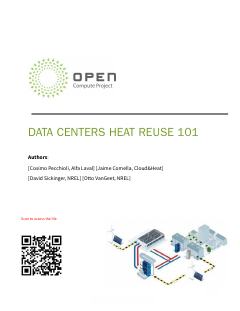
Data Centers Heat Reuse 101
A heat-reuse module should report recoverable heat (kW) and its temperature band by cooling technology (air, RDHx, DLC/immersion) and suggest compatible heat-host categories.
- Containerised/modular data centres can exceed 0.5 MW, a significant heat quantity for many local applications.
U.S. DOE FEMP / NREL 2019
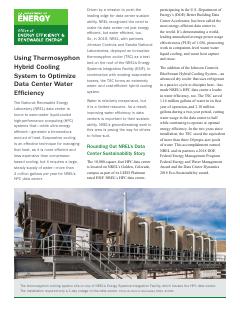
Using Thermosyphon Hybrid Cooling System to Optimize Data Center Water Efficiency (DOE/GO-102019-5172, May 2019)
Arrange the heat-rejection hierarchy as in the scheme: heat reuse first, then dry cooling, evaporative towers last; write the control logic in that order.
- Installing the TSC required only a 1-day data center outage.
Sustainability (MDPI AG) 2015
The Water Footprint of Data Centers
Compare HVAC options not only by on-site water use but by total water footprint including the grid's water intensity (WUEsource); the ranking can flip with the grid.
- Outbound data traffic carries a water footprint of 1-205 litres per gigabyte; the high end is close to the 214 L footprint of 1 kg of tomatoes.
Google 2026
Google Data Centers — Operating sustainably (energy and water)
In the cooling-selection UX present an explicit energy-versus-water trade-off (PUE versus WUE) per site, with a water-stress input (for example a WRI Aqueduct category).
- 87% of 2025 freshwater withdrawal from sources at low or medium depletion/scarcity risk.