
Sustainable AI infrastructure: A scenario-based forecast of water footprint under uncertainty
Journal of Cleaner Production (Elsevier BV) · Manuel Herrera, Xiang Xie et al.
A global, probabilistic forecast of water consumption by AI-driven data centres to 2030 and 2050 that separates on-site water (energy × WUE), off-site electricity water (energy × PUE × EWIF) and embodied hardware water.
CC BY 4.0 — share with attribution
On this page
Overview
The rapid expansion of AI and cloud computing is creating a significant but often overlooked impact on global water resources. The study distinguishes water consumption for operational use at the facility, off-site water consumption related to electricity generation, and embodied water associated with hardware manufacturing and supply chains. Total water is modelled as on-site W_on = e(t) × WUE(t), plus off-site W_off = e(t) × PUE(t) × EWIF(t), plus embodied water divided by equipment lifespan; each parameter declines at a scenario-specific annual improvement rate.
A Monte Carlo framework inspired by Bayesian methods samples uncertain server energy and applies scenario growth and efficiency-improvement rates, run for business-as-usual (BAU), moderate-intervention and sustainable-transformation pathways. Mean projected global data-centre water use (billion L/day) is 4.18 (2030) and 28.11 (2050) under BAU, 3.06 and 8.36 under moderate intervention, and 1.86 and 1.38 under sustainable transformation. Under BAU, water demand rises nearly sevenfold between 2030 and 2050; improvements in WUE, EWIF and embodied water could cut 2050 use by up to 95% against BAU.
The sensitivity analysis finds compute growth, WUE and EWIF dominate the outcome: against the 2050 BAU baseline of 28.11 billion L/day, a ±20% shift in WUE changes demand by 4.69 billion L/day (16.7%), EWIF by 4.24 (15.1%) and embodied water by 1.29 billion L/day. A qualitative comparison puts evaporative cooling as high water and high efficiency, air-based cooling as low water and moderate-low efficiency, direct liquid cooling as low water and very high efficiency, and immersion as very low water and very high efficiency.
Limits: the model works at global scale with sparse empirical data and expert-informed assumptions. The authors call for closed-loop and immersion cooling, standard water accounting and climate-aware siting, and argue that this trajectory is not inevitable: improvements in cooling performance, alternative water sources and siting could substantially curb demand.
Key points
- Total water is modelled as on-site W_on = e(t) × WUE(t), plus off-site W_off = e(t) × PUE(t) × EWIF(t), plus embodied water divided by equipment lifespan; each parameter declines at a scenario-specific annual improvement rate.
- Mean projected global data-centre water use (billion L/day): 4.18 (2030) and 28.11 (2050) under BAU, 3.06 and 8.36 under moderate intervention, 1.86 and 1.38 under sustainable transformation.
- Under BAU, water demand rises nearly sevenfold between 2030 and 2050; improvements in WUE, EWIF and embodied water could cut 2050 use by up to 95% against BAU.
- Against the 2050 BAU baseline of 28.11 billion L/day, a ±20% shift in WUE changes demand by 4.69 billion L/day (16.7%), EWIF by 4.24 (15.1%) and embodied water by 1.29 billion L/day.
- Qualitative comparison: evaporative cooling is high water and high efficiency; air-based cooling low water and moderate-low efficiency; direct liquid cooling low water and very high efficiency; immersion very low water and very high efficiency.
- Compute growth, WUE and EWIF dominate the outcome.
Using it in design
- In water-footprint planning, calculate on-site (WUE), off-site electricity (PUE × EWIF) and embodied hardware water as separate items.
- In cooling selection, weigh water and efficiency together: evaporative cooling is high water, closed-loop and immersion low water; a ±20% shift in WUE changes 2050 BAU demand by 16.7%.
- Site by regional climate and grid EWIF and use standard accounting in water reporting.
Monthly newsletter · free
Keep your reading list current
Once a month: new library sources, changes to Turkish regulations and upcoming data centre events.
SoSo CAD
Check cooling capacity alongside your design
Review zone heat loads, available capacity and the capacity balance after the largest unit is lost in SoSo CAD.
Request a demo
Who should read it
Designers, sustainability managers and policy specialists planning the water impact of AI infrastructure.
Document contents
- 1. Introduction
- 2. Drivers of AI data centre water consumption (2.1 AI water footprint: impact at scale, 2.2 AI water footprint: quantification)
- 3. Cooling systems and their role in operational water consumption (3.1 Air-based cooling systems, 3.2 Evaporative cooling towers, 3.3 Liquid and immersion cooling, 3.4 Adoption rate of cooling technologies)
- 4. Regional variations in data centre water consumption
- 5. Probabilistic scenario-based forecasting (5.1 Probabilistic scenario-based forecasting, 5.2 Probabilistic scenario projections from scenario-based simulations)
- 6. Discussion and recommendations (6.2 Probabilistic scenario-based framework: strengths and limitations, 6.3 Interpretation of results and policy implications)
- 7. Conclusions
Related standards
- ISO/IEC 30134-9 (WUE)
Read the document
ai-water-footprint-scenario-forecast-2025.pdf
CC BY 4.0 — share with attribution
The document is provided unaltered because its licence permits redistribution.
Publication details
- Authors
- Manuel Herrera; Xiang Xie; Andrea Menapace; Ariele Zanfei; Bruno M. Brentan
- Publisher
- Journal of Cleaner Production (Elsevier BV)
- Year
- 2025
- Volume
- 526
- Pages
- 146528
- Document language
- English
- Source type
- Scientific
- Access
- Open licence — downloadable
- Licence
- CC BY 4.0 — share with attribution
- Licence evidence
- eartharxiv.org
Original licence note
Downloaded file is the EarthArXiv preprint (submitted 29 July 2025), which EarthArXiv lists under CC BY 4.0. The journal version (vol. 526, 146528) is also CC BY. Numbers are from the preprint and may differ slightly from the published article.
Citation
Manuel Herrera; Xiang Xie; Andrea Menapace; Ariele Zanfei; Bruno M. Brentan (2025). Sustainable AI infrastructure: A scenario-based forecast of water footprint under uncertainty. Journal of Cleaner Production (Elsevier BV). 526, 146528. https://doi.org/10.1016/j.jclepro.2025.146528
Events on this subject
Browse the events calendarAll content and rights belong to the respective authors and publishers. SoSo CAD provides only the citation, its own summary and a link to the source, and is not responsible for the sources' content.
Related sources
All sources on this topic
Open Compute Project Foundation 2026
Guidelines: Impact of Strategies on Data Center Energy Consumption, Carbon Footprint, and Water Consumption (March 2026)
Evaluate cooling and siting options on energy, carbon, site water and water scarcity together, not on PUE or WUE alone.
- Same example: emissions fall from 3,500 to 2,700 t CO2/yr with the carbon factor of 0.26 kg CO2/kWh.
Open Compute Project Foundation 2023
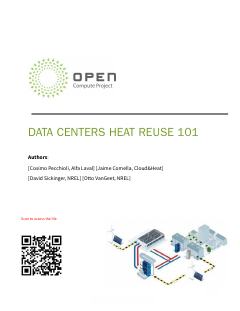
Data Centers Heat Reuse 101
A heat-reuse module should report recoverable heat (kW) and its temperature band by cooling technology (air, RDHx, DLC/immersion) and suggest compatible heat-host categories.
- Containerised/modular data centres can exceed 0.5 MW, a significant heat quantity for many local applications.
U.S. DOE FEMP / NREL 2019
Using Thermosyphon Hybrid Cooling System to Optimize Data Center Water Efficiency (DOE/GO-102019-5172, May 2019)
Arrange the heat-rejection hierarchy as in the scheme: heat reuse first, then dry cooling, evaporative towers last; write the control logic in that order.
- Installing the TSC required only a 1-day data center outage.
Sustainability (MDPI AG) 2015
The Water Footprint of Data Centers
Compare HVAC options not only by on-site water use but by total water footprint including the grid's water intensity (WUEsource); the ranking can flip with the grid.
- Outbound data traffic carries a water footprint of 1-205 litres per gigabyte; the high end is close to the 214 L footprint of 1 kg of tomatoes.
Google 2026
Google Data Centers — Operating sustainably (energy and water)
In the cooling-selection UX present an explicit energy-versus-water trade-off (PUE versus WUE) per site, with a water-stress input (for example a WRI Aqueduct category).
- 87% of 2025 freshwater withdrawal from sources at low or medium depletion/scarcity risk.
Schneider Electric 2026
Water Usage at AI Scale: Insights from a 100 MW Comparative Analysis
Compute and display WUE (L/kWh IT) next to PUE for every cooling design.
- Dallas WUE falls from 0.42 to 0.22 L/kWh; Paris from 0.12 to 0.06 L/kWh.