
TM 5-698-3, Reliability Primer for Command, Control, Communications, Computer, Intelligence, Surveillance, and Reconnaissance (C4ISR) Facilities (14 October 2005)
U.S. Army Corps of Engineers (Headquarters, Department of the Army technical manual) · Headquarters, Department of the Army
An Army introduction to reliability engineering: probability foundations, reliability prediction, series, parallel and k-of-N block diagrams, designing for reliability, production and operational data trending. It is a concise source for the availability mathematics used when evaluating data centre power and cooling topologies.
U.S. public domain — U.S. Government work; free to reuse
On this page
Overview
TM 5-698-3 gives personnel who acquire and support equipment for mission-critical facilities such as command and data processing centres a basic introduction to and overview of reliability. The theory is purposely limited and kept simple, drawing on commercial practice and lessons learned from many reliability programmes. It supersedes the edition of 10 July 2003. It notes that reliability has grown in importance over the past 30 years as systems became more complex, support costs rose and defence budgets fell.
Chapter 2 gives the mathematical foundation: probability and statistics, reliability functions, sampling and estimation. For the exponential distribution reliability is R(t) = e^(-lambda t) and MTBF is 1/lambda. Chapter 3 covers reliability prediction and block-diagram modelling; the authors remark that the word 'prediction' sounds like fortune telling when it is only a quantitative assessment of the reliability inherent in a design or achieved in a product. A series system's reliability is the product of its elements; for active parallel, R = 1 - (1-R1)(1-R2)(1-R3).
Chapter 4 treats designing for reliability in eight steps: establish and allocate requirements, develop a system reliability model, conduct analyses (FMECA, fault tree, thermal analysis, worst-case circuit analysis and others), design, development testing, iterate the design, demonstration tests and a team approach. It carries an important warning on redundancy: redundancy raises only system-level mission reliability, not the reliability of individual items, and in fact lowers basic reliability because more failures occur, even if they are not mission failures, which raises support costs. Chapter 5 covers production and quality control and chapter 6 data collection and trending in operation.
The limit is that the manual is general and tutorial; it contains no facility-specific failure-rate data, which sits in other volumes of the TM 5-698 series (notably TM 5-698-5). It dates from 2005. Appendix B covers inherent and operational availability, and Appendix C gives examples of failure rate, similarity analysis, stress-strength interference, empirical models and failure data analysis. For a data centre designer the most useful parts are the block-diagram formulas and the warnings on redundancy.
Key points
- Under an exponential failure distribution reliability is R(t) = e^(-lambda t), and MTBF (or MTTF) equals 1/lambda.
- Series system reliability is the product of element reliabilities: R = R1 x R2 x R3.
- Active parallel redundancy: R_system = 1 - (1-R1)(1-R2)(1-R3); a three-element unpowered standby set with perfect switching gives R = e^(-lambda t) + lambda t e^(-lambda t) + 0.5 (lambda t)^2 e^(-lambda t).
- Allocation example: for 95 percent system reliability over a 10-hour mission, subsystems A, B and C must satisfy RA x RB x RC = 0.95.
- Inherent availability Ai = MTBF / (MTBF + MTTR) excludes logistic and administrative delays.
- Operational availability Ao = MTBM / (MTBM + MDT) x 100 percent accounts for all preventive and corrective maintenance and logistics delays; a maintainability specification such as MMax(95) = 6 h means 95 percent of repairs finish within 6 hours.
- Redundancy lowers basic reliability: more components mean more failures and repairs, plus added weight, cost and complexity.
- Reliability usually degrades over time; causes include changes in operating concept or environment, inadequate training, wearout and supplier changes, and the true root cause must be found before the design is changed.
- Standard parts should be preferred and applied conservatively (derating); using a part at maximum capability raises its failure rate and leaves no margin for transients.
Using it in design
- Draw the UPS, generator and chiller chain as a series-parallel block diagram and compute system reliability on paper first, with the product rule for series parts and the parallel formula for redundant ones.
- When allocating a system reliability target to subsystems, check the product condition (RA x RB x RC = 0.95 in the example).
- Before adding redundancy, weigh the extra failures, maintenance load and cost of the added components; redundancy raises mission reliability but lowers basic reliability.
- Define the availability target in both inherent (MTBF/MTTR) and operational (MTBM/MDT) form, and write the maintainability requirement as a measurable condition such as a 95 percent repair time.
- Add derating of equipment below its rated limit and environmental characterisation (temperature, vibration and others) at design stage to the design criteria.
- Collect failure data in operation and trend it; when reliability falls, examine training, operating conditions and maintenance first before turning to design changes.
Monthly newsletter · free
Keep your reading list current
Once a month: new library sources, changes to Turkish regulations and upcoming data centre events.
SoSo CAD
Assess redundancy through scenarios
Compare normal operation and equipment failures in SoSo CAD, with supplied loads and capacity shortfalls in one view.
Request a demo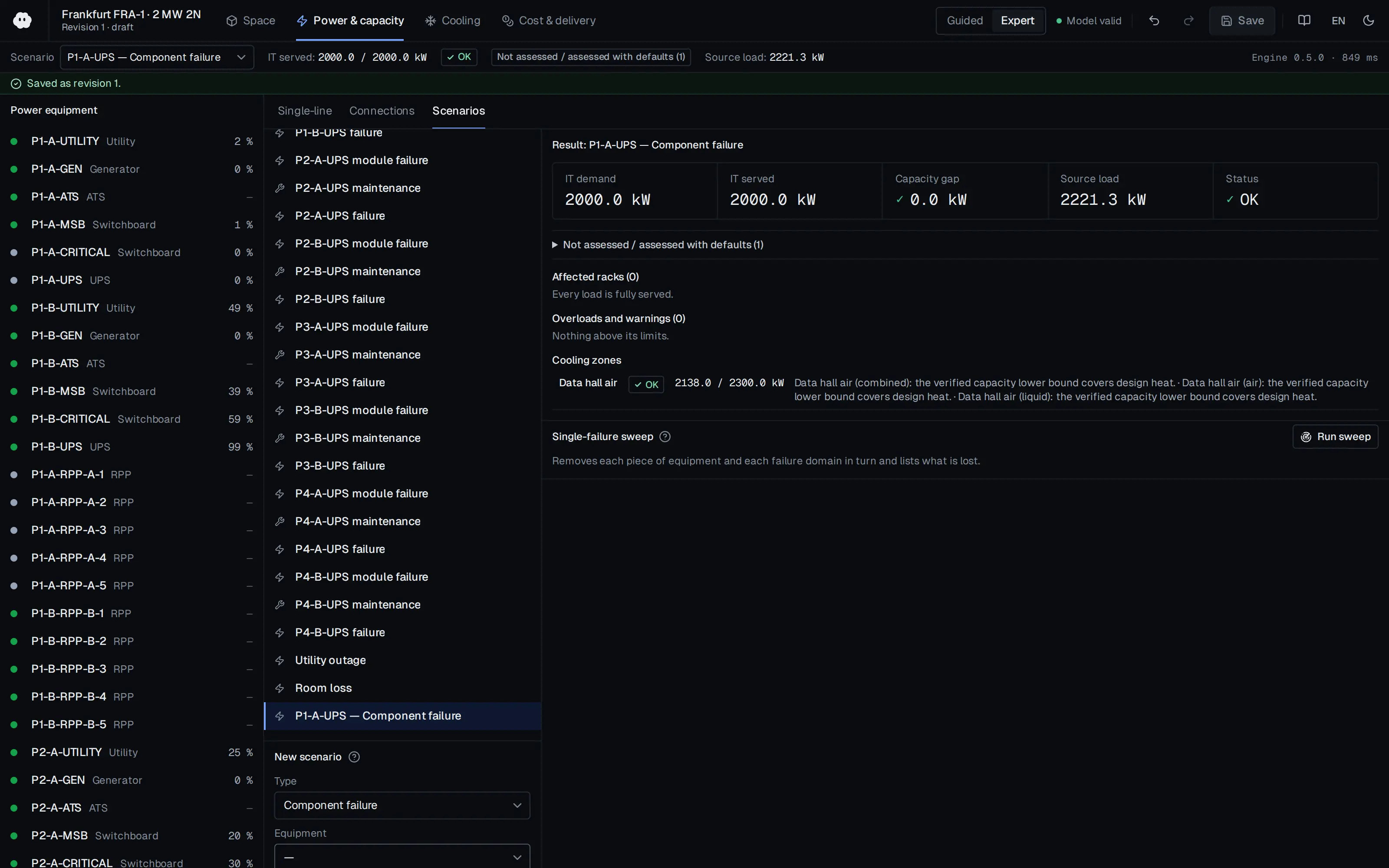
Who should read it
Newcomers to reliability engineering and designers who will assess data centre topologies with availability mathematics.
Document contents
- Chapter 1 Introduction to Reliability: purpose, scope, definitions, historical perspective, importance of reliability
- Chapter 2 Reliability and Its Mathematical Foundations
- 2-2 Mathematical foundations: probability and statistics
- 2-4 Sampling and estimation
- Chapter 3 Reliability Prediction
- 3-5 Reliability modeling (series, parallel, k of N)
- Chapter 4 Designing for Reliability
- 4-1 Establish and allocate requirements
- 4-3 Conduct analyses
- 4-4 Design for reliability
- 4-5 Conduct development testing
- 4-7 Conduct demonstration tests
- Chapter 5 Producing Reliable Systems
- Chapter 6 Reliability Improvement: data collection, trending, corrective actions
- Appendix B Availability
- Appendix C Examples of Reliability Prediction Methods
Read the document
usace-tm-5-698-3-reliability-primer.pdf
U.S. public domain — U.S. Government work; free to reuse
The document is provided unaltered because its licence permits redistribution.
Publication details
- Authors
- Headquarters, Department of the Army
- Publisher
- U.S. Army Corps of Engineers (Headquarters, Department of the Army technical manual)
- Year
- 2005
- Document language
- English
- Source type
- Government / public
- Access
- Open licence — downloadable
- Licence
- U.S. public domain — U.S. Government work; free to reuse
- Licence evidence
- www.copyright.gov
Original licence note
DoD/USACE criteria marked "Approved for public release; distribution unlimited"; work of the U.S. Government (17 U.S.C. 105).
Citation
Headquarters, Department of the Army (2005). TM 5-698-3, Reliability Primer for Command, Control, Communications, Computer, Intelligence, Surveillance, and Reconnaissance (C4ISR) Facilities (14 October 2005). U.S. Army Corps of Engineers (Headquarters, Department of the Army technical manual). https://www.wbdg.org/FFC/ARMYCOE/COETM/tm_5_698_3.pdf
Events on this subject
Browse the events calendarAll content and rights belong to the respective authors and publishers. SoSo CAD provides only the citation, its own summary and a link to the source, and is not responsible for the sources' content.
Related sources
All sources on this topic
U.S. Army Corps of Engineers 2006
TM 5-698-2, Reliability-Centered Maintenance (RCM) for Command, Control, Communications, Computer, Intelligence, Surveillance, and Reconnaissance (C4ISR) Facilities (6 October 2006)
At design stage carry out an FMEA for each critical system and record failure modes, effects and detection methods as input to the RCM decision logic; the text stresses that RCM starts in design and continues for the life of the facility.
- For an exponential failure distribution with constant failure rate, an item with a 1000-hour MTBF has only a 37 percent probability of surviving 1000 hours of continuous operation.
U.S. Army Corps of Engineers (Headquarters, Department of the Army) 2006
TM 5-698-4 Failure Modes, Effects and Criticality Analyses (FMECA) for Command, Control, Communications, Computer, Intelligence, Surveillance, and Reconnaissance (C4ISR) Facilities (29 September 2006)
At design stage run a functional FMEA of each critical system (power, generators, cooling); do not start without schematics, bill of materials, block diagram and the mission requirement.
- The Risk Priority Number is Severity (1-10) x Occurrence (1-10), optionally multiplied by Detection: RPN = S x O x D.
U.S. Army Corps of Engineers (Headquarters, Department of the Army) 2002
TM 5-693 Uninterruptible Power Supply System Selection, Installation, and Maintenance for Command, Control, Communications, Computer, Intelligence, Surveillance, and Reconnaissance (C4ISR) Facilities (31 May 2002)
Calculate availability from MTBF and MTTR before choosing a UPS configuration; apply the same method to single-unit, N+1 and dual-redundant layouts to compare the gain from redundancy with the cost of the added components.
- C4ISR facilities require a reliability level of 99.9999 percent (the six-nine rule), which may call for greater redundancy.
Fire (MDPI AG) 2026
Reframing Data Center Fire Safety as a Socio-Technical Reliability System: A Systematic Review
Ask for a fire-safety design file that covers a lifecycle plan (aligned with NFPA 75 and NFPA 76) including emergency response, damage control and post-fire recovery, not only prevention and suppression.
- The search found 806 records (Scopus 330, Web of Science 476); twelve empirical studies were synthesised and benchmarked against NFPA 75 and NFPA 76.
Journal of Engineering Research and Sciences (Journal of Engineering Research and Sciences) 2026
CFD Analysis of Data Center Hall Cooling Performance under Normal and Failure Modes with Control Strategies and Airflow Leakages
Do thermal verification of failure mode (two ACUs offline) with realistic air leakage (cabinet gaps, HAC panel joints); a leak-free model can comply while the leaky model exceeds 32 °C.
- The grid study selected 7,288,454 cells with the standard k-epsilon model and wall functions.
IEEE Access (Institute of Electrical and Electronics Engineers (IEEE)) 2026
GRAPE-UPS: Direction-Constrained Peer Anomaly Detection for Weak Batteries in Data-Center UPS Strings
Require block-level (per-unit) voltage and resistance monitoring in UPS battery monitoring rather than string totals, citing that one weak unit in a series string limits the whole string's capacity.
- On an independent electrochemical simulation benchmark, directed peer scoring achieved AUPRC 0.848 under nominal conditions and 0.850-0.877 under operating shifts.