
Turning AI Data Centers into Grid-Interactive Assets: Results from a Field Demonstration in Phoenix, Arizona
arXiv preprint (Emerald AI / NVIDIA / Salt River Project / EPRI) · Philip Colangelo, Ayse K. Coskun et al.
An arXiv preprint reporting the first field demonstration, under the EPRI DCFlex initiative, of software-only demand response for an AI cluster.
On this page
Overview
This document is a joint arXiv preprint by Emerald AI, NVIDIA, Salt River Project and EPRI (arXiv:2507.00909, 2025), written by Philip Colangelo, Ayse K. Coskun and others. It reports the first field demonstration, under the EPRI DCFlex initiative, of software-only demand response for a 256-GPU NVIDIA A100 cluster in a commercial hyperscale cloud data center in Phoenix.
A controller (Emerald Conductor) and a simulator orchestrate training, fine-tuning and inference jobs using GPU power capping/DVFS and job pausing within flexibility tiers that bound the allowed performance loss. The tiers are Flex 0, no performance reduction; Flex 1, up to 10% average-throughput reduction over 3-6 h; Flex 2, up to 25%; and Flex 3, up to 50%. No hardware changes or energy storage are needed.
In the demonstration, during peak grid events (APS and SRP system peaks on 1 and 3 May 2025) the cluster cut power by 25% for three hours, with 15-minute ramp-down and ramp-up to avoid snap-back. In a re-enactment of CAISO's August 2020 emergency the system delivered an initial 15% curtailment followed by a further 10% step-down. 33 experiments (each 3-6 hours) with 212 jobs were run; the simulator predicted power with 4.52% RMSE relative to average experiment power.
The discussion notes that, according to cited studies, reducing AI data-center power by roughly 25% for up to 200 hours a year (far less than 1% of the time) could unlock up to 100 GW of new U.S. data-center capacity. The demonstration used a single cluster and a limited number of events; the results should not be generalised beyond that scope.
Key points
- During peak grid events (APS and SRP system peaks on 1 and 3 May 2025) cluster power was cut 25% for three hours, with 15-minute ramps to avoid snap-back.
- Flexibility tiers: Flex 0 no reduction; Flex 1 up to 10% over 3-6 h; Flex 2 up to 25%; Flex 3 up to 50%.
- In a re-enactment of CAISO's August 2020 emergency the system delivered 15% curtailment then a further 10% step-down.
- 33 experiments (each 3-6 hours) with 212 jobs; the simulator predicted power with 4.52% RMSE.
- 256-GPU NVIDIA A100 cluster; no hardware changes or energy storage.
- Reducing power ~25% for up to 200 hours a year could unlock up to 100 GW of new U.S. capacity (cited studies).
Using it in design
- Provide a demand-response calculator that maps a workload mix and flexibility tiers (allowed throughput loss) to achievable curtailment depth and duration, with ramp-time settings to avoid rebound.
- Use the result to evaluate flexible/non-firm interconnection capacity (e.g. curtailment of about 25% for up to 200 h/yr) in site studies.
- Note that software-only flexibility needs no extra storage but does need GPU power-cap telemetry and scheduler integration.
Monthly newsletter · free
Keep your reading list current
Once a month: new library sources, changes to Turkish regulations and upcoming data centre events.
SoSo CAD
Compare the cost of design decisions
Evaluate equipment costs, energy expenses and total cost of ownership (TCO) using your inputs and assumptions in SoSo CAD.
Request a demo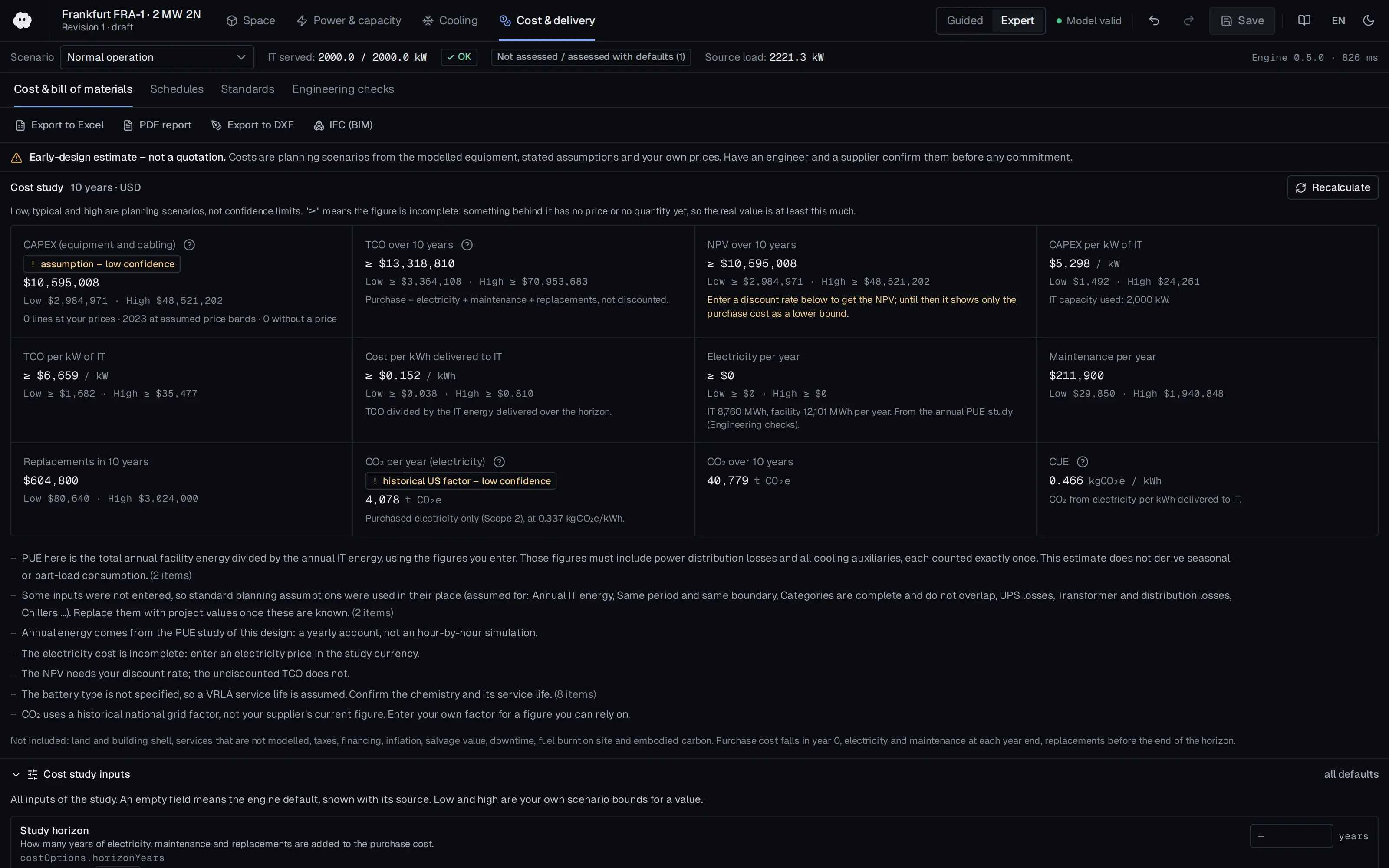
Who should read it
Electrical designers, energy planners and operators evaluating AI data center grid flexibility and non-firm interconnection capacity.
Publication details
- Authors
- Philip Colangelo; Ayse K. Coskun; Jack Megrue; Ciaran Roberts; Shayan Sengupta; Varun Sivaram; Ethan Tiao; Aroon Vijaykar; Chris Williams; Daniel C. Wilson; Zack MacFarland; Daniel Dreiling; Nathan Morey; Anuja Ratnayake; Baskar Vairamohan
- Publisher
- arXiv preprint (Emerald AI / NVIDIA / Salt River Project / EPRI)
- Year
- 2025
- Document number
- arXiv:2507.00909
- Document language
- English
- Source type
- Scientific
- Access
- Free to read
- Licence
- arXiv distribution permission — reuse conditions remain with the rights holder
Original licence note
arXiv default non-exclusive distribution licence; citation only
Citation
Philip Colangelo; Ayse K. Coskun; Jack Megrue; Ciaran Roberts; Shayan Sengupta; Varun Sivaram; Ethan Tiao; Aroon Vijaykar; Chris Williams; Daniel C. Wilson; Zack MacFarland; Daniel Dreiling; Nathan Morey; Anuja Ratnayake; Baskar Vairamohan (2025). Turning AI Data Centers into Grid-Interactive Assets: Results from a Field Demonstration in Phoenix, Arizona. arXiv preprint (Emerald AI / NVIDIA / Salt River Project / EPRI). arXiv:2507.00909. https://doi.org/10.48550/arXiv.2507.00909
Events on this subject
Browse the events calendarAll content and rights belong to the respective authors and publishers. SoSo CAD provides only the citation, its own summary and a link to the source, and is not responsible for the sources' content.
Related sources
All sources on this topic
arXiv preprint (University of Alberta) 2026
To Defer or To Shift? The Role of AI Data Center Flexibility on Grid Interconnection
In large-load interconnection negotiation, present AI load flexibility (a deferral window of up to about 3 hours) as a lever for interconnection capacity and timing; returns diminish beyond 3 hours.
- In the IEEE 14-bus study, data centres on buses connected to congested lines benefit most from geographic load shifting.
arXiv preprint (math.OC), MIT Operations Research Center 2025
Locational Marginal Emissions for Carbon-Aware Data Center Operations in Large-Scale Power Grids
In data-centre carbon accounting, consider hourly locational marginal emissions (LME) rather than an annual-average grid factor; the LME-based intensity (about 672 kgCO2/MWh) was about 3 times the average factor (202).
- Emission rates assumed in the simulated grid: coal 800 kgCO2/MWh, gas 450 kgCO2/MWh, wind/solar/nuclear/hydro 0.
arXiv preprint (cs.SE), Google 2024
Carbon accounting in the Cloud: a methodology for allocating emissions across data center users
In allocating carbon to data-centre users, give idle power to whoever holds the resource allocation and share dynamic power by actual usage; because an idle server draws about 45% of peak power, the idle share is large.
- Resources with equivalent busy power used to weight idle-power allocation: 1 Intel Skylake N1 CPU core = 20 GiB RAM = 1 TiB SSD = 6 TiB HDD.
arXiv preprint (Oklahoma State University / New York University) 2026
Regime-Adaptive Weighted Ensemble Learning for Computing-Driven Dynamic Load Forecasting in AI Data Centers
For operations and grid-interaction features, use regime-aware (idle/ramp/high) minute-resolution IT load forecasting with job-scheduler signals (active jobs) as inputs, rather than only historical kW.
- Relative to the strongest baseline (1D-CNN) the method improves NRMSE by 66.1% and NMAE by 80.2%.
arXiv preprint (Emerald AI / EPRI / National Grid / NVIDIA / Oracle; submitted to IEEE) 2026
Power-Flexible AI Data Centers: A New Paradigm for Grid-Responsive Compute
Add a 'flexible load' profile in the grid-connection module: committed reduction depth (%), response time (s), duration (h) and recovery, derived from the workload priority mix.
- Achieved 100% compliance across 200+ distinct National Grid power events on a 130 kW cluster of NVIDIA Blackwell Ultra GPUs.
arXiv preprint (Microsoft Azure) 2023
POLCA: Power Oversubscription in LLM Cloud Providers
In the power planner, apply different diversity and oversubscription factors by workload: inference rows can be provisioned below sum-of-nameplate (for example peak about 80% of provisioned), while training rows should assume near-coincident peaks with only about 10% headroom.
- POLCA allows 30% more servers in the same inference GPU cluster while maintaining SLOs.