
Sustainable Supercomputing for AI: GPU Power Capping at HPC Scale
Proceedings of the 2023 ACM Symposium on Cloud Computing (ACM) · Dan Zhao, Siddharth Samsi et al.
A vision paper analysing the effect of a system-wide GPU power cap (60% of peak) at the MIT supercomputing center, which runs nodes with two V100 GPUs each, using more than 123,000 GPU jobs, about 19,700 of them power-capped.
CC BY 4.0 — share with attribution
On this page
Overview
As research and deployment of AI grows, the computational burden to support it grows too; to train or fine-tune state-of-the-art language models some form of AI hardware acceleration is virtually a requirement. The paper studies the aggregate effect of power-capping GPUs on GPU temperature and power draw. A 60% power cap was deployed on GPUs at an academic supercomputing center. The dataset covers 123,204 GPU jobs, of which 19,676 were subject to power caps; the cluster consists of 224 nodes with two NVIDIA V100 GPUs each.
The authors apply hypothesis tests and average-treatment-effect estimates to compare capped and uncapped jobs. The estimated average treatment effect of power capping was a reduction of about 10 W in per-job GPU power draw and 4.78 °C in mean GPU temperature (95% CI -4.93 to -4.62 °C). Power-capped jobs show a smaller and more stable range of temperature fluctuations than uncapped jobs. Prior work cited: capping a model at 150 W (60% of peak) required 8.5% additional compute time but saved 12.5% of energy; another cluster capped GPUs from 400 W to 225 W while preserving 90% of performance.
The authors argue that power caps can extend hardware life and amortise embodied carbon, but warn that users may submit extra jobs to compensate for slowdowns and so erode the energy savings.
Limits: observational job-level telemetry; because capped and uncapped jobs were not randomly assigned, causal inference is limited even with matching and bias mitigation. A single centre and GPU generation (V100); results do not transfer directly to newer GPUs.
Key points
- A 60% power cap was deployed on GPUs at an academic supercomputing center.
- The dataset covers 123,204 GPU jobs, of which 19,676 were subject to power caps; the cluster consists of 224 nodes with two NVIDIA V100 GPUs each.
- Prior work cited: capping a model at 150 W (60% of peak) required 8.5% additional compute time but saved 12.5% of energy; another cluster capped GPUs from 400 W to 225 W while preserving 90% of performance.
- The estimated average treatment effect of power capping was a reduction of about 10 W in per-job GPU power draw and 4.78 °C in mean GPU temperature (95% CI -4.93 to -4.62 °C).
- Power-capped jobs show a smaller and more stable range of temperature fluctuations than uncapped jobs.
Using it in design
- Consider a GPU power cap (for example 60% of peak) as a control in capacity and cooling planning: about 10 W per job and a 4.78 °C lower mean temperature were reported.
- Verify the performance cost of a cap (cited: 8.5% extra time for 12.5% energy saving) per workload, and allow for savings being eroded if users submit extra jobs to compensate.
- Add the potential of more stable temperatures to extend hardware life and amortise embodied carbon to the life-cycle cost calculation.
Monthly newsletter · free
Keep your reading list current
Once a month: new library sources, changes to Turkish regulations and upcoming data centre events.
SoSo CAD
Compare the cost of design decisions
Evaluate equipment costs, energy expenses and total cost of ownership (TCO) using your inputs and assumptions in SoSo CAD.
Request a demo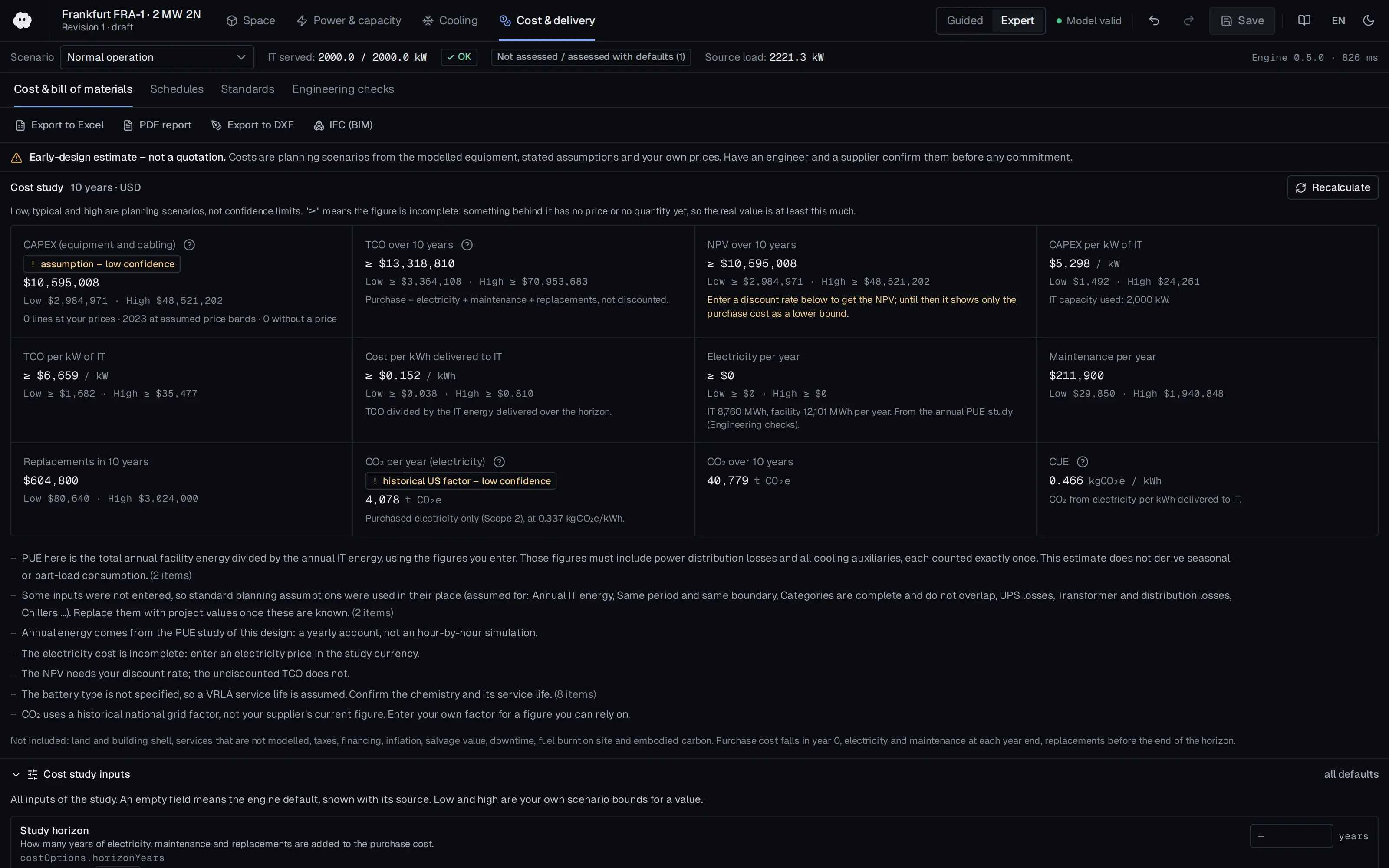
Who should read it
Operators and researchers setting GPU cluster energy and temperature management and sustainable HPC policies.
Document contents
- I. Introduction
- II. Related Work
- III. Data & Methodology (A. An Empirical Analysis of Power Capping, B. Hypothesis Testing & Inference, C. Average Treatment Effect (ATE) Estimation, D. Bias Mitigation & Matching for ATE, E. Performance Impact)
- IV. Discussion and Vision
- V. Conclusion
Read the document
gpu-power-capping-hpc-scale-2023.pdf
CC BY 4.0 — share with attribution
The document is provided unaltered because its licence permits redistribution.
Publication details
- Authors
- Dan Zhao; Siddharth Samsi; Joseph McDonald; Baolin Li; David Bestor; Michael Jones; Devesh Tiwari; Vijay Gadepally
- Publisher
- Proceedings of the 2023 ACM Symposium on Cloud Computing (ACM)
- Year
- 2023
- Document number
- arXiv:2402.18593
- Pages
- 588-596
- Document language
- English
- Source type
- Scientific
- Access
- Open licence — downloadable
- Licence
- CC BY 4.0 — share with attribution
- Licence evidence
- arxiv.org
Original licence note
arXiv version licensed http://creativecommons.org/licenses/by/4.0/ (checked via arXiv OAI-PMH); arXiv PDF is the redistributed file
Citation
Dan Zhao; Siddharth Samsi; Joseph McDonald; Baolin Li; David Bestor; Michael Jones; Devesh Tiwari; Vijay Gadepally (2023). Sustainable Supercomputing for AI: GPU Power Capping at HPC Scale. Proceedings of the 2023 ACM Symposium on Cloud Computing (ACM). arXiv:2402.18593. 588-596. https://doi.org/10.1145/3620678.3624793
Events on this subject
- Hannover Messe
- SC26 – International Conference for High Performance Computing, Networking, Storage and Analysis
- iMasons Climate Accord Summit
All content and rights belong to the respective authors and publishers. SoSo CAD provides only the citation, its own summary and a link to the source, and is not responsible for the sources' content.
Related sources
All sources on this topicUptime Institute 2025
Uptime Institute Global Data Center Survey 2025 (15th annual) — press release and public highlights
Use PUE 1.54 as the 'industry average' line on the efficiency dashboard, year-stamped and user-overridable
- Survey run April-May 2025 with 800+ respondents
arXiv preprint (Microsoft Azure) 2023
POLCA: Power Oversubscription in LLM Cloud Providers
In the power planner, apply different diversity and oversubscription factors by workload: inference rows can be provisioned below sum-of-nameplate (for example peak about 80% of provisioned), while training rows should assume near-coincident peaks with only about 10% headroom.
- POLCA allows 30% more servers in the same inference GPU cluster while maintaining SLOs.
Schneider Electric 2011
Determining Total Cost of Ownership for Data Center and Network Room Infrastructure
Have the TCO engine report cost per rack and per kW over a user-selectable life (default 10 years) and split capex from opex.
- Model basis: 100 kW capacity, 10-year life.
IEEE Access (Institute of Electrical and Electronics Engineers (IEEE)) 2026
Review of the 800-VDC Power Delivery Architecture and Isolated 800-V to 48-V Converter Solutions for Future AI Data Centers
Define 800 VDC unipolar, ±400 VDC bipolar and 48/54 VDC busbar as separate voltage classes in the single-line diagram, each with its own conductor ampacity, breaker pole count and clearance (IEC 60664-1) checks.
- The OCP Open Rack V3 PSU specification targets above 97.5% peak efficiency and at least 96.5% across 30%-100% load.
arXiv preprint (University of Alberta) 2026
To Defer or To Shift? The Role of AI Data Center Flexibility on Grid Interconnection
In large-load interconnection negotiation, present AI load flexibility (a deferral window of up to about 3 hours) as a lever for interconnection capacity and timing; returns diminish beyond 3 hours.
- In the IEEE 14-bus study, data centres on buses connected to congested lines benefit most from geographic load shifting.
IEEE Open Journal of Power Electronics (Institute of Electrical and Electronics Engineers (IEEE)) 2026
State-of-the-Art Power Electronics in AI Data Centers
In rack power templates, model PSU count per shelf and the 33 kW shelf limit for AC distribution, and check busbar, PDU and cooling impact together for racks that exceed 100 kW with several shelves.
- AI rack density is 30-100+ kW against 7-10 kW for traditional racks; an 8-GPU DGX H100 draws around 10,200 W.