
Information technology - Data centre facilities and infrastructures - Part 31: Key performance indicators for resilience
ISO/IEC · ISO/IEC JTC 1
The 2026 second edition of the technical specification defining KPIs and resilience levels for the resilience, dependability, fault tolerance and availability tolerance of data centre power and environmental-control infrastructure.
On this page
Overview
ISO/IEC TS 22237-31:2026 is the second edition of the technical specification that defines resilience KPIs for data centre infrastructure. It was published on 3 February 2026, runs to 60 pages and revises the first edition of 2023. According to the publisher's abstract, it provides metrics for resilience, dependability, fault tolerance and availability tolerance. This page rests on the publisher's public abstract, not on the full text of the standard.
The scope is data centre infrastructure for power distribution and supply and for environmental control; it can be extended to areas such as cabling. The document defines how these KPIs are measured and calculated, and the resulting resilience levels (RLs). It targets maintainability, recoverability and vulnerability, and includes worked examples for comparing designs. A scope note says it can be extended, so the method is not tied to one fixed list of subsystems.
An important limit is what falls outside the scope: IT equipment, cloud services, software and business applications are not covered. The standard therefore assesses the resilience of the physical facility infrastructure only. Related documents include ISO/IEC 22237-1, EN 50600-4-31 and IEEE 3006.7.
Key points
- Defines KPIs for resilience, dependability, fault tolerance and availability tolerance of data centres.
- Covers power distribution/supply and environmental-control infrastructure; extendable to e.g. cabling.
- Defines measurement and calculation of the KPIs and resilience levels (RLs).
- Targets maintainability, recoverability and vulnerability; includes worked comparison examples.
- Does not apply to IT equipment, cloud services, software or business applications.
- Edition 2 published 3 February 2026 (60 pages); revises the 2023 first edition.
- Related: ISO/IEC 22237-1, EN 50600-4-31, IEEE 3006.7.
Using it in design
- In the reliability module, add a resilience-level calculator that compares alternative power/cooling topologies on maintainability, recoverability and vulnerability.
- Complement redundancy-class checks with a quantitative score.
- When choosing between two designs of the same redundancy class, use the standard's worked comparison examples as the method.
- Apply the assessment to facility infrastructure only; the IT and software layers must be handled separately.
Monthly newsletter · free
Keep your reading list current
Once a month: new library sources, changes to Turkish regulations and upcoming data centre events.
SoSo CAD
Assess redundancy through scenarios
Compare normal operation and equipment failures in SoSo CAD, with supplied loads and capacity shortfalls in one view.
Request a demo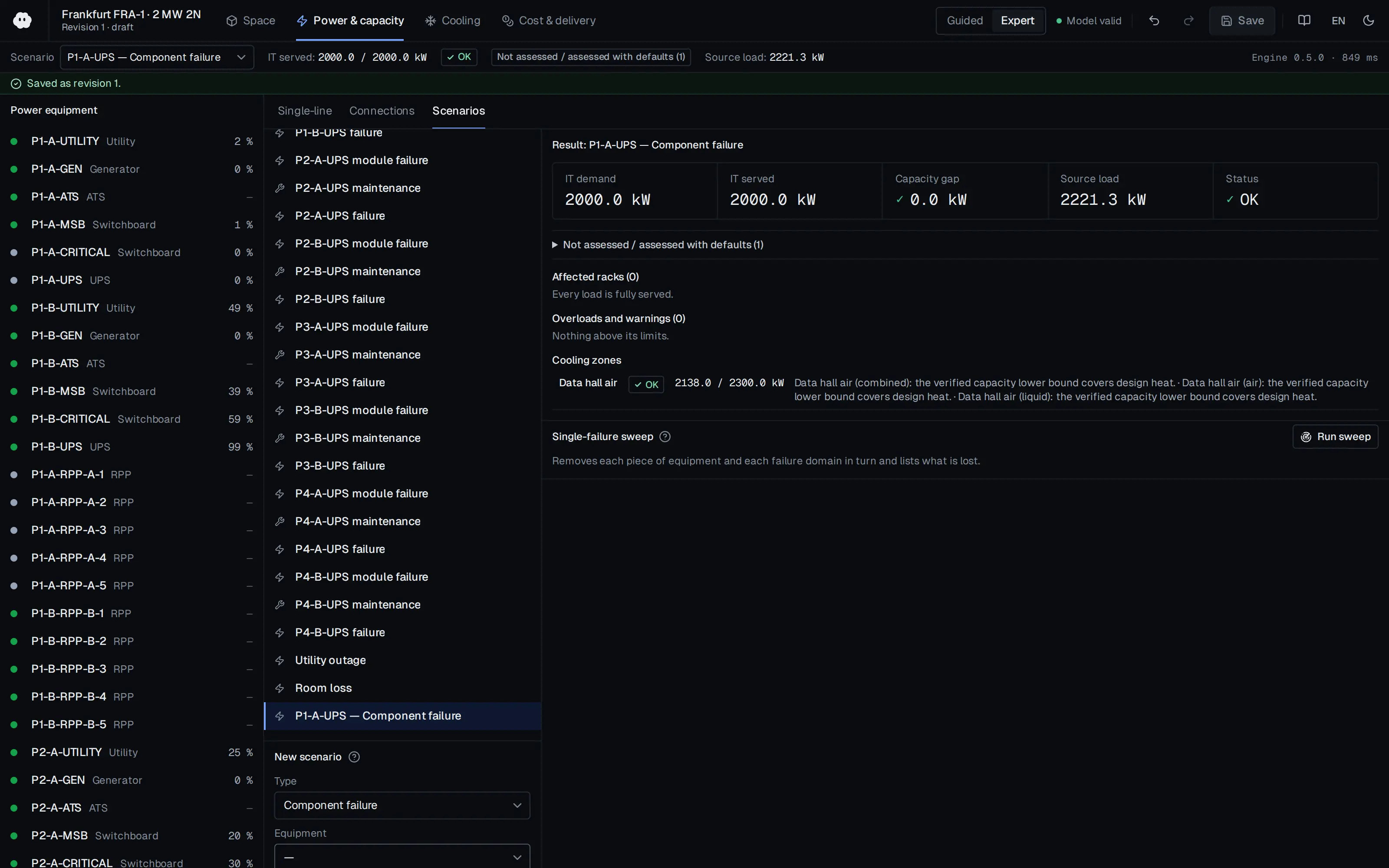
Who should read it
Design engineers comparing power and cooling topologies, and consultants and owners preparing a resilience-class justification.
Related standards
- ISO/IEC 22237-1
- EN 50600-4-31
- IEEE 3006.7
Publication details
- Authors
- ISO/IEC JTC 1
- Publisher
- ISO/IEC
- Year
- 2026
- Document number
- ISO/IEC TS 22237-31:2026
- Document language
- English
- Source type
- Standard
- Access
- Citation only
- Licence
- Copyright retained; citation only — the publisher’s terms apply to the original document
Original licence note
Paid standard. Record built only from the publisher's public catalogue abstract and product metadata; full text not redistributed.
Citation
ISO/IEC JTC 1 (2026). Information technology - Data centre facilities and infrastructures - Part 31: Key performance indicators for resilience. ISO/IEC. ISO/IEC TS 22237-31:2026. https://webstore.iec.ch/en/publication/111919
Events on this subject
Browse the events calendarAll content and rights belong to the respective authors and publishers. SoSo CAD provides only the citation, its own summary and a link to the source, and is not responsible for the sources' content.
Related sources
All sources on this topicTÜV NORD 2026
EN 50600 — data centre facilities and infrastructures (overview and certification)
In an 'EN 50600' standards profile, offer separate availability-class selectors for power, cooling and cabling (instead of a single Tier), plus a protection-class selector per room or zone
- Protection classes 1-4 for unauthorised access and other hazards; physical-security zoning required
International Energy Agency 2025
Energy and AI (World Energy Outlook Special Report)
Use the IEA component split (servers about 60%, storage about 5%, network up to 5%, cooling 7-30%) to sanity-check modelled energy breakdowns.
- The 2035 range across cases is 700-1,700 TWh; the High Efficiency Case is 20% below the Base Case.
U.S. DOE FEMP / NREL 2024
Best Practices Guide for Energy-Efficient Data Center Design (Revised July 2024)
Weigh the supply air setpoint against server fan energy: raise it in small steps within the ASHRAE recommended range so the most demanding inlet nears 80 °F, only after air management is in place, and control to IT inlet temperature rather than return temperature.
- Compute racks reached 60 kW in 2013, and recent liquid-cooled racks exceed 125 kW.
Headquarters, Department of the Army (U.S. Army Corps of Engineers) 2007
TM 5-698-1 Reliability/Availability of Electrical & Mechanical Systems for Command, Control, Communications, Computer, Intelligence, Surveillance and Reconnaissance (C4ISR) Facilities (19 January 2007)
When writing an availability target into a data centre specification, state the measurement interval as well; the same downtime gives 95.83 or 99.86 percent depending on the interval.
- With exponentially distributed failures, reliability at an operating time equal to the MTBF is only about 37 percent (e^-1 = 0.368).
Headquarters, Department of the Army (U.S. Army Corps of Engineers PREP) 2006
TM 5-698-5 Survey of Reliability and Availability Information for Power Distribution, Power Generation, and Heating, Ventilating and Air Conditioning (HVAC) Components for Commercial, Industrial, and Utility Installations (22 July 2006)
When modelling the power and cooling chain use these values as starting failure rates and MTBF/MTTR inputs and convert them into availability with the method of TM 5-698-1.
- Diesel engine generators overall: 0.528 failures/yr, MTBF about 16,590 h, MTTR 24.22 h, operational availability 0.99399.
Uptime Institute Journal 2026
Survey findings link higher redundancy to lower outage risk (Owen Rogers, Douglas Donnellan)
Use these ratios as indicative risk multipliers in an option-comparison view, for example showing relative outage likelihood when switching cooling from N+1 to 2N.
- Power, same comparison: 23%, 37% and 44%.