
Meta: surplus heat to district heating (Odense heat pump installation)
Ramboll
A Ramboll project record for the heat pump plant that recovers surplus heat from Meta's hyperscale data centre in Odense and feeds Fjernvarme Fyn's district heating network.
On this page
Overview
This record describes the heat pump plant that recovers surplus heat from Meta's hyperscale data centre in Odense and feeds Fjernvarme Fyn's district heating network. Ramboll acted as owner's engineer, designing the energy centre, running tenders, managing construction and writing the operating strategy. The page is a consultancy's project showcase and contains no detailed engineering data.
The plant recovers about 215,000 MWh per year from Meta's Tietgenbyen data centre and delivers about 45 MW of heat output to the Odense network. Heat leaves the data centre through a water circuit, above and below ground, to the adjacent ammonia heat pump plant, and Ramboll did the strength calculations for the chilled water pipe network. Large electrically driven ammonia heat pumps raise the temperature to 70-75 C. The plant heats more than 12,000 homes (2023).
The page also covers the policy change and proximity conditions that made the business case work. The Danish surplus-heat tax was abolished from January 2022 for certified businesses. Viability depends on being close to a district heating network, and EU guidance suggests a cost-benefit analysis above 1 MW.
The limit of the document is that it concerns a single project and does not disclose electricity consumption, heat pump coefficient of performance or economic results. The EU Energy Efficiency Directive (EU) 2023/1791 is named as the related regulation. It nonetheless offers a real reference case for key design parameters such as scale, temperature lift and network proximity.
Key points
- About 215,000 MWh/yr is recovered from Meta's Tietgenbyen data centre, with about 45 MW of heat output to the Odense network.
- Large electrically driven ammonia heat pumps raise the temperature to 70-75 C.
- A water circuit (above and below ground) carries heat to the adjacent heat pump plant; Ramboll did strength calculations for the chilled water pipe network.
- The plant heats more than 12,000 homes (2023).
- The Danish surplus-heat tax was abolished from January 2022 for certified businesses.
- Viability depends on proximity to a district heating network; EU guidance suggests cost-benefit analysis above 1 MW.
Using it in design
- Use as a reference case for the heat-export module: default the lift to 70-75 C via ammonia heat pumps.
- Add a distance-to-network input that drives a feasibility warning.
- Trigger a cost-benefit prompt for facilities above 1 MW in EU jurisdictions.
- Define local policy conditions such as a surplus-heat tax as economic analysis inputs.
Monthly newsletter · free
Keep your reading list current
Once a month: new library sources, changes to Turkish regulations and upcoming data centre events.
SoSo CAD
Compare the cost of design decisions
Evaluate equipment costs, energy expenses and total cost of ownership (TCO) using your inputs and assumptions in SoSo CAD.
Request a demo
Who should read it
Designers, developers and energy planners working on heat recovery and district heating integration.
Related standards
- EU Energy Efficiency Directive (EU) 2023/1791
Publication details
- Authors
- Ramboll
- Publisher
- Ramboll
- Year
- 2019
- Document language
- English
- Source type
- Expert / community
- Access
- Free to read
- Licence
- Copyright retained; citation only — the publisher’s terms apply to the original document
Citation
Ramboll (2019). Meta: surplus heat to district heating (Odense heat pump installation). Ramboll. https://www.ramboll.com/projects/energy/meta-surplus-heat-to-district-heating
Events on this subject
Browse the events calendarAll content and rights belong to the respective authors and publishers. SoSo CAD provides only the citation, its own summary and a link to the source, and is not responsible for the sources' content.
Related sources
All sources on this topic
Energies (MDPI AG) 2026
Smart Reuse of Waste Heat from Data Centres: Energy and Exergy Analysis for a District-Heating Network in Bulgaria
Set data-centre setpoints (air temperature, free-cooling threshold) together with waste-heat sales: warmer setpoints and more free cooling cut cooling electricity by about 45% but also cut recoverable heat to about 45%.
- Centralised DH heat pumps are cited as giving COP 3-5 for supply temperatures up to 70-80 °C.
Open Compute Project Foundation 2026
Guidelines: Impact of Strategies on Data Center Energy Consumption, Carbon Footprint, and Water Consumption (March 2026)
Evaluate cooling and siting options on energy, carbon, site water and water scarcity together, not on PUE or WUE alone.
- Same example: emissions fall from 3,500 to 2,700 t CO2/yr with the carbon factor of 0.26 kg CO2/kWh.
Buildings (MDPI AG) 2025
Energy Performance Study of a Data Center Combined Cooling System Integrated with Heat Storage and Waste Heat Recovery System
Assess heat recovery from chilled-water return with a water-source heat pump and hot-water storage in annual-hour simulation; match the winter and summer outlet temperature difference (45 and 30 °C) to the user's need.
- Free natural-resource cooling covers about 28% of the cooling demand.
European Commission JRC 2025
2025 Best Practice Guidelines for the EU Code of Conduct on Data Centre Energy Efficiency (JRC141521, EUR 40267)
Design the facility to operate within the ASHRAE Class A2 allowable range and require A2 operation within warranty in IT procurement; plan separate environmental zones (practice 5.3.4) for legacy equipment.
- IT equipment AC/DC power converters should be rated at 90% efficiency or better across expected load ranges.
Open Compute Project Foundation 2025
Reference Designs for Data Center Heat Reuse, Revision 1.0
Provide a heat-recovery-station block in the site layout with space sized from capacity (plate HX footprint, 10 m2 per MW for heat pumps, about 43 m3 per MW per 30 minutes of storage) and a demarcation boundary to the heat host.
- ORC heat-to-power converts less than 4% of the heat to electricity at these low temperatures.
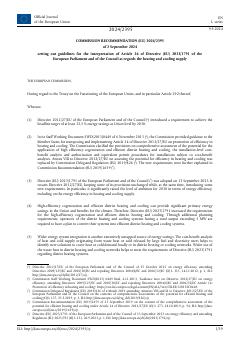
European Commission 2024
Commission Recommendation (EU) 2024/2395 of 2 September 2024 setting out guidelines for the interpretation of Article 26 of Directive (EU) 2023/1791 as regards heating and cooling supply requirements
When testing the 1 MW waste heat threshold, compute "total rated energy input" from rated capacity (for example utility connection or rated IT plus infrastructure), not modelled annual energy, and take the measurement point at the handover of electricity supply.
- CBA thresholds: thermal electricity generation 10 MW, industrial installation 8 MW, service facility 7 MW, data centre 1 MW.