
SCARIF: Towards Carbon Modeling of Cloud Servers with Accelerators
arXiv preprint (cs.DC) · Shixin Ji, Zhuoping Yang et al.
A preprint that builds a linear embodied-carbon model for servers from 96 Dell, HP and Lenovo product carbon footprint reports and scales it to servers with GPU or FPGA accelerators.
On this page
Overview
The authors collected 96 vendor product-carbon-footprint reports for servers from Dell, HP and Lenovo, all produced with the PAIA LCA tool, and built a linear model of embodied carbon. It predicts a server's embodied carbon from total CPU core count, SSD, HDD and memory capacity, and release year. Bottom-up tools such as ACT leave out mainboard PCBs, connectors, PSUs, chassis and other peripherals, so they underestimate whole-server embodied carbon several-fold.
In vendor reports covering a 4- or 5-year lifetime, the operational share of server life-cycle carbon is 70.2-90.2 percent (Dell), 66.2-93.7 percent (HP) and 39.4-97.0 percent (Lenovo); the manufacturing share is 9.5-27.7, 5.4-28.4 and 2.9-59.5 percent. Transport and end-of-life are usually below 1 percent. The SCARIF model is E = K1*#CPU cores + K2*SSD_GB + K3*HDD_GB + K4*Mem_GB + K5*(year-2000) + D, with K1 = 5.01 kgCO2e per core, K2 = 0.16, K3 = 0.04, K4 = 0.95 kgCO2e/GB, K5 = 83.08 kgCO2e/year and D = -1100 on HP data.
In validation, predictions fall within 0.4 sigma of Dell's reported values for 37 servers, with an average error within 0.15 sigma; the average error on 40 Lenovo reports is 50 percent. For a Dell R740, ACT and the vendor PAIA LCA differ 2.26x in total; components ACT omits add 136.3 kgCO2e, and the mainboard PWB alone is 108.68 kgCO2e. An R740 with 2x Xeon 8180, 1 TB HDD and 64 GB memory has 1993.72 kgCO2e embodied, or 2158.53 kgCO2e with one V100 GPU.
In the case study, the carbon breakeven for upgrading R740+V100 to R750+A100 is 4.2 years (TX), 4.6 (AZ), 7.8 (CA) and 9.8 (NY), using grid intensities of 0.438, 0.395, 0.234 and 0.188 kgCO2e/kWh; this exceeds the roughly 4-year vendor lifetime. ACT's lower embodied estimate would give a breakeven under 1 year and reverse the decision. The document is a preprint, not peer reviewed, and the model is an approximate estimate from vendor data; the error is large on Lenovo data.
Key points
- In vendor reports, the operational share is 70.2-90.2 percent (Dell), 66.2-93.7 percent (HP) and 39.4-97.0 percent (Lenovo); transport and end-of-life are usually below 1 percent.
- Total embodied carbon of the highest/lowest servers: Dell 1782/1133, HP 3880/423, Lenovo 15593/585 kgCO2e.
- SCARIF: K1 = 5.01 kgCO2e per core, K2 = 0.16 (SSD), K3 = 0.04 (HDD), K4 = 0.95 (memory) kgCO2e/GB, K5 = 83.08 kgCO2e/year, D = -1100 on HP data.
- Validation: within 0.4 sigma of Dell's reported values for 37 servers, average error within 0.15 sigma; average error on 40 Lenovo reports is 50 percent.
- For a Dell R740, ACT and the vendor PAIA LCA differ 2.26x; omitted components add 136.3 kgCO2e, the mainboard PWB alone is 108.68 kgCO2e.
- Breakeven for upgrading R740+V100 to R750+A100 is 4.2 (TX), 4.6 (AZ), 7.8 (CA) and 9.8 (NY) years, exceeding the roughly 4-year vendor lifetime.
Using it in design
- Add an embodied-carbon estimator per server SKU using the SCARIF linear model (5.01 kg per CPU core, 0.16 kg/GB SSD, 0.04 kg/GB HDD, 0.95 kg/GB DRAM, 83.08 kg x (year-2000), intercept -1100), and tag the result as an approximate, vendor-calibrated value.
- Let vendor PCF report values override the estimate.
- Include a refresh-breakeven calculator that weighs a new server's embodied carbon against its annual energy savings at the site's grid intensity, and warn when breakeven exceeds the planned server lifetime.
- Warn users that chip-only (ACT-style) estimates can understate whole-server embodied carbon by more than 2x.
Monthly newsletter · free
Keep your reading list current
Once a month: new library sources, changes to Turkish regulations and upcoming data centre events.
SoSo CAD
Compare the cost of design decisions
Evaluate equipment costs, energy expenses and total cost of ownership (TCO) using your inputs and assumptions in SoSo CAD.
Request a demo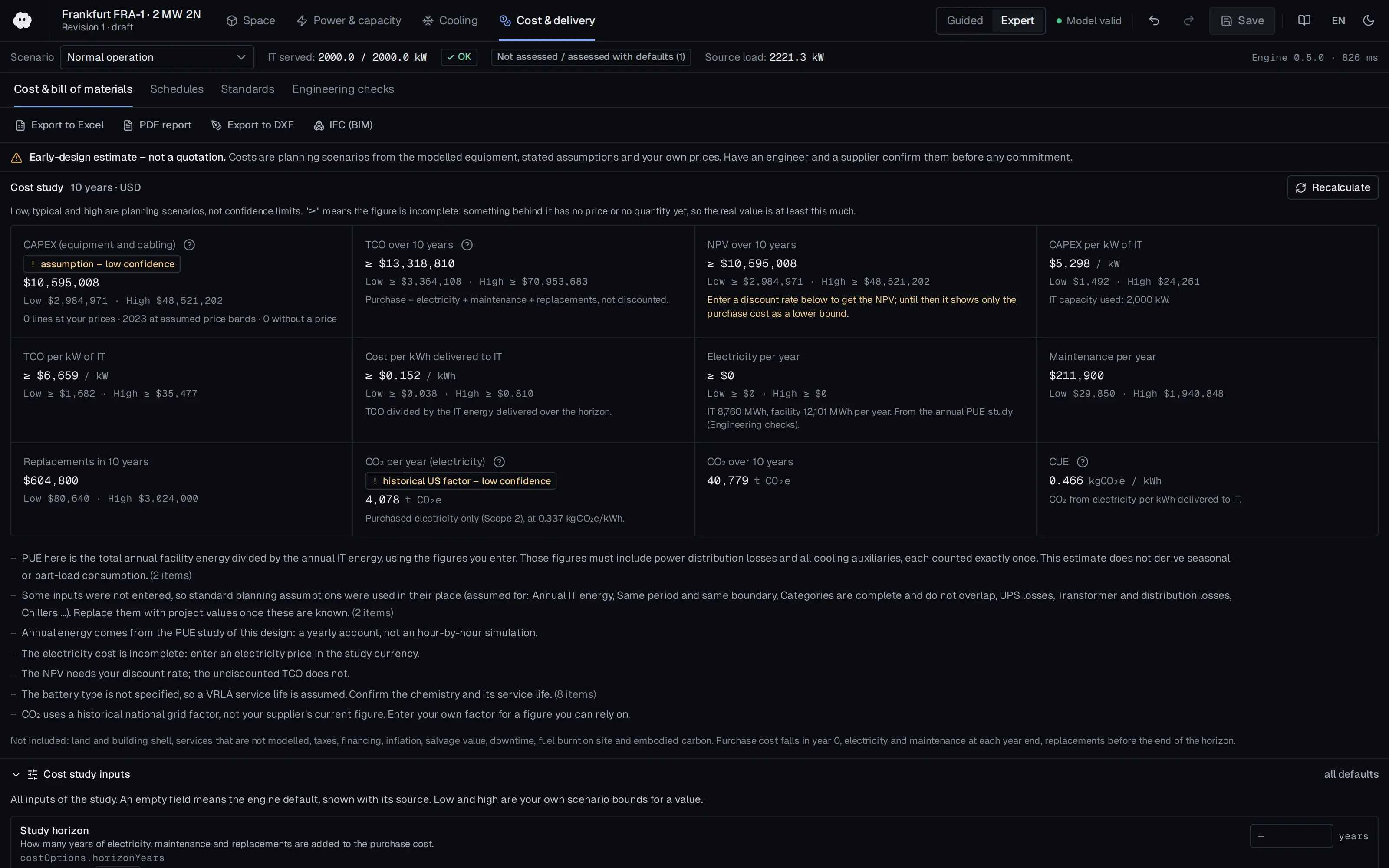
Who should read it
Sustainability and capacity planning engineers weighing embodied carbon in server refresh decisions and Scope 3 accounting.
Publication details
- Authors
- Shixin Ji; Zhuoping Yang; Xingzhen Chen; Stephen Cahoon; Jingtong Hu; Yiyu Shi; Alex K. Jones; Peipei Zhou
- Publisher
- arXiv preprint (cs.DC)
- Year
- 2024
- Document number
- arXiv:2401.06270
- Document language
- English
- Source type
- Scientific
- Access
- Free to read
- Licence
- arXiv distribution permission — reuse conditions remain with the rights holder
Original licence note
arXiv default non-exclusive licence; not redistributable.
Citation
Shixin Ji; Zhuoping Yang; Xingzhen Chen; Stephen Cahoon; Jingtong Hu; Yiyu Shi; Alex K. Jones; Peipei Zhou (2024). SCARIF: Towards Carbon Modeling of Cloud Servers with Accelerators. arXiv preprint (cs.DC). arXiv:2401.06270. https://doi.org/10.48550/arXiv.2401.06270
Events on this subject
- Data Centre World Frankfurt
- Datacloud Global Congress
- SC26 – International Conference for High Performance Computing, Networking, Storage and Analysis
All content and rights belong to the respective authors and publishers. SoSo CAD provides only the citation, its own summary and a link to the source, and is not responsible for the sources' content.
Related sources
All sources on this topic
European Commission JRC 2020
Development of the EU Green Public Procurement (GPP) Criteria for Data Centres, Server Rooms and Cloud Services - Final Technical Report (JRC118558, EUR 30251 EN, 2020)
Ask in the specification for a designed PUE (dPUE) at a stated IT load (for example 50%) and conditions, under ISO/IEC 30134-2 or EN 50600-4-2, and write PUE demonstration at handover and the commissioning test into the contract.
- ASHRAE liquid cooling classes cited: W1 2-17 °C, W2 2-27 °C, W3 2-32 °C, W4 2-45 °C, W5 above 45 °C.
Open Compute Project Foundation 2025
Data Center Evolution: Powering the AI Revolution Sustainably (OCP EMEA Summit 2025 keynote, Madhusudan Iyengar)
Rack catalogue entries should carry a distribution-voltage attribute (48 VDC, +/-400 VDC, AC); flag 48 V in-rack designs above roughly 150 kW per rack as needing a sidecar or higher-voltage DC architecture.
- Related: OCP Open Rack V3, OCP Diablo 400 (Mt Diablo) power rack.
ACM SIGEnergy Energy Informatics Review (Association for Computing Machinery (ACM)) 2023
The Dirty Secret of SSDs: Embodied Carbon
In the storage catalogue, store embodied carbon per drive SKU: a default of 0.16 kgCO2e/GB for SSD (Tannu and Nair SEF) and a much lower HDD default.
- Server emissions are concentrated in the operational phase, whereas about 80% of an iPhone's emissions come from manufacturing.
Schneider Electric 2022
Best Practices to Deploy Sustainable and Resilient Data Centers at Scale at the Network Edge
Add site type (legacy telco, distributed cloud, MEC), environment class and power type (AC, -48 V DC, hybrid) to the project template.
- Harsh environments may need NEMA 4 and IP 65 enclosures.
Vertiv 2021
Understanding Data Center Liquid Cooling Options and Infrastructure Requirements
Rule: rack kW > 20 suggests containment plus in-row cooling or rear-door heat exchangers; rack kW > 30-40 recommends liquid.
- Single CDUs are available above 1 MW
arXiv preprint (cs.CY; formatted for ACM e-Energy '26) 2026
Beyond PUE: A Local-Impact Audit Framework for Data Center Environmental Accountability
In siting and community-acceptance files, present PUE, WUE and CUE together with regional water stress, grid headroom and verification maturity (L0-L4); back project commitments with contractual limits and independent metering (L2-L3).
- Compliance gate: any unresolved major regulatory violation caps the composite score at a ceiling of 40 (suggested, subject to calibration).