
Accounting and Tax Benefits of Modular, Portable Data Center Infrastructure
Schneider Electric · Barry Rimler
Schneider Electric WP 115 (Barry Rimler, 2011) looks at the accounting and property-tax side of choosing factory-built modular power infrastructure over field-wired systems, from a US viewpoint. It is not tax advice.
On this page
Overview
The core argument: field-built UPS and PDU systems are usually booked as building or leasehold improvements. Building assets may carry a depreciable life upwards of 30+ years, while DCPI such as UPS and PDUs has a much shorter useful life. That inflates taxable real property and forces write-downs when equipment retires early. Example: a legacy UPS depreciated over 30 years and scrapped after 15 years faces a write-down of 50% of its original value.
Factory-built, cord-connected systems can often be treated as business equipment (personal property) with shorter lives, may avoid permit and inspection fees, and can sit on the computer-room floor without a dedicated UPS room. Inspection fees are usually 2%-3% of the value of the field-constructed portion of a contractor's contract. Avoiding a separate UPS room saves construction cost of roughly $18 to $35 per square foot in office buildings and well beyond $75 per square foot in medium and large standalone data centres. Base rents can range between $19 and $50 per square foot plus taxes, utilities and common areas, so a separate UPS room with aisles is disproportionately expensive except in larger installations.
A seven-step asset-management process ends in cost segregation: 5, 7, 10, 15 and 20 year property is separated from 30 or 39 year property to qualify for accelerated depreciation, and assets must pass the function-and-use and inherent-permanency tests. Tax and tax-related savings can exceed 20% of installed cost for a properly sized and booked factory-built UPS and PDU solution.
Key points
- Building assets may depreciate over 30+ years; DCPI such as UPS and PDUs has a much shorter useful life.
- A UPS depreciated over 30 years and scrapped at 15 faces a write-down of 50% of original value.
- Inspection fees are usually 2%-3% of the field-constructed portion of the contract.
- Avoiding a UPS room saves about $18-35/ft2 in offices and well over $75/ft2 in standalone data centres.
- Base rents of $19-50/ft2 plus taxes, utilities and common areas.
- Cost segregation separates 5/7/10/15/20 year property from 30 or 39 year property.
- Savings can exceed 20% of installed cost for a properly sized and booked factory-built solution.
Using it in design
- Add UPS placement (dedicated_ups_room, white_space) to the TCO module and charge room construction ($/ft2 or $/m2, editable by building type) plus occupancy cost for a dedicated room.
- Add an asset class (building_improvement vs business_equipment) and depreciation life per item so stranded-asset write-down can be estimated when refresh cycles are shorter than depreciation life.
- Apply a permit/inspection fee percentage only to field-built scope.
- Label all tax outputs as indicative and jurisdiction-specific.
Monthly newsletter · free
Keep your reading list current
Once a month: new library sources, changes to Turkish regulations and upcoming data centre events.
SoSo CAD
Review your power design in SoSo CAD
Inspect supply paths, equipment loads and UPS failure scenarios in one model.
Request a demo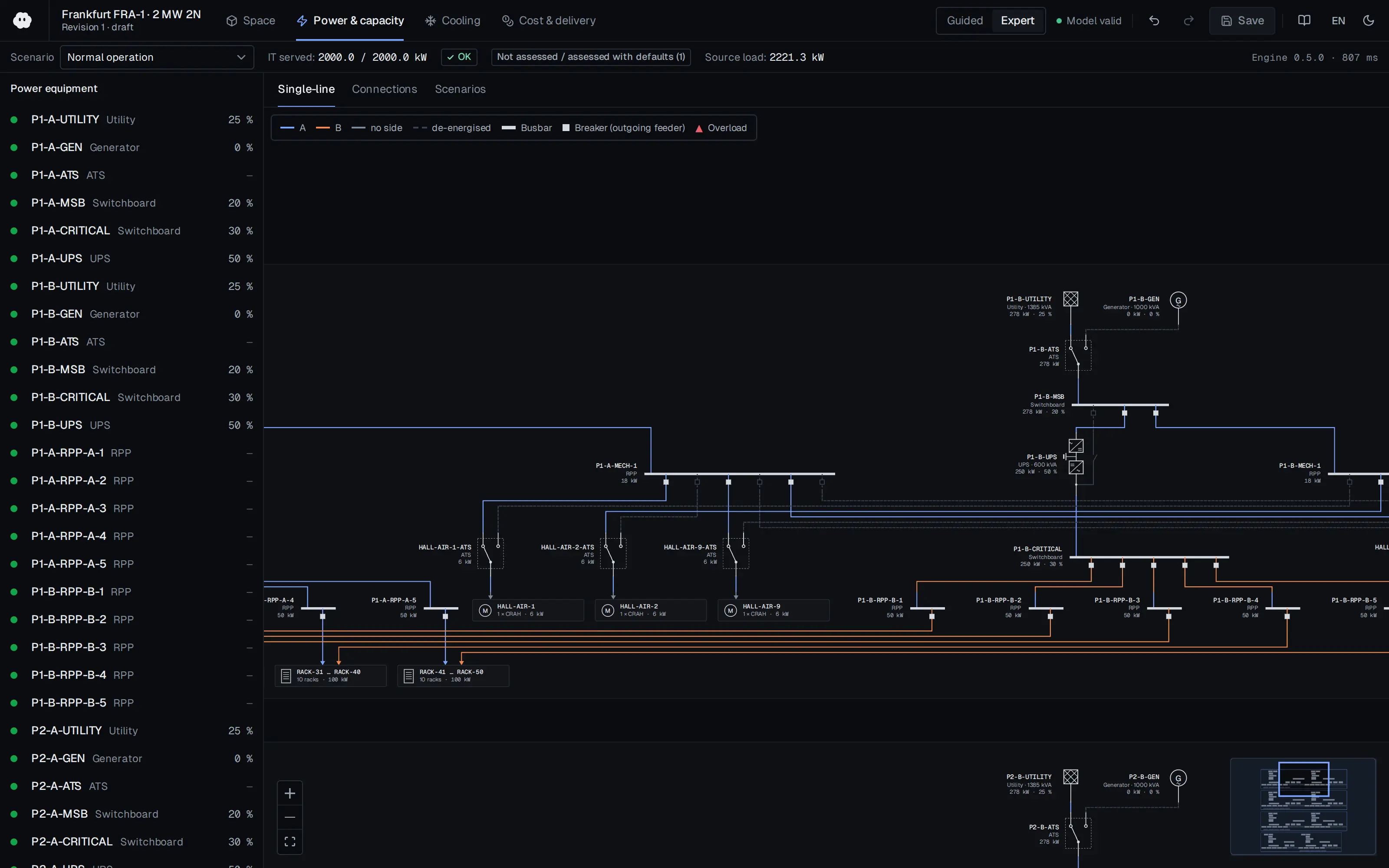
Who should read it
Designers, finance and corporate real-estate teams assessing infrastructure investment in TCO and asset-class terms.
Publication details
- Authors
- Barry Rimler
- Publisher
- Schneider Electric
- Year
- 2011
- Document number
- WP 115
- Document language
- English
- Source type
- Manufacturer
- Access
- Free to read
- Licence
- Copyright retained; citation only — the publisher’s terms apply to the original document
Citation
Barry Rimler (2011). Accounting and Tax Benefits of Modular, Portable Data Center Infrastructure. Schneider Electric. WP 115. https://download.schneider-electric.com/files?p_Doc_Ref=SPD_BRIR-5Z5T7P_EN
Events on this subject
Browse the events calendarAll content and rights belong to the respective authors and publishers. SoSo CAD provides only the citation, its own summary and a link to the source, and is not responsible for the sources' content.
Related sources
All sources on this topicSchneider Electric 2022
Best Practices to Deploy Sustainable and Resilient Data Centers at Scale at the Network Edge
Add site type (legacy telco, distributed cloud, MEC), environment class and power type (AC, -48 V DC, hybrid) to the project template.
- Harsh environments may need NEMA 4 and IP 65 enclosures.
Schneider Electric 2020
Industry 4.0: Minimizing Downtime Risk with Resilient Edge Computing
Add a processCoupling flag (in_series, in_parallel) to edge sites; for in_series default the availability target to Tier III equivalent and require redundant UPS/cooling (N+1 or 2N) plus maintenance bypass.
- Tier 1 edge IT: 99.67%, 28.82 h/yr, $38.7M loss.
Open Compute Project Foundation 2026
Interface Specification Between Hyperscalers and Utility Grid for Disturbance Performance (Version 1.0.0)
For a new site, write the POI LVRT/HVRT envelope and the PFAPR requirement (90% within 2 s) as design criteria, and settle which voltage measurement (line-to-neutral or line-to-line) governs during protection coordination with the utility.
- In ERCOT NOGRR 282, cooling load is subtracted from the pre-fault load used to judge PFAPR.

U.S. DoD (UFC) 2021
UFC 3-600-01, Fire Protection Engineering for Facilities (8 August 2016, Change 6, 6 May 2021)
Build the data hall protection concept in this order: very early warning smoke detection, wet-pipe sprinklers throughout, clean agent only as an addition, and state in the specification that clean agent cannot replace the sprinklers.
- Stand-alone telecommunication facilities over 2,500 ft2 (232 m2) need clean agent or sprinklers; over 7,500 ft2 (696 m2) sprinklers are required and clean agent may only be added.
FEMA 2014
FEMA P-1019, Emergency Power Systems for Critical Facilities: A Best Practices Approach to Improving Reliability (September 2014)
At critical-facility data centers, place generators, ATS, fuel tanks and pumps above the greatest of BFE + 3 ft, DFE + 1 ft and 500-year elevation + 1 ft, and prefer elevation to dry floodproofing.
- Generators over 300 kW are almost exclusively diesel-fueled.
ABB 2026
Next-Generation Medium-Voltage Architecture for AI Data Centers
For loads above roughly 30-50 MW add a grid-code compliance checklist (LVRT duration, frequency band, RoCoF, PF) and let users choose LV-UPS versus MV-UPS architecture.
- BESS blocks 0.6-21.6 MW with 1, 2 or 4 h durations