
Tier Standard: Operational Sustainability
Uptime Institute
The companion Tier standard covering the site-management behaviours and risks, beyond topology, that determine a data centre's long-term performance. Gold, Silver and Bronze are the scale for operational certification.
On this page
Overview
Operational Sustainability complements Tier Standard: Topology and addresses what design alone cannot settle: how the facility is run. The current edition took effect on 1 April 2013. It removed the 'bonus behaviors'; some were eliminated outright and others were made mandatory for Tier III and IV. Practices once treated as optional are therefore now required at the upper Tiers. The standard is built from elements that unify management behaviours (staffing, maintenance, training, planning) with Tier functionality. The aim is to stop a site with excellent topology from suffering outages because of weak operations.
Operational certification is expressed as Gold, Silver or Bronze, which grades operating maturity rather than giving a binary pass or fail. The source is a short public abstract; the download requires a form and the full text was not read. Individual behaviour criteria, scoring weights and rating thresholds are therefore not given here. The page's value lies in its positioning: it makes explicit that a Tier IV design and a Tier IV outcome are not the same thing, and that the second depends on operations.
Other Uptime material supports this emphasis: most human-error outages stem from procedures not being followed or being flawed. This standard is the remedy side of that problem, making the staffing model, maintenance programme, training and procedures a subject of certification. The split with the Topology standard is clean: Topology decides which redundant components and paths exist, while Operational Sustainability covers the staffing, maintenance and training regime under which that hardware is run. The 2013 edition moved this second layer out of optional bonus points and made it a condition at the upper Tiers.
Key points
- Current edition effective 1 April 2013
- 'Bonus behaviors' removed: either eliminated or made required for Tier III/IV
- Operational ratings are Gold, Silver and Bronze
- Elements unify management behaviours (staffing, maintenance, training, planning) with Tier functionality
- Complements the Topology standard by covering factors outside the design
- Full text is behind a form; only the public abstract was used
Using it in design
- Build an operational-readiness score in the operations module: staffing model (24x7 on-site for Tier III/IV intent), maintenance programme (PM schedule, CMMS), training/qualification and procedures (MOP/SOP/EOP)
- Show that score as a dimension separate from topology so users do not equate a Tier IV design with a Tier IV outcome
- Weight operational readiness heavily in risk scoring
- Add the behaviour requirements that become mandatory at the upper Tiers to the project checklist
Monthly newsletter · free
Keep your reading list current
Once a month: new library sources, changes to Turkish regulations and upcoming data centre events.
SoSo CAD
Assess redundancy through scenarios
Compare normal operation and equipment failures in SoSo CAD, with supplied loads and capacity shortfalls in one view.
Request a demo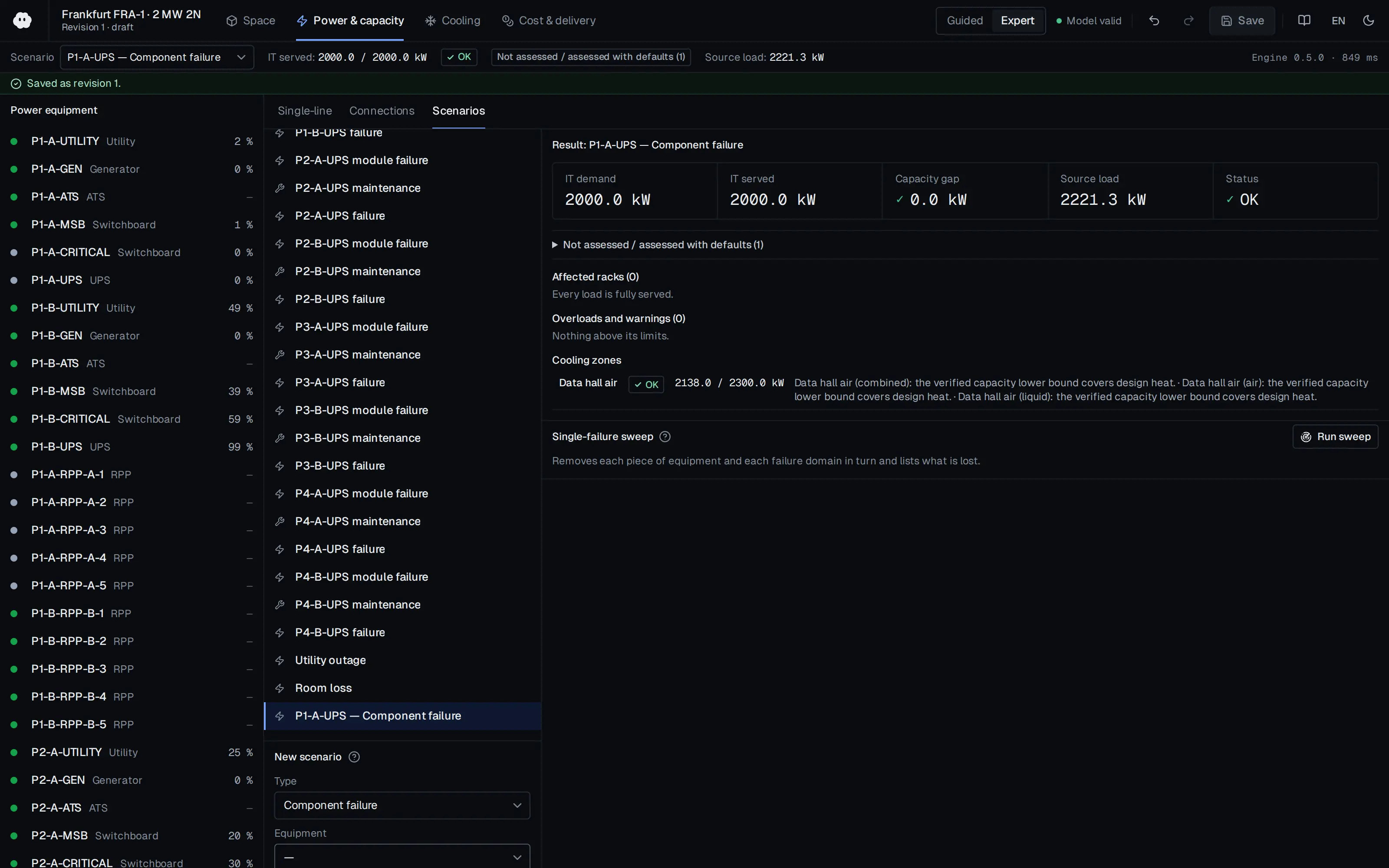
Who should read it
Data-centre operations managers, owners considering Tier operational certification, and product teams designing an operations module.
Related standards
- Uptime Tier Standard: Topology
- EN 50600-3-1
Publication details
- Authors
- Uptime Institute
- Publisher
- Uptime Institute
- Year
- 2013
- Document language
- English
- Source type
- Industry body
- Access
- Citation only
- Licence
- Copyright retained; citation only — the publisher’s terms apply to the original document
Citation
Uptime Institute (2013). Tier Standard: Operational Sustainability. Uptime Institute. https://uptimeinstitute.com/publications/asset/tier-standard-operational-sustainability
Events on this subject
Browse the events calendarAll content and rights belong to the respective authors and publishers. SoSo CAD provides only the citation, its own summary and a link to the source, and is not responsible for the sources' content.