
United States Data Center Energy Usage Report: 2025 Update
Lawrence Berkeley National Laboratory · Sarah Josephine Smith, Alex Hubbard et al.
An update of LBNL's bottom-up estimate of US data center electricity use, giving a 2030 reference case and AI sensitivity cases.
On this page
Overview
This report is the update of the Lawrence Berkeley National Laboratory's (LBNL) 2024 estimate of US data center electricity use. Its authors include Sarah Josephine Smith, Alex Hubbard, Alexander Newkirk, Mohan Ganeshalingam, Billie Holecek, Dale A. Sartor, Michael Mills and Arman Shehabi.
The method is bottom-up: it builds from IT equipment shipments, per-device energy use, cooling simulations, and facility types and locations. This structure shows that the estimate is derived from hardware- and facility-level assumptions and not from an aggregate statistic. The report also projects 2030 consumption and enriches it with sensitivity cases for AI chip shipments, chip lifetime, and AI server idle power and utilisation.
In the reference case, US data center electricity in 2030 is 649 TWh, about 11.8% of US electricity. The scenario range is 9.5%-15.3% of US electricity by 2030, compared with 6.7%-12.0% for 2028 in the 2024 report. Higher idle power and utilization for AI servers give 782 TWh, and lower installations give 578 TWh. The combined uncertainty range for 2030 is 521-843 TWh.
As a limit, the results are specific to the United States, and the 2030 projections depend on assumptions, such as AI hardware shipments, that carry large uncertainty; the wide range reflects this. The record holds only the figures in the abstract, with the detailed method and data tables in the full text of the report. The report gives sector-level context for load growth and grid demand narratives.
Key points
- Reference case: 649 TWh of US data center electricity in 2030, about 11.8% of US electricity.
- Scenario range 9.5%-15.3% of US electricity by 2030 (2024 report: 6.7%-12.0% for 2028).
- Higher idle power and utilization for AI servers gives 782 TWh.
- Lower installations give 578 TWh.
- Combined uncertainty range for 2030 is 521-843 TWh.
- Method is bottom-up: IT shipments, per-device energy, cooling simulations, facility types and locations.
- Sensitivity cases: AI chip shipments, chip lifetime, AI server idle power and utilisation.
Using it in design
- Use the 2030 ranges as context in load-growth and grid-request narratives.
- The AI-server idle-power sensitivity supports modelling GPU idle draw explicitly rather than assuming proportional power.
- Label the figures as US-specific; do not apply them directly to estimates for other countries.
Monthly newsletter · free
Keep your reading list current
Once a month: new library sources, changes to Turkish regulations and upcoming data centre events.
SoSo CAD
Compare the cost of design decisions
Evaluate equipment costs, energy expenses and total cost of ownership (TCO) using your inputs and assumptions in SoSo CAD.
Request a demo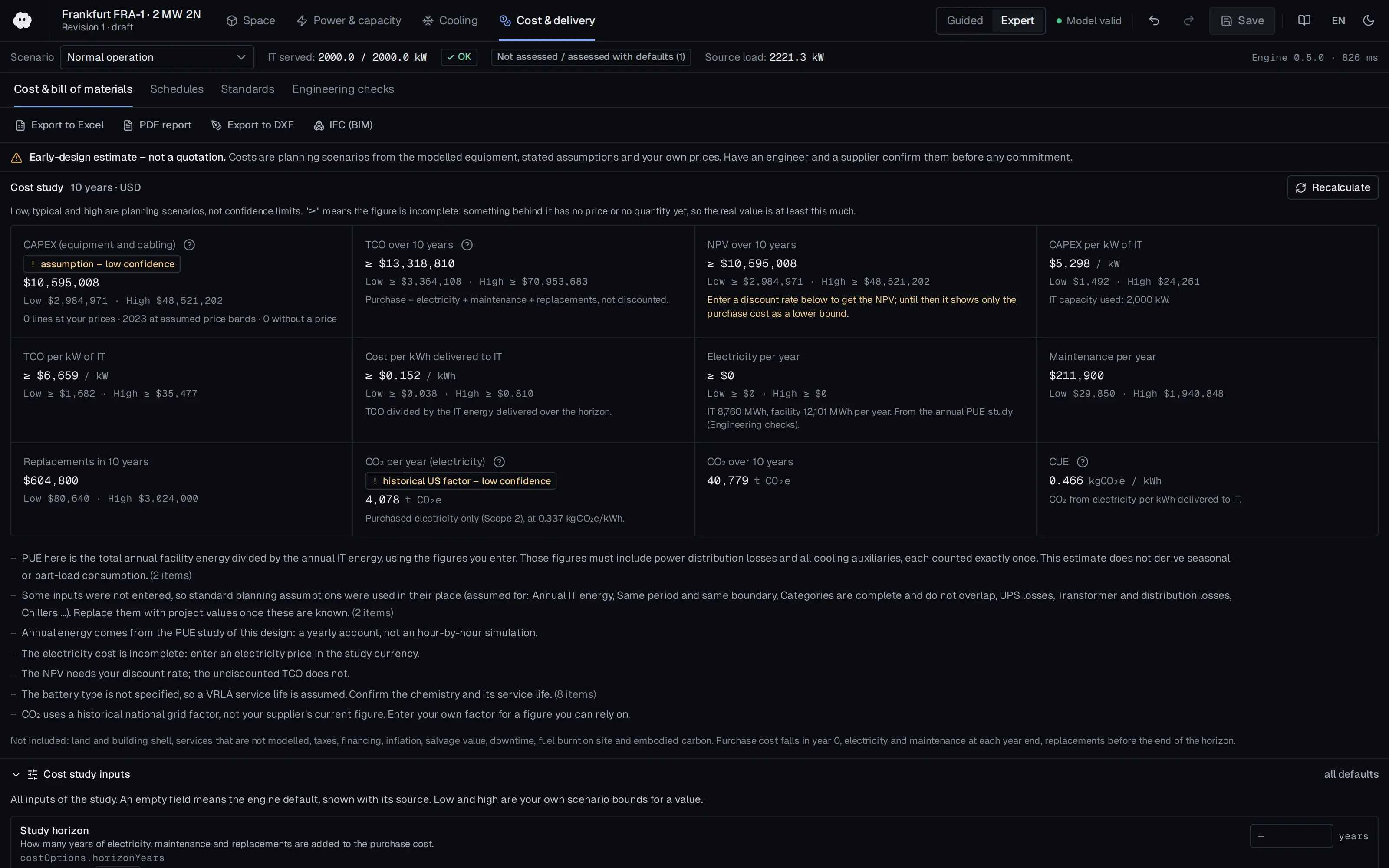
Who should read it
Designers, energy analysts and decision makers planning data center load growth and grid demand.
Related standards
- LBNL 2024 US Data Center Energy Usage Report
Publication details
- Authors
- Sarah Josephine Smith; Alex Hubbard; Alexander Newkirk; Mohan Ganeshalingam; Billie Holecek; Dale A. Sartor; Michael Mills; Arman Shehabi
- Publisher
- Lawrence Berkeley National Laboratory
- Year
- 2026
- Document language
- English
- Source type
- Government / public
- Access
- Free to read
- Licence
- Copyright retained; citation only — the publisher’s terms apply to the original document
Original licence note
LBNL (contractor-operated DOE laboratory) resource; not US-Gov public domain. Cited only.
Citation
Sarah Josephine Smith; Alex Hubbard; Alexander Newkirk; Mohan Ganeshalingam; Billie Holecek; Dale A. Sartor; Michael Mills; Arman Shehabi (2026). United States Data Center Energy Usage Report: 2025 Update. Lawrence Berkeley National Laboratory. https://escholarship.org/uc/item/33m6w3x0
Events on this subject
Browse the events calendarAll content and rights belong to the respective authors and publishers. SoSo CAD provides only the citation, its own summary and a link to the source, and is not responsible for the sources' content.
Related sources
All sources on this topicLawrence Berkeley National Laboratory 2024
2024 United States Data Center Energy Usage Report (LBNL-2001637, December 2024)
Take AI rack and node power assumptions (3.4 to 12.2 kW per 8-GPU server, 20% idle) as a cross-check on IT load models, not as a substitute for vendor data.
- U.S. data centers used about 76 TWh (1.9% of U.S. electricity) in 2018 and 176 TWh (4.4%) in 2023.
Lawrence Berkeley National Laboratory 2016
United States Data Center Energy Usage Report (LBNL-1005775, June 2016)
Use the space-type PUE table as a sanity check on early-stage PUE assumptions, remembering these are 2014 national averages, not design targets.
- Electricity use grew about 4% over 2010-2014, versus about 24% over 2005-2010 and nearly 90% over 2000-2005.
arXiv preprint (cs.AI), Harvard T.H. Chan School of Public Health 2026
Assessing the Carbon Emissions and Energy Consumption of U.S. Hyperscale Data Centers
In fleet or facility energy estimation, use capacity × 8,760 × facility-load coefficient (0.48-0.70, central 0.58) and report the range (67.7-98.6 TWh) explicitly.
- State-level intensities (central scenario): Virginia 535, Oregon 440, Iowa 645, Nebraska 740, Wyoming 1035 gCO2/kWh; Virginia had 142 HDCs, 21.0 TWh, 11.5 Mt.
Applied Energy (Elsevier BV) 2025
Accounting carbon emissions from electricity generation: a review and comparison of emission factor-based methods
In data-centre carbon accounting, state the method (Tier 1, 2, 3) and factor source (IPCC or national) when choosing a grid emission factor; simple methods can underestimate generation emissions by about 73%.
- AEF for the North zone by Method 5 rose from 0.1627 tCO2/MWh in 2016 to 0.4709 in 2022, then fell to 0.3936 in 2023.
European Commission, DG Energy 2025
Assessment of the energy performance and sustainability of data centres in EU - First technical report (July 2025)
Compare your design PUE target with the real EU spread: 1.21 on average above 10 MW, 1.55 at 1-2 MW; set a realistic bound for your facility size.
- Rule of thumb cited: PUE below 1.2 excellent, 1.2-1.5 good, above 1.5 room for improvement.
European Commission JRC 2025
2025 Best Practice Guidelines for the EU Code of Conduct on Data Centre Energy Efficiency (JRC141521, EUR 40267)
Design the facility to operate within the ASHRAE Class A2 allowable range and require A2 operation within warranty in IT procurement; plan separate environmental zones (practice 5.3.4) for legacy equipment.
- IT equipment AC/DC power converters should be rated at 90% efficiency or better across expected load ranges.