
Fundamentals of Managing the Data Center Life Cycle for Owners
Schneider Electric · Patrick Donovan
This 2013 Schneider Electric white paper gives owners an overview of the five-phase data center life cycle (plan, design, build, operate, assess): what each phase should produce, who takes part and where projects go wrong.
On this page
Overview
The plan phase should fix six project parameters (criticality, capacity, growth plan, efficiency, density, budget) and develop a system concept before site selection or detailed design. Site evaluation should start only after the system concept is agreed, because a site chosen early may not meet the eventual design requirements.
Design proceeds through schematic, design-development and construction-document stages. A well-managed design phase takes about 4-6 weeks under design/build and about 8-10 weeks under design/bid/build. Documentation is commonly issued at 10% (schematic), 50% (design development) and 100% (construction documents) completion, with contractor bidding at each level under design/bid/build.
The build phase ends only when QA confirms completion, a certificate of completion is issued, commissioning has passed (if in scope) and the owner gives a formal acceptance letter. Commissioning is described as integrated system-level testing rather than equipment start-up, and should yield three documents: an as-built script report (pass/fail per line), a component error log report and a trending report.
The operate phase is the longest and costliest, often lasting 10, 15 or even 20 years. Assessment rests on KPIs that are collected continuously, tabulated monthly and formally reviewed quarterly, each with defined target, acceptable and failure levels.
Key points
- The plan phase fixes six parameters: criticality, capacity, growth plan, efficiency, density, budget.
- Site evaluation should begin only after the system concept is agreed.
- Design takes about 4-6 weeks under design/build and 8-10 weeks under design/bid/build.
- Documentation is issued at 10%, 50% and 100% completion.
- Build completion needs QA confirmation, a certificate of completion, passed commissioning and an owner acceptance letter.
- Commissioning yields three documents: as-built script report, component error log, trending report.
- The operate phase often lasts 10, 15 or 20 years.
- KPIs are collected continuously, tabulated monthly and reviewed quarterly.
Using it in design
- Model a project as plan -> design -> build -> operate/assess and gate site selection behind the six completed requirements, warning if a site is chosen before they are set.
- Track design deliverable maturity (10/50/100%) as a project field.
- In the commissioning module, generate placeholders for the three Cx outputs and require a 'Cx passed' flag before marking build complete.
- Include as-built drawings, sequence of operations and equipment manuals in the handover export.
Monthly newsletter · free
Keep your reading list current
Once a month: new library sources, changes to Turkish regulations and upcoming data centre events.
SoSo CAD
Assess redundancy through scenarios
Compare normal operation and equipment failures in SoSo CAD, with supplied loads and capacity shortfalls in one view.
Request a demo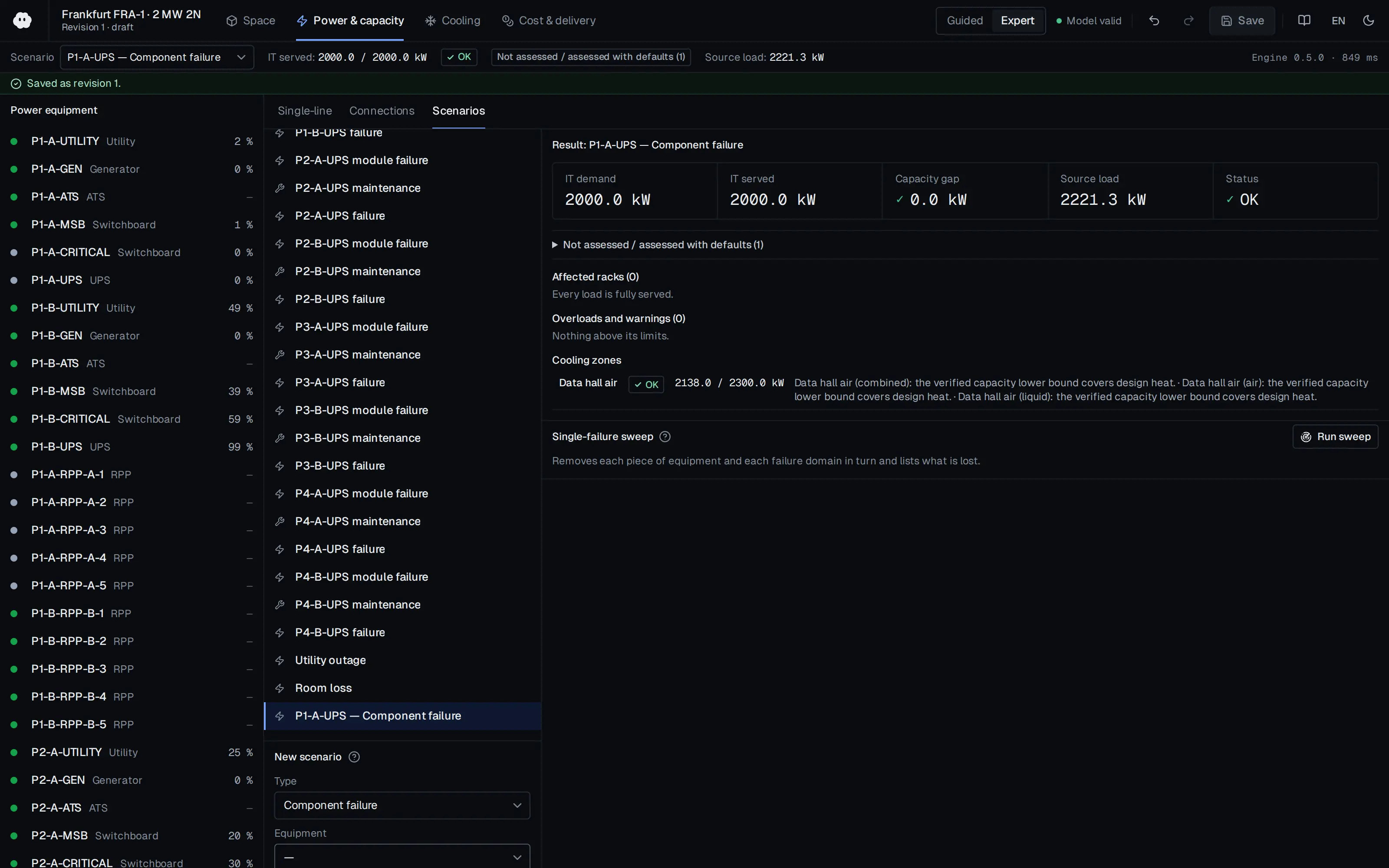
Who should read it
Owners and project managers running a data center project from plan to operation.
Related standards
- ASHRAE Guideline 0
- EN 50600-1
- Uptime Institute Tier Standard: Operational Sustainability
Publication details
- Authors
- Patrick Donovan
- Publisher
- Schneider Electric
- Year
- 2013
- Document number
- WP 195
- Document language
- English
- Source type
- Manufacturer
- Access
- Free to read
- Licence
- Copyright retained; citation only — the publisher’s terms apply to the original document
Citation
Patrick Donovan (2013). Fundamentals of Managing the Data Center Life Cycle for Owners. Schneider Electric. WP 195. https://download.schneider-electric.com/files?p_Doc_Ref=SPD_PDON-936Q38_EN
Events on this subject
Browse the events calendarAll content and rights belong to the respective authors and publishers. SoSo CAD provides only the citation, its own summary and a link to the source, and is not responsible for the sources' content.