
Scaling AI-Enabled Digital Twins Across the Data Center Lifecycle with OpenUSD
Schneider Electric · Kevin Brown, Alison Matte
Schneider Electric WP 302 (2026) is a position paper explaining why Schneider backs OpenUSD-based, AI-enabled digital twin platforms such as NVIDIA Omniverse for data centres.
On this page
Overview
The authors argue that current twin and DCIM-type tools are point solutions limited by proprietary data models, fragmented scope, inconsistent fidelity and missing logical constructs such as redundancy zones and operating modes. A data centre "scene" captures what exists (assets and logical constructs), how it is connected (topology and dependencies), what it means (semantics and intent) and how it behaves (operating states and constraints). A USD representation gives identity, structure, spatial context and relationships only; a SimReady representation adds the validated semantics, physical properties and behaviour (control, protection logic, dynamics) needed for physics simulation and AI.
A shared OpenUSD scene is meant to keep asset identity, semantics and design intent intact from planning through operations, with domain tools such as DCIM, BMS, EPMS and ETAP remaining the systems of record. Higher fidelity is not automatically more valuable: for early planning (site capacity, land constraints) rack-level airflow or breaker-setting detail adds no value. An example co-simulation use case assesses a rack density increase simultaneously for transformer heating, breaker loading, coolant loop, airflow dynamics and SLA risk.
Design intent (density limits, redundancy intent, control philosophies, risk tolerances) should stay embedded so operations can be checked against tier or availability assumptions even without alarms. For construction and commissioning the paper proposes simulation-first validation, including electronic site acceptance testing (e-SAT) and pre-energization verification. Other use cases are AI-generated fault scenarios, synthetic training data, copilots and brownfield retrofits. The authors themselves say lifecycle-scale adoption is still early.
Key points
- A scene captures four things: what exists, how it is connected, what it means, how it behaves.
- USD gives identity, structure, spatial context and relationships; SimReady adds validated semantics, physical properties and behaviour.
- Traditional models often omit redundancy zones, operating modes and workload groupings.
- Higher fidelity is not always more valuable; early planning gains nothing from rack airflow or breaker-setting detail.
- Co-simulation example: a rack density increase assessed for transformer, breaker, coolant loop, airflow and SLA risk at once.
- Design intent should stay embedded so operations can be checked against tier assumptions even without alarms.
- Simulation-first validation for construction and commissioning: e-SAT and pre-energization verification.
- Domain tools (DCIM, BMS, EPMS, ETAP) remain systems of record; adoption is still early per the authors.
Using it in design
- Keep design intent as first-class, exportable data: redundancy zones, operating modes, density limits, tier target and control philosophy attached to the model, not notes.
- Model logical constructs such as redundancy zone and workload group alongside physical assets.
- Offer an OpenUSD (.usd/.usda) export of geometry and topology with stable asset IDs and semantic type tags, and mark catalog items with a simReady level (geometry_only, usd_semantic, sim_ready).
- Fit model fidelity to the phase, allowing coarse block models in early planning without forcing rack airflow or breaker-setting detail.
Monthly newsletter · free
Keep your reading list current
Once a month: new library sources, changes to Turkish regulations and upcoming data centre events.
SoSo CAD
Assess redundancy through scenarios
Compare normal operation and equipment failures in SoSo CAD, with supplied loads and capacity shortfalls in one view.
Request a demo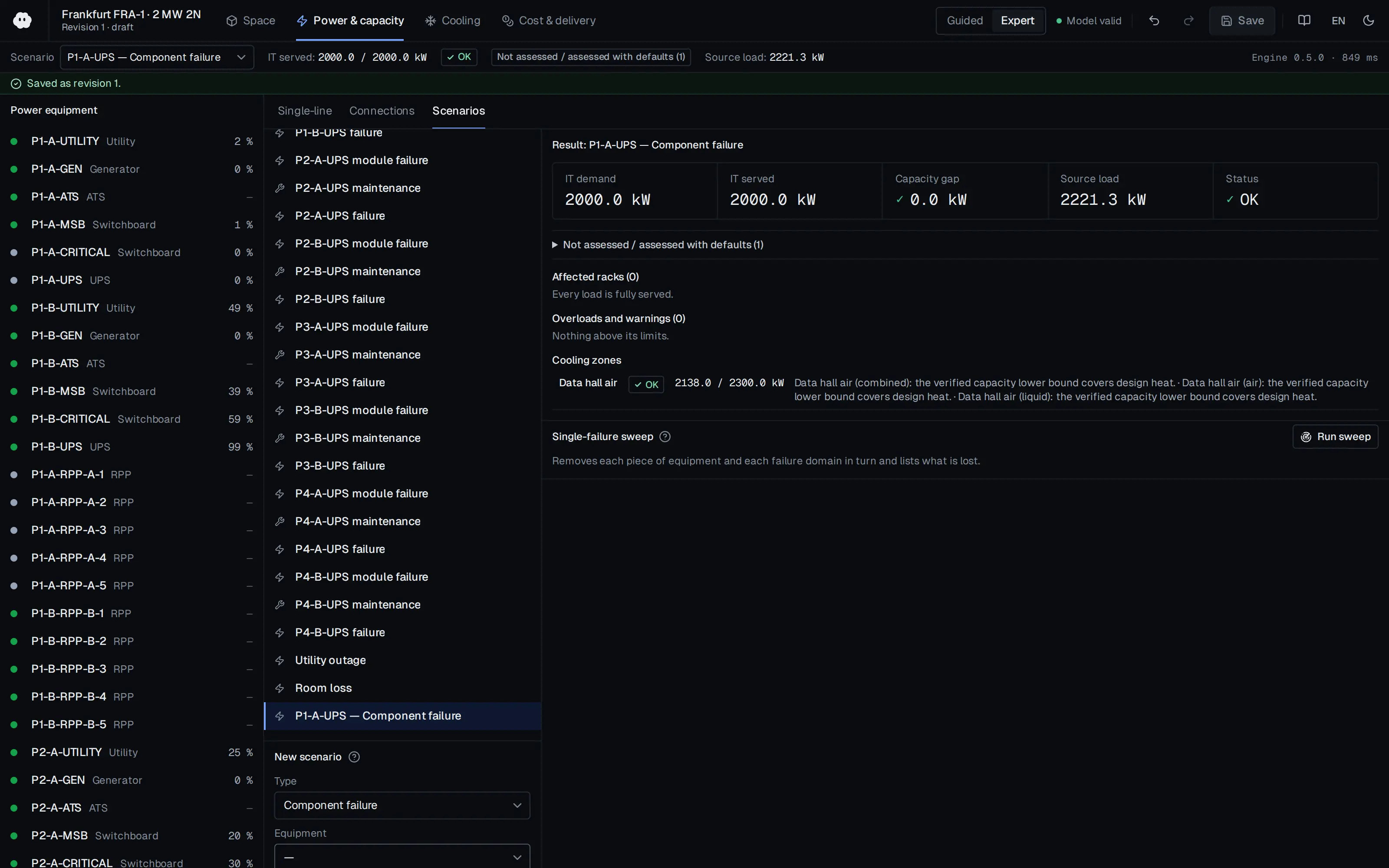
Who should read it
Data-centre owners building a digital-twin strategy and engineers planning how design data carries into operations.
Related standards
- OpenUSD (Alliance for OpenUSD)
Publication details
- Authors
- Kevin Brown; Alison Matte
- Publisher
- Schneider Electric
- Year
- 2026
- Document number
- WP 302
- Document language
- English
- Source type
- Manufacturer
- Access
- Free to read
- Licence
- Copyright retained; citation only — the publisher’s terms apply to the original document
Citation
Kevin Brown; Alison Matte (2026). Scaling AI-Enabled Digital Twins Across the Data Center Lifecycle with OpenUSD. Schneider Electric. WP 302. https://download.schneider-electric.com/files?p_Doc_Ref=SPD_WP302_EN
Events on this subject
Browse the events calendarAll content and rights belong to the respective authors and publishers. SoSo CAD provides only the citation, its own summary and a link to the source, and is not responsible for the sources' content.