
Uptime Institute 2016 Data Center Industry Survey (6th annual) - press release
Uptime Institute
The press release for Uptime Institute's sixth annual survey, summarising the shift of enterprise workloads to cloud and colocation and the risks of colocation contracts.
On this page
Overview
This document is the press release announcing the results of Uptime Institute's sixth annual data center industry survey. Its focus is the move of enterprise workloads out of owned facilities into cloud and colocation, together with how satisfied customers are with colocation contracts and what risks those contracts carry. It is a short public summary of industry trends rather than a technical design guide.
The survey was run by email in February 2016 and reached over 1,000 data center operators and IT practitioners. The release reports that enterprise IT budgets are stagnating and that 55% of enterprise-managed server footprints are flat or shrinking. Among senior enterprise IT executives, 50% expect most IT workloads to reside off-premise, in cloud or colocation, in the future.
The most notable finding is that outsourcing does not remove risk. Nearly one third of enterprise respondents had experienced an outage at a colocation vendor's site. More than 60% said their SLA penalty clause would not adequately offset the cost of an outage to the business. In other words, contractual compensation is not proportional to the real business loss.
The limits are plain. This is a press release, with no raw data or methodology appendix, the respondent pool may not represent the whole industry, and the figures date from 2016. Even so, as an early baseline for a long-running survey series, it is useful for showing how outage risk should be framed in colocation and tenant scenarios.
Key points
- Survey conducted by email in February 2016 with over 1,000 data center operators and IT practitioners.
- 50% of senior enterprise IT executives expect most IT workloads to sit off-premise in cloud or colocation.
- Nearly one third of enterprise respondents had an outage at a colocation vendor site.
- Over 60% said the SLA penalty clause would not offset the business cost of an outage.
- 55% of enterprise-managed server footprints are flat or shrinking.
- Enterprise IT budgets are stagnant; the survey focused on the cloud/colocation shift and contract satisfaction.
Using it in design
- In colocation or tenant scenarios, state explicitly that SLA credits rarely cover outage cost.
- In the risk and cost module, value downtime separately from contractual penalties.
- Do not present outsourcing as a risk-free option; include the probability of an outage at the provider site in scenarios.
- Use this document as a baseline reference for tracking change across the long-running survey series.
Monthly newsletter · free
Keep your reading list current
Once a month: new library sources, changes to Turkish regulations and upcoming data centre events.
SoSo CAD
Assess redundancy through scenarios
Compare normal operation and equipment failures in SoSo CAD, with supplied loads and capacity shortfalls in one view.
Request a demo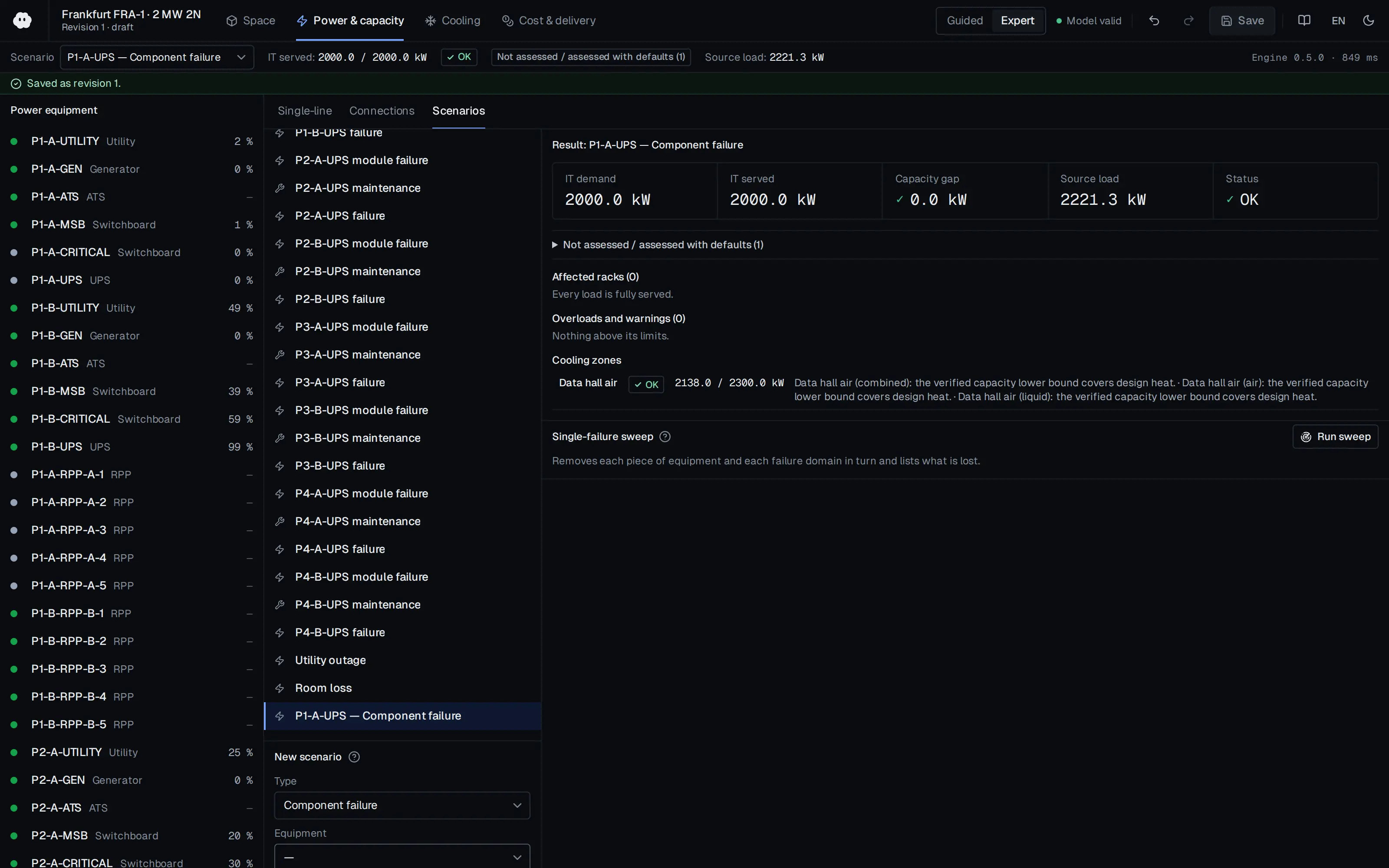
Who should read it
Decision makers choosing colocation, tenant-side IT managers and design engineers who model outage risk.
Publication details
- Authors
- Uptime Institute
- Publisher
- Uptime Institute
- Year
- 2016
- Document language
- English
- Source type
- Industry body
- Access
- Free to read
- Licence
- Copyright retained; citation only — the publisher’s terms apply to the original document
Original licence note
Publisher press release / public web page; copyright Uptime Institute, no open licence. Citation only.
Citation
Uptime Institute (2016). Uptime Institute 2016 Data Center Industry Survey (6th annual) - press release. Uptime Institute. https://uptimeinstitute.com/about-ui/press-releases/2016-survey-results
Events on this subject
Browse the events calendarAll content and rights belong to the respective authors and publishers. SoSo CAD provides only the citation, its own summary and a link to the source, and is not responsible for the sources' content.