
Uptime Institute 2017 Data Center Industry Survey (7th annual) - press release
Uptime Institute
The May 2017 release of Uptime Institute's seventh annual survey: enterprise-owned data centres still host most IT assets, and IT-level resiliency has not replaced physical site redundancy.
On this page
Overview
This document is the press release for Uptime Institute's seventh annual data centre industry survey, published in May 2017. The survey was conducted by email in early 2017 and drew on more than 1,000 data centre and IT professionals. The release is a short summary of headline findings rather than a full research report, so it offers little on breakdowns, sample composition or methodological detail.
The first finding is that the share of workloads in enterprise-owned and operated data centres has held steady at 65 percent since 2014. Respondents reported placing about two-thirds of their IT assets in their own facilities, 22 percent in colocation and 13 percent in the cloud. In other words, although cloud and colocation are growing, in-house facilities remain the main computing venue for these organisations.
On resilience, the survey shows that 68 percent rely on IT-based resiliency such as multi-site live failover. Even so, 73 percent are not deploying lower-redundancy physical sites. Distributed IT architecture is therefore not treated as a way to economise on electrical and cooling redundancy at each site; the two layers are handled as complementary measures rather than substitutes.
The release also highlights a gap in operational maturity: although 90 percent of organisations conduct root cause analysis of IT outages, only 60 percent measure the cost of downtime as a business metric. The main limitation is that this is a press release, with no method detail, margins of error or question wording. The results are best read as an indicator of industry trends, not as a design standard.
Key points
- The survey was run by email in early 2017 and reached more than 1,000 data centre and IT professionals.
- The share of workloads in enterprise-owned data centres has stayed at 65 percent since 2014.
- About two-thirds of IT assets sit in own data centres, 22 percent in colocation and 13 percent in the cloud.
- 68 percent rely on IT-based resiliency (multi-site live failover).
- 73 percent are not deploying lower-redundancy physical sites despite IT-level resiliency.
- 90 percent run root cause analysis of IT outages, but only 60 percent measure downtime cost as a business metric.
Using it in design
- Offer a 'distributed / IT-level resiliency' option in the redundancy selector, but do not automatically downgrade site topology because of it.
- Add a downtime-cost input to every design comparison so that redundancy spending can be justified against it.
- Take the split between in-house, colocation and cloud as a project input and assess per facility whether physical redundancy is still needed.
Monthly newsletter · free
Keep your reading list current
Once a month: new library sources, changes to Turkish regulations and upcoming data centre events.
SoSo CAD
Assess redundancy through scenarios
Compare normal operation and equipment failures in SoSo CAD, with supplied loads and capacity shortfalls in one view.
Request a demo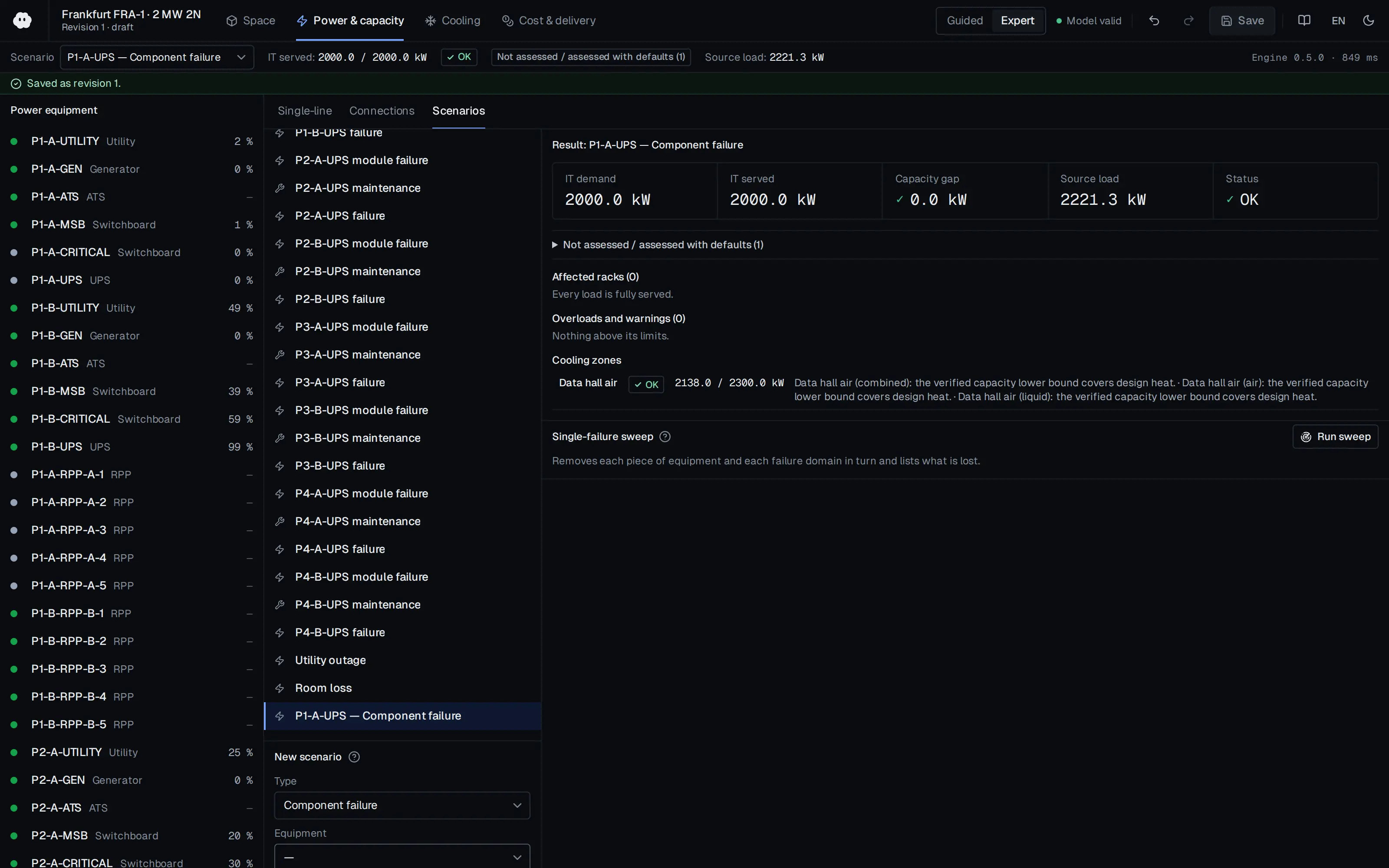
Who should read it
Data centre owners, operations managers and designers deciding on redundancy levels.
Publication details
- Authors
- Uptime Institute
- Publisher
- Uptime Institute
- Year
- 2017
- Document language
- English
- Source type
- Industry body
- Access
- Free to read
- Licence
- Copyright retained; citation only — the publisher’s terms apply to the original document
Original licence note
Publisher press release / public web page; copyright Uptime Institute, no open licence. Citation only.
Citation
Uptime Institute (2017). Uptime Institute 2017 Data Center Industry Survey (7th annual) - press release. Uptime Institute. https://uptimeinstitute.com/about-ui/press-releases/uptime-institute-annual-survey-results-enterprise-owned-data-centers-still-primary-compute-venue
Events on this subject
Browse the events calendarAll content and rights belong to the respective authors and publishers. SoSo CAD provides only the citation, its own summary and a link to the source, and is not responsible for the sources' content.