
Comparing the severity of IT service outages: Uptime Institute's Outage Severity Rating
Uptime Institute Journal (Uptime Institute) · A. Lawrence
An Uptime Journal article that introduces a qualitative five-category scale describing the business impact of an IT service outage regardless of its cause.
On this page
Overview
Published by A. Lawrence in the Uptime Institute Journal in 2019, this article introduces Uptime's five-category Outage Severity Rating. The scale aims to make the business impact of an IT service interruption comparable whatever its technical cause. The author likens the approach to the Beaufort scale: rather than a measured quantity, it is a qualitative rating that classifies the impact actually experienced.
The scale has five steps running from negligible to severe (Category 5). Each category describes business impact without regard to cause, so a power failure and a software fault can be compared within the same frame. This tries to get past the limits of reducing outages to a single yardstick such as duration or the number of affected users. The article applies the scale to public outages between 2016 and 2018. In that period, 11 outages were tracked as Severe (Category 5) and 46 as Serious (Category 4). Five of the 11 severe outages occurred at airlines. When Categories 4 and 5 are combined, banking and financial services is the most over-weighted sector relative to its share.
The scale's limit is its qualitative nature: the categories are a judgement-based classification rather than a precise calculation, and the analysis covers only outages that became public. Even so, the scale gives managers and engineers a shared vocabulary for discussing outage risk. In data centre design, that vocabulary can express incident severity consistently in risk registers and outage-cost estimates.
Key points
- The scale defines business impact in five categories, from negligible to severe (Category 5), regardless of cause.
- The rating is qualitative and is compared to the Beaufort scale.
- In 2016-2018, 11 Severe (Category 5) and 46 Serious (Category 4) public outages were tracked.
- Five of the 11 severe outages occurred at airlines.
- Banking and financial services is the most over-weighted sector when Categories 4 and 5 are combined.
- The article appeared in the Uptime Institute Journal in 2019 and is freely readable.
- The analysis covers only publicly reported outages.
Using it in design
- Express incident severity in the risk register on a 1-5 scale.
- In the outage-cost estimator interface, map the user's scenario to one of the five severity categories.
- Compare outages with different causes (power, cooling, software) on a common impact scale.
- For high-impact sectors such as finance and aviation, define the target severity category as a design requirement.
Monthly newsletter · free
Keep your reading list current
Once a month: new library sources, changes to Turkish regulations and upcoming data centre events.
SoSo CAD
Assess redundancy through scenarios
Compare normal operation and equipment failures in SoSo CAD, with supplied loads and capacity shortfalls in one view.
Request a demo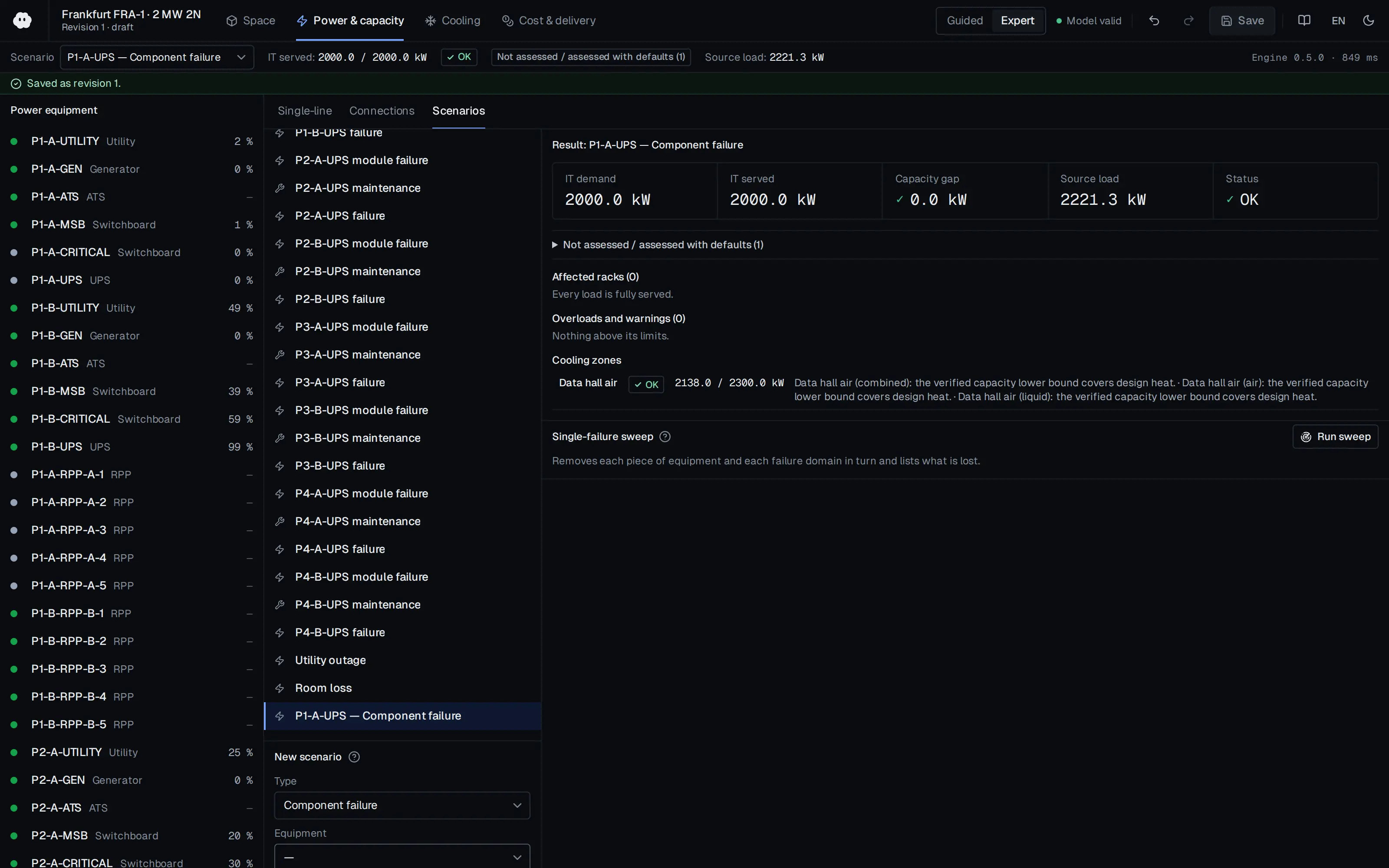
Who should read it
Data centre engineers and risk managers who prepare risk registers and outage-impact assessments.
Publication details
- Authors
- A. Lawrence
- Publisher
- Uptime Institute Journal (Uptime Institute)
- Year
- 2019
- Document language
- English
- Source type
- Industry body
- Access
- Free to read
- Licence
- Copyright retained; citation only — the publisher’s terms apply to the original document
Original licence note
Uptime Institute Journal article, copyright Uptime Institute, no open licence. Citation only.
Citation
A. Lawrence (2019). Comparing the severity of IT service outages: Uptime Institute's Outage Severity Rating. Uptime Institute Journal (Uptime Institute). https://journal.uptimeinstitute.com/comparing-the-severity-of-it-service-outages-uptime-institutes-outage-severity-rating-system/
Events on this subject
Browse the events calendarAll content and rights belong to the respective authors and publishers. SoSo CAD provides only the citation, its own summary and a link to the source, and is not responsible for the sources' content.