
Guide to Meteorological Instruments and Methods of Observation, 2008 edition updated in 2010 (2012 publication)
World Meteorological Organization · World Meteorological Organization (WMO)
The WMO-No. 8 guide includes humidity definitions and calculation formulas. Annex 4.B gives the saturation vapour pressure and dew-point relations needed to check the consistency of temperature and humidity inputs.
On this page
Overview
Annex 4.B gives the water-phase saturation vapour pressure as 6.112 exp(17.62 t / (243.12 + t)) with t in degrees Celsius, and defines relative humidity as actual vapour pressure divided by saturation vapour pressure. For example, saturation vapour pressure is about 23.3 hPa at 20 C and about 42.3 hPa at 30 C; these values are applications of the formula.
The same annex gives the Assmann psychrometer relation over water: vapour pressure equals the saturation value at the wet-bulb temperature minus 6.53e-4 (1 + 0.000944 tw) p (t - tw). For instance, t = 25 C, tw = 18 C and p = 1013.25 hPa give a vapour pressure of about 15.9 hPa and a relative humidity of about 50%. The inverse relation yields dew point.
The record points to the original WMO document hosted by Radiometrics. The formulas are defined for the Celsius convention and the stated range of applicability. The calculation is an approximation for checking whether dry-bulb, dew-point and relative-humidity inputs agree with one another; it is not a substitute for sensor calibration. The guide itself is a broad document on meteorological observation methods; this record uses only the humidity definitions and the Annex 4.B formulas.
Key points
- Saturation vapour pressure (water phase): 6.112 exp(17.62 t / (243.12 + t)), t in C.
- Relative humidity is actual vapour pressure divided by saturation vapour pressure.
- Assmann psychrometer relation: vapour pressure = saturation value at wet-bulb minus 6.53e-4 (1 + 0.000944 tw) p (t - tw).
- The inverse relation gives dew point.
- Use the Celsius convention and stated range; the calculation is not sensor calibration.
Using it in design
- Use the stated Celsius convention and applicability range when comparing dry-bulb, dew point and relative humidity.
- Run this calculation as a consistency check to warn the user when the input triple disagrees.
- Label the result as an approximation and state that it does not replace sensor calibration.
Monthly newsletter · free
Keep your reading list current
Once a month: new library sources, changes to Turkish regulations and upcoming data centre events.
SoSo CAD
Check cooling capacity alongside your design
Review zone heat loads, available capacity and the capacity balance after the largest unit is lost in SoSo CAD.
Request a demo
Who should read it
Software developers writing humidity and dew-point calculations and mechanical engineers validating ambient conditions.
Related standards
- WMO-No. 8
Publication details
- Authors
- World Meteorological Organization (WMO)
- Publisher
- World Meteorological Organization
- Year
- 2012
- Document number
- WMO-No. 8
- Document language
- English
- Source type
- Government / public
- Access
- Free to read
- Licence
- Copyright retained; citation only — the publisher’s terms apply to the original document
Citation
World Meteorological Organization (WMO) (2012). Guide to Meteorological Instruments and Methods of Observation, 2008 edition updated in 2010 (2012 publication). World Meteorological Organization. WMO-No. 8. https://radiometrics.com/wp-content/uploads/2021/10/wmo_8_en-2012.pdf
Events on this subject
Browse the events calendarAll content and rights belong to the respective authors and publishers. SoSo CAD provides only the citation, its own summary and a link to the source, and is not responsible for the sources' content.
Related sources
All sources on this topic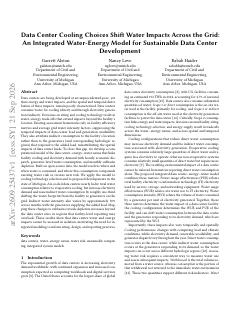
arXiv (University of Michigan preprint) 2026
Data Center Cooling Choices Shift Water Impacts Across the Grid: An Integrated Water-Energy Model for Sustainable Data Center Development
In cooling selection, calculate direct and indirect water together: an air-cooled chiller cut direct water 97% but raised the indirect share to 96.6% and electricity by 32%.
- Indirect water intensity varied by about 50% across months, depending on which generators supplied the added load.

Open Compute Project Foundation 2026
Guidelines: Impact of Strategies on Data Center Energy Consumption, Carbon Footprint, and Water Consumption (March 2026)
Evaluate cooling and siting options on energy, carbon, site water and water scarcity together, not on PUE or WUE alone.
- Same example: emissions fall from 3,500 to 2,700 t CO2/yr with the carbon factor of 0.26 kg CO2/kWh.
Sensors (MDPI AG) 2022
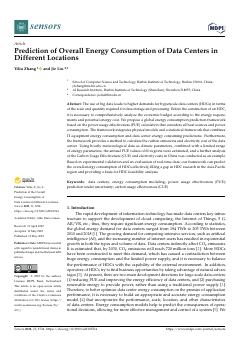
Prediction of Overall Energy Consumption of Data Centers in Different Locations
In siting, do not use PUE as the only criterion; evaluate it together with electricity cost (tariff) and carbon (CUE, grid mix) estimates derived from PUE, since a low-PUE site may have a high tariff or carbon-intensive grid.
- For an assumed 100 million kWh/yr of IT energy, estimated annual electricity cost ranged from $8.1376M (Delinha) to $9.6742M (Yinchuan) among five regions.

Open Compute Project Foundation 2022
Guidelines for Connection of Liquid Cooled Information Technology Equipment (ITE) to Data Center Facility Systems, Revision 1, Version 1.0 (April 2022)
Place standard tap-off points with isolation valves, vent/drain/flush connections and strainers at every rack or CDU connection in liquid cooling layouts, sized from Q = flow x delta T x cp so future kW per position is explicit.
- Keeping FWS liquid above dew point avoids condensation; the ASHRAE recommended dew point limit for air-cooled classes A1-A4 is 15 C.

Open Compute Project Foundation 2020
Colocation Facility Guidelines for Deployment of Open Racks, Revision 4.0 (15 December 2020)
Check the delivery route against rack height plus 0.5 m, door and corridor widths, and the lift capacity, before agreeing to host or design for Open Racks.
- Maximum rack density is at least 8 kW (Acceptable) or 12 kW (Optimum); cold aisle width is at least 1,200 mm or 1,500 mm.
BICSI 2026
BICSI Data Center Design Consultant (DCDC) certification
Add a 'credentials' field to the user profile and recognise DCDC as a value there.
- ANSI/BICSI 002-2024 is listed as a related resource.