
NIST SP 800-116 Rev. 1: Guidelines for the Use of PIV Credentials in Facility Access
National Institute of Standards and Technology · Hildegard Ferraiolo, Ketan Mehta et al.
NIST's guideline on using US federal employee and contractor PIV cards in physical access control systems (PACS). It divides protected space into Controlled, Limited and Exclusion areas and sets a minimum number of authentication factors for each.
U.S. public domain — U.S. Government work; free to reuse
On this page
Overview
The guideline gives technical direction for using the PIV Card, required by HSPD-12 for physical access to federal facilities, in government-wide interoperable PACS. FIPS 201 defines authentication mechanisms at four assurance levels (LITTLE or NO, SOME, HIGH, VERY HIGH), and this document recommends a risk-based strategy for choosing among them. It is aimed at officials implementing HSPD-12 compliant PACS, contractors and physical security vendors, and it covers PIV Cards only, not non-PIV credentials.
The central recommendation is to choose mechanisms by the protective areas around assets rather than by facility: Controlled areas need at least 1 authentication factor, Limited areas 2 and Exclusion areas 3. These areas correspond generally to LOW, MODERATE and HIGH impact assets. There is no simple one-to-one mapping between Facility Security Level (FSL) and mechanism; an FSL I campus may need nested perimeters because of localised high-value assets. PKI-CAK, BIO, BIO-A and PKI-AUTH rely on mandatory card features, while SYM-CAK and OCC-AUTH are optional, so access points should not rely solely on optional features.
Revision 1 aligns with FIPS 201-2 by making credential validation required. The CHUID authentication mechanism is deprecated for security reasons, although the CHUID data element stays mandatory as a source of expiry date and unique identifier. VIS + CHUID was dropped because it gives LITTLE or NO confidence. Online validation is recommended where current status is needed; where it is impractical a caching status proxy can be used and its cache must be refreshed at least every 24 hours. A revoked certificate must always block access.
Section 3 surveys threats such as identifier collisions, revoked cards, visual counterfeiting, skimming, sniffing, social engineering, electronic cloning and counterfeiting. Section 5 works through single-tenant, federal multi-tenant, mixed multi-tenant and FSL I-II, III and IV-V campus examples, and Section 6 covers PIV identifiers, PACS registration, role-based access control, disaster response, temporary badges, lost cards and PACS and ICAM infrastructure.
Key points
- Minimum authentication factors: Controlled 1, Limited 2, Exclusion 3.
- Controlled, Limited and Exclusion areas correspond generally to LOW, MODERATE and HIGH impact assets.
- Authentication mechanisms exist at four assurance levels: LITTLE or NO, SOME, HIGH, VERY HIGH.
- Access points should not rely solely on optional card features such as SYM-CAK or OCC-AUTH.
- Credential validation is now required, and the CHUID authentication mechanism is deprecated.
- VIS + CHUID is excluded because it provides LITTLE or NO confidence.
- The caching status proxy must refresh at least once every 24 hours; a revoked certificate must always prevent access.
- FSL I or II facilities may decline PACS; FSL III and above should implement it.
- The single-tenant example has two perimeters: the lobby and the entrance to a room with high-value assets such as a server room.
Using it in design
- Map data-centre layers (site perimeter, building lobby, data hall, cage or cabinet) to Controlled, Limited and Exclusion areas and set 1, 2 or 3 factors at each transition.
- Include reader hardware for three-factor authentication (card, biometric, PIN) at doors to high-value areas such as server rooms.
- Reflect the caching proxy and its 24-hour refresh rule in network and power redundancy design for when online validation is interrupted.
- For multi-tenant colocation, decide early which security level applies to the outer perimeter and to tenant-specific inner perimeters.
- Put the limitations of legacy PACS components (reader interface, wiring, software upgrades) on the retrofit checklist.
- Plan disaster response, temporary badge and lost card processes together with the PACS registration infrastructure.
Monthly newsletter · free
Keep your reading list current
Once a month: new library sources, changes to Turkish regulations and upcoming data centre events.
SoSo CAD
Bring standards pre-checks into your project
Review model-based TS EN 50600 and Tier pre-checks, missing inputs and items requiring engineering review in SoSo CAD.
Request a demo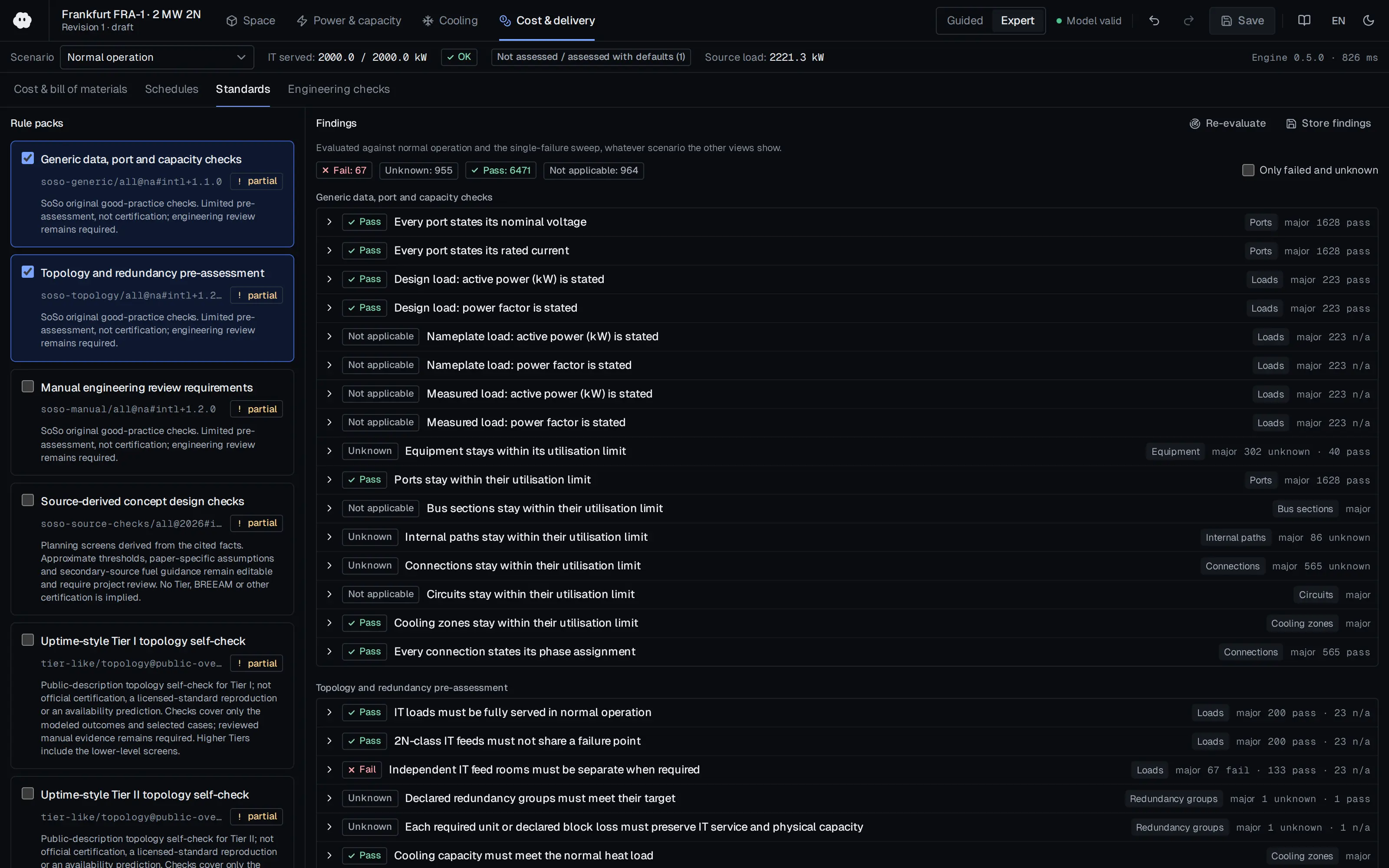
Who should read it
Officials implementing HSPD-12 compliant physical access control systems, contractors and physical security integrators.
Document contents
- 1. Introduction
- 2. Characteristics of PIV Implementations
- 3. Threat Environment
- 4. PIV Authentication Mechanisms in PACS Applications
- 4.1 PIV Authentication Mechanisms
- 4.2 Authentication Factors
- 4.3 Selection of PIV Authentication Factors
- 4.4 Credential Validation
- 5. PACS Use Cases
- 6. Deployment Consideration
- Appendix A. An Overview of PIV Authentication Mechanisms
- Appendix B. Combinations of PIV Authentication Mechanisms in PACS
- Appendix C. Improving Authentication Transaction Times
- Appendix E. Limitations of Legacy Physical Access Control Systems
- Appendix I. Revision History
Related standards
- FIPS 201-3
- NIST SP 800-73
- EN 50600-2-5
Read the document
nist-sp-800-116r1.pdf
U.S. public domain — U.S. Government work; free to reuse
The document is provided unaltered because its licence permits redistribution.
Publication details
- Authors
- Hildegard Ferraiolo; Ketan Mehta; Nabil Ghadiali; Jason Mohler; Vincent Johnson; Steven Brady
- Publisher
- National Institute of Standards and Technology
- Year
- 2018
- Document number
- NIST SP 800-116 Rev. 1
- Document language
- English
- Source type
- Expert / community
- Access
- Open licence — downloadable
- Licence
- U.S. public domain — U.S. Government work; free to reuse
- Licence evidence
- www.copyright.gov
Original licence note
NIST publication available free of charge via doi.org/10.6028; the front-matter authority/copyright statement says it is not subject to copyright in the United States (attribution appreciated); U.S. government work under 17 U.S.C. 105.
Citation
Hildegard Ferraiolo; Ketan Mehta; Nabil Ghadiali; Jason Mohler; Vincent Johnson; Steven Brady (2018). NIST SP 800-116 Rev. 1: Guidelines for the Use of PIV Credentials in Facility Access. National Institute of Standards and Technology. NIST SP 800-116 Rev. 1. https://doi.org/10.6028/NIST.SP.800-116r1
Events on this subject
Browse the events calendarAll content and rights belong to the respective authors and publishers. SoSo CAD provides only the citation, its own summary and a link to the source, and is not responsible for the sources' content.
Related sources
All sources on this topic
National Institute of Standards and Technology 2025
NIST SP 800-88 Rev. 2: Guidelines for Media Sanitization
Add media sanitization to the facility's storage and server lifecycle plan at commissioning, and label media with the confidentiality category of the system.
- Cryptographic erase: at least 128 bits of security strength, key sanitization by ISO/IEC 19790 zeroization, ECB mode not allowed.
National Institute of Standards and Technology 2024
The NIST Cybersecurity Framework (CSF) 2.0
Create separate Organizational Profiles for a facility's IT, OT and building management systems (for example electrical and cooling SCADA/BMS) and state each Profile's scope.
- The Core has 22 Categories with Subcategories; the outcomes are not a checklist.
National Institute of Standards and Technology 2023
NIST SP 800-82 Rev. 3: Guide to Operational Technology (OT) Security
Zone the data centre's electrical (UPS, generator, ATS) and mechanical (cooling, HVAC) control systems as an OT network, separated from the corporate IT network by a DMZ.
- Network architecture should characterise, segment and isolate IT and OT devices, using the Purdue model, ISA-95 or an IIoT model, with a DMZ.
National Institute of Standards and Technology 2021
NIST SP 1108r4: NIST Framework and Roadmap for Smart Grid Interoperability Standards, Release 4.0
Decide which communication pathways scenario (high-DER, microgrid) applies to on-site generation, batteries and flexible load in the facility's electrical infrastructure.
National Institute of Standards and Technology 2020
NIST SP 800-53 Rev. 5: Security and Privacy Controls for Information Systems and Organizations
In data-centre power design, set PE-9 requirements for physically separated redundant cabling paths and automatic voltage control on critical components, and define the separation distance as an organisational parameter.
- Baselines and tailoring guidance moved to SP 800-53B.
Fire (MDPI AG) 2026
Probabilistic Risk Assessment of Grid-Scale Lithium-Ion Battery Energy Storage System Fire Hazards: Hydrogen Fluoride (HF) Toxicity, Suppression Effectiveness, and Comparative Compartment Design Analysis
Compare BESS compartmentation quantitatively: two compartments halve HF dose and IDLH clearance time, but IDLH is still exceeded for anyone in the room in full thermal runaway, so runaway prevention (BMS integrity, UL 9540A containment, emergency power off) must stay the primary control.
- Mean IDLH (25 mg/m³) clearance time with 9 ACH was 599 min for one compartment and 301 min for two; the probability of clearing within 5 min was 0% for both.