Collection

Liquid cooling

Direct-to-chip, immersion, CDUs and facility water interfaces.

Sources
153
Downloadable PDFs
48
Years
2011–2026

All sources

121–144 / 153

White paperPDF

Open Compute Project Foundation Year not stated

Guidelines for Using Propylene Glycol-Based Heat Transfer Fluids in Single-Phase Cold Plate-Based Liquid Cooled Racks (OCP white paper)

Write the PG25 or PG55 choice into the fluid specification according to the freeze protection the climate needs, and record that keeping glycol above 25% by volume removes the need for biocide.

  • Maximum corrosion rates under ASTM D8040-17: copper 0.22 mpy (5 mg/coupon), brass 0.46 mpy (10 mg/coupon).

White paperPDF

Open Compute Project Foundation 2022

Leak Detection and Intervention, Revision 1.0 (OCP Advanced Cooling Solutions white paper)

Run a probability-and-impact leak risk analysis at project start, specify BSPP/O-ring joints for serviceable connections and check the O-ring compound against the coolant chemistry using the full wetted-materials list.

  • A UQD2 dry-break quick disconnect is specified to drip less than 0.063 cc when disconnected at 200 psi.
Technical guidePDF

Open Compute Project Foundation 2025

Modular Technology Cooling System for "Cloud Scale": Design & Delivery of Liquid to Rack Distribution Systems, Version 1.0 (25 August 2025)

When sizing TCS capacity against electrical capacity, state the cold-plate capture fraction (70-80%) and target delta-T (10 or 20 C) explicitly, and use the roughly doubled delivery at 20 C (4,845 versus 2,422 kW) as design headroom.

  • Most IT equipment is designed for a 10 C coolant delta-T, with some designs considering 20 C.
Technical guidePDF

Open Compute Project Foundation 2026

OCP Cooling Environments: Cold Plate Sub-Project Design Specification, Universal Quick Disconnect (UQD), v2.0.0 (effective September 22, 2026)

Select size (02-08) by rack or server loop flow: rated flows run from 2.27 to 17.79 L/min; estimate pressure drop from the Cv range and ask for correction or extra testing where the fluid differs from water.

  • Cv ranges: 0.30-0.43 for size 02, 1.1-1.6 for 04, 2.2-3.3 for 06 and 3.6-5.6 for 08.
Technical guidePDF

Open Compute Project Foundation 2020

Design Guidelines for Immersion-Cooled IT Equipment, Revision 1.0 (December 2020)

Compare the bill of materials of a server to be immersed (cable jackets, heat-shrink, EPDM capacitors, CMOS battery, relays, thermal paste) against the paper's problem table and obtain a compatibility statement from the fluid supplier for each item.

  • In Soxhlet extraction testing, a mass loss below 2% indicates good material compatibility; the 48-hour test gives worst-case results.
Technical guidePDF

Open Compute Project Foundation 2026

Single-Phase Direct-to-Chip Cold Plate Test Specification, Version 1.0.0 (OCP Cooling Environments: Cold Plate Sub-Project, effective September 3, 2026)

Reference the specification in a cold plate purchase requirement and state which tests, limits and sampling the customer requires, since many limits are examples.

  • Flow rate testing goes up to velocities below 1.5 m/s to ensure no erosion or leaks.
Technical guideCitation

NREL 2017

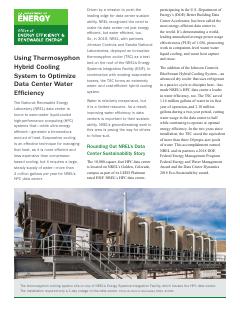
Thermosyphon Cooler Hybrid System for Water Savings in an Energy-Efficient HPC Data Center: Modeling and Installation (NREL/CP-2C00-66690, February 2017)

Place a dry stage upstream of the tower and size it against the share of hours where warm return water exceeds dry-bulb temperature by enough margin, as the 9.4 °C transition point does here.

  • Building heat reuse peaks at 0.434 MW of a 0.910 MW load, leaving 0.496 MW to reject to atmosphere.
Technical guideCitation

NREL 2018

Thermosyphon Cooler Hybrid System for Water Savings in an Energy-Efficient HPC Data Center: Results (NREL/TP-2C00-72196, September 2018)

Check whether the warm return water from liquid cooling (here 84 °F after energy recovery) leaves enough temperature difference to ambient for a dry or hybrid stage, and size it against local dry-bulb hours.

  • First-year heat rejection: 10.5% building heat reuse, 42.5% thermosyphon and 47% cooling towers.

All content and rights belong to the respective authors and publishers. SoSo CAD provides only the citation, its own summary and a link to the source, and is not responsible for the sources' content.

Monthly newsletter · free

Keep your reading list current

Once a month: new library sources, changes to Turkish regulations and upcoming data centre events.