Topic guide

UPS

Browse technical references on uninterruptible power supplies, batteries and redundant power arrangements. Explore capacity, efficiency, runtime and maintenance considerations alongside each publication’s assumptions and scope.

Sources
175
Downloadable PDFs
50
Years
2002–2026

All sources

73–96 / 175

Technical guideFree to read

Inform Elektronik 2025

Inform UPS - Uninterruptible Power Supply Catalogue

Keep module size, frame maximum, maximum parallel frames, output PF, online and eco efficiency, IEC 62040-3 class, overload curve points, THDi, altitude limit and battery string voltage options as UPS catalog fields.

  • Operating temperature 0-40 C; 20-25 C recommended for battery life.

White paperFree to read

Schneider Electric 2012

Making Large UPS Systems More Efficient

Store UPS losses as a three-coefficient model (no-load, proportional, square-law) or a 0/25/50/75/100% curve, and record whether quoted efficiency includes input filters or transformers.

  • Cooling adds 0.4 kW per kW of loss.
White paperFree to read

Schneider Electric 2011

Modular Systems: The Evolution of Reliability

In the availability model give each UPS and cooling unit a failure-domain attribute (racks lost on its failure) alongside MTBF, so users can compare one large UPS with distributed or modular N+1 options by blast radius, not just component count.

  • IT equipment changes every 2 to 3 years, while traditional infrastructure is deployed once for projected maximum load.
Technical guidePDF

Open Compute Project Foundation 2022

Open Rack V3 BBU Shelf Specification, Rev 1.1

Model ORV3 in-rack BBU as an alternative to a central UPS and check that generator start and transfer time fit inside the roughly 4-minute window at rated load per shelf.

  • Each BBU shelf holds one PMI module and six 3 kW BBU modules in 5+1 redundancy.
White paperFree to read

Eaton 2020

Parallel UPS Systems

Add maxParallelUnits, paralleling architecture (distributed or centralised bypass) and static switch rating to the UPS catalogue.

  • N+1 alarm: five 100 kVA modules alarm when load exceeds 400 kVA.
Research paperPDF

IEEE Transactions on Industry Applications (Institute of Electrical and Electronics Engineers (IEEE)) 2026

Practical Battery Arc Flash Models

In battery-room arc-flash labelling, calculate the self-extinguishing model alongside the maximum power method rather than using the latter as the only reference, and check cases where excessive PPE categories make maintenance impractical.

  • An arc-in-a-box coefficient of 1.52, based on the value calculated for panelboards, was used for enclosed-space experiments.
Research paperPDF

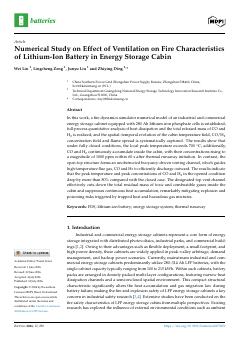
Fire (MDPI AG) 2026

Probabilistic Risk Assessment of Grid-Scale Lithium-Ion Battery Energy Storage System Fire Hazards: Hydrogen Fluoride (HF) Toxicity, Suppression Effectiveness, and Comparative Compartment Design Analysis

Compare BESS compartmentation quantitatively: two compartments halve HF dose and IDLH clearance time, but IDLH is still exceeded for anyone in the room in full thermal runaway, so runaway prevention (BMS integrity, UL 9540A containment, emergency power off) must stay the primary control.

  • Mean IDLH (25 mg/m³) clearance time with 9 ACH was 599 min for one compartment and 301 min for two; the probability of clearing within 5 min was 0% for both.
White paperFree to read

Schneider Electric 2024

Recycling and Circularity of Li-Ion Batteries

Add chemistry (LFP/NMC/NCA), module construction (bolted or welded), battery passport availability, take-back/EPR programme and declared recycled content to the battery catalog.

  • Li-ion batteries are UN Class 9 dangerous goods.
Research paperFree to read

Proceedings of the 2018 3rd Joint International Information Technology,Mechanical and Electronic Engineering Conference (JIMEC 2018) (Atlantis Press) 2018

Research on Availability of Data Center UPS Power Supply System

Offer 'UPS + utility (mains) dual bus' as a topology template beside 2N and N+1, with an RBD calculation that shows it can match 2N for dual-corded IT load.

  • Power-system failures are cited as 72.2% of data-centre failures.

All content and rights belong to the respective authors and publishers. SoSo CAD provides only the citation, its own summary and a link to the source, and is not responsible for the sources' content.

Monthly newsletter · free

Keep your reading list current

Once a month: new library sources, changes to Turkish regulations and upcoming data centre events.