Topic guide

UPS

Browse technical references on uninterruptible power supplies, batteries and redundant power arrangements. Explore capacity, efficiency, runtime and maintenance considerations alongside each publication’s assumptions and scope.

Sources
175
Downloadable PDFs
50
Years
2002–2026

All sources

49–72 / 175

White paperFree to read

Schneider Electric 2015

Electrical Distribution Equipment in Data Center Environments

In the single-line editor define node types for MV switchgear, MV/LV transformer, LV switchboard/ATS, UPS input/output/distribution boards, STS, PDU, RPP, busway, panelboard and rack PDU, each with rated voltage, rated current, breaking capacity (kAIC/Icu) and withstand rating (SCCR/Icw).

  • MV switchgear marks the service entrance above 1 MW IT load; LV switchgear/switchboard marks it below 1 MW.
RegulationFree to read

Enerji Piyasası Düzenleme Kurumu (EPDK) 2021

Elektrik Piyasasında Depolama Faaliyetleri Yönetmeliği

Treat a grid-interactive data-centre battery as storage integrated with a consumption facility: same metering point and a distribution company connection opinion are required.

  • The regulation was published in Official Gazette No. 31479 on 9 May 2021.
Research paperFree to read

ACM e-Energy '26 (author version on arXiv) 2025

Enhancing Data Center Low-Voltage Ride-Through

Add a ride-through check to the electrical module: compare the selected UPS input tolerance (IEC 62040-3 class) and IT tolerance (ITI/CBEMA) against the applicable grid-code LVRT envelope for the site's region, and flag the gap.

  • IEC 62040-3 (UPS) and ITI/CBEMA (IT loads) are the least strict compared with proposed TSO grid codes, with a substantial performance gap.
Research paperPDF

Batteries (MDPI AG) 2025

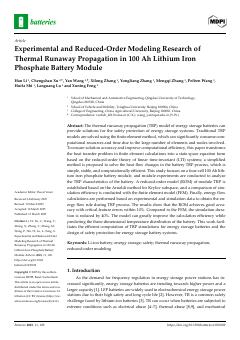
Experimental and Reduced-Order Modeling Research of Thermal Runaway Propagation in 100 Ah Lithium Iron Phosphate Battery Module

In LFP module design, evaluate inter-cell thermal resistance (interface insulation) together with measures that cut heat release to stop propagation; in the model an interface resistance of hR = 100 W·m^-2·K^-1 alone suppressed it.

  • Venting phases (vent opening to runaway) lasted 204 s, 399 s, 156 s and 309 s for cells 1-4.
Research paperPDF

Batteries (MDPI AG) 2026

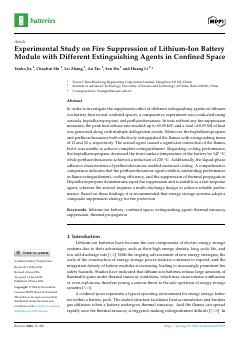
Experimental Study on Fire Suppression of Lithium-Ion Battery Module with Different Extinguishing Agents in Confined Space

For confined battery packs and cabinets, evaluate a fast flame-knockdown agent (such as heptafluoropropane) together with an agent or approach giving long-lasting cooling (such as perfluorohexanone); no single agent stopped heat transfer to neighbouring cells.

  • Without suppression, peak HRR reached 69.09 kW and total heat release was 8.05 MJ, with multiple deflagrations after venting in the confined space.
White paperFree to read

Schneider Electric 2018

FAQs for Using Lithium-ion Batteries with a UPS

Battery catalog: chemistry (VRLA, LFP, NMC, LMO, NCA, LTO, LCO), specific energy, design and cycle life, rated temperature, footprint and weight per kWh, recharge time and compatible UPS models.

  • Li-ion takes 50-80% less floor space and weighs 60-80% less.
Research paperFree to read

IET Generation, Transmission & Distribution (Institution of Engineering and Technology (IET)) 2026

From Liability to Asset: A Three-Mode Grid-Forming Control Framework for Centralized Data Center UPS Systems

For large or AI facilities, record the UPS's fault ride-through behaviour (momentary cessation versus ride-through with minimum grid draw), the inverter current limit and the post-fault ramp rate, alongside the point-of-interconnection short-circuit ratio.

  • Unserved IT energy was 0.00000 MWh with the proposed controller versus 0.00208 MWh for a momentary-cessation benchmark.
Research paperPDF

Energy Advances (Royal Society of Chemistry (RSC)) 2025

Full life cycle assessment of an industrial lead–acid battery based on primary data

For UPS duty with a few cycles a year and minutes of autonomy, compare battery chemistries by environmental impact categories (GWP, ecotoxicity, resource depletion) as well as energy density, because production and EOL dominate.

  • Data centres account for about 37% of the roughly 3.4 billion USD global stationary-battery market, followed by telecom at 25%.
Research paperPDF

IEEE Access (Institute of Electrical and Electronics Engineers (IEEE)) 2026

GRAPE-UPS: Direction-Constrained Peer Anomaly Detection for Weak Batteries in Data-Center UPS Strings

Require block-level (per-unit) voltage and resistance monitoring in UPS battery monitoring rather than string totals, citing that one weak unit in a series string limits the whole string's capacity.

  • On an independent electrochemical simulation benchmark, directed peer scoring achieved AUPRC 0.848 under nominal conditions and 0.850-0.877 under operating shifts.
Research paperPDF

Advances in Applied Energy (Elsevier BV) 2026

Grid Integration of AI Data Centers: A Critical Review of Energy Storage Solutions

Layer storage by timescale: GPU/server supercapacitors for sub-second swings, rack BBUs for minutes, facility GiUPS and BESS for grid services and longer durations; show each layer's duty and coordination separately in the architecture.

  • BESS cost fell from about $7,500/kWh in 1991 to $133/kWh in 2024, with about $80/kWh projected by 2030.
Technical guideFree to read

Huawei Digital Power 2025

Huawei AI Data Center Reference Design

Import RD 01-21 as parametric AI-hall templates (rack kW, racks per module, module kW, redundancy of fan walls/TMUs/towers, generator and transformer counts) and as golden test cases for capacity math.

  • Power distribution supports 2N, DR and BR architectures.

All content and rights belong to the respective authors and publishers. SoSo CAD provides only the citation, its own summary and a link to the source, and is not responsible for the sources' content.

Monthly newsletter · free

Keep your reading list current

Once a month: new library sources, changes to Turkish regulations and upcoming data centre events.