Topic guide

Water

Find references on data centre water consumption, cooling water and water efficiency. Investigate local conditions, measurement boundaries and the relationship between energy and water use through technical notes.

Sources
93
Downloadable PDFs
26
Years
2009–2026

All sources

73–93 / 93

Technical guideCitation

Lawrence Berkeley National Laboratory 2017

Humidity Control in Data Centers (March 8, 2017)

Write the humidity strategy around room dew point: set a wide dead band (about 16 °F to 59 °F dew point unless the IT owner agrees a higher lower limit) rather than a narrow RH band.

  • Class A1 equipment is known to function up to 90 °F and A4 up to 113 °F, although all classes share the same recommended range.
Technical guidePDF

U.S. DOE FEMP 2010

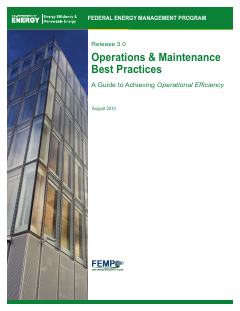
Operations & Maintenance Best Practices: A Guide to Achieving Operational Efficiency, Release 3.0 (August 2010)

Choose maintenance strategy by equipment criticality: predictive for critical equipment with random failures, preventive for equipment subject to wear, reactive for small non-critical items; build a master equipment list and priority matrix.

  • Boiler combustion tuning and related O&M can yield fuel savings of 2% to 20%.
Technical guideCitation

NREL 2017

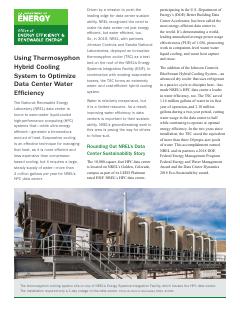
Thermosyphon Cooler Hybrid System for Water Savings in an Energy-Efficient HPC Data Center: Modeling and Installation (NREL/CP-2C00-66690, February 2017)

Place a dry stage upstream of the tower and size it against the share of hours where warm return water exceeds dry-bulb temperature by enough margin, as the 9.4 °C transition point does here.

  • Building heat reuse peaks at 0.434 MW of a 0.910 MW load, leaving 0.496 MW to reject to atmosphere.
Technical guideCitation

NREL 2018

Thermosyphon Cooler Hybrid System for Water Savings in an Energy-Efficient HPC Data Center: Results (NREL/TP-2C00-72196, September 2018)

Check whether the warm return water from liquid cooling (here 84 °F after energy recovery) leaves enough temperature difference to ambient for a dry or hybrid stage, and size it against local dry-bulb hours.

  • First-year heat rejection: 10.5% building heat reuse, 42.5% thermosyphon and 47% cooling towers.

All content and rights belong to the respective authors and publishers. SoSo CAD provides only the citation, its own summary and a link to the source, and is not responsible for the sources' content.

Monthly newsletter · free

Keep your reading list current

Once a month: new library sources, changes to Turkish regulations and upcoming data centre events.