Collection

Power and UPS

Power distribution, UPS, batteries, protection and redundant supply.

Sources
418
Downloadable PDFs
95
Years
1984–2027

All sources

337–360 / 418

White paperFree to read

Schneider Electric 2016

Comparing UPS System Design Configurations

Offer N, isolated redundant, N+1, distributed redundant (catcher/STS), tri-redundant, 2N and 2(N+1) in the topology library, and label availability values as comparative rather than absolute.

  • N+1 module loading for a 240 kW load: 2x240 kW 50%; 3x120 66%; 4x80 75%; 5x60 80%.
Technical guidePDF

Open Compute Project Foundation 2026

Interface Specification Between Hyperscalers and Utility Grid for Disturbance Performance (Version 1.0.0)

For a new site, write the POI LVRT/HVRT envelope and the PFAPR requirement (90% within 2 s) as design criteria, and settle which voltage measurement (line-to-neutral or line-to-line) governs during protection coordination with the utility.

  • In ERCOT NOGRR 282, cooling load is subtracted from the pre-fault load used to judge PFAPR.
Technical guideCitation

Lawrence Berkeley National Laboratory (Center of Expertise for Energy Efficiency in Data Centers) / U.S. DOE FEMP 2020

Data Center Master List of Energy Efficiency Measures, Version 2.0 (September 2020)

Compare the planned UPS module count and redundancy scheme against the load curve: check the per-unit load at day-one and at full build, and consider modular units or switching off surplus modules.

  • Variable-speed chillers usually peak at 60-80% of full load; constant-speed chillers peak at full load.
Technical guideCitation

U.S. DOE Better Buildings / Lawrence Berkeley National Laboratory 2017

Data Center Metering and Resource Guide (February 2017)

At a stand-alone site, design meters that record energy (kWh) at the utility entrance and at the UPS output (or at panels serving only IT if there is no UPS); a UPS display that shows only power (kW) is not enough.

  • PUE Level 1 for a stand-alone data center is utility meter reading divided by UPS output energy (M1/M2).
Technical guidePDF

U.S. EPA / ENERGY STAR 2024

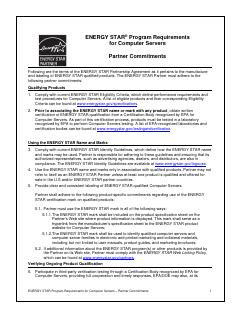
ENERGY STAR Program Requirements for Computer Servers, Version 4.0 (Partner Commitments, Eligibility Criteria, and Final Test Method Rev. April 2023)

Write ENERGY STAR Version 4.0 certification and the PSU efficiency steps (at 10% to 100% load points) into the server procurement specification; look especially at 10% and 20% load efficiency for redundant supplies that run lightly loaded.

  • EffACTIVE = EXP(0.65 ln EffCPU + 0.30 ln EffMEMORY + 0.05 ln EffSTORAGE).
Technical guidePDF

U.S. EPA / ENERGY STAR 2017

ENERGY STAR Program Requirements for Uninterruptible Power Supplies (UPSs) - Partner Commitments, Eligibility Criteria Version 2.0, and Test Method (Rev. Dec-2017)

Write the Version 2.0 thresholds into UPS procurement as a floor; for VFI units above 10,000 W compute the minimum from 0.0058 x ln(P) + 0.886 for the actual rating.

  • Modular UPSs in the 1,500-10,000 W range receive an efficiency allowance (EMOD) of 0.004.

All content and rights belong to the respective authors and publishers. SoSo CAD provides only the citation, its own summary and a link to the source, and is not responsible for the sources' content.

Monthly newsletter · free

Keep your reading list current

Once a month: new library sources, changes to Turkish regulations and upcoming data centre events.