Topic guide

Reliability

Explore references on reliability, availability and redundant architectures. Review failure models, maintenance arrangements and system dependencies while keeping the evidence, methods and scope of each publication in view.

Sources
255
Downloadable PDFs
58
Years
2002–2026

All sources

73–96 / 255

Research paperPDF

Batteries (MDPI AG) 2025

Experimental and Reduced-Order Modeling Research of Thermal Runaway Propagation in 100 Ah Lithium Iron Phosphate Battery Module

In LFP module design, evaluate inter-cell thermal resistance (interface insulation) together with measures that cut heat release to stop propagation; in the model an interface resistance of hR = 100 W·m^-2·K^-1 alone suppressed it.

  • Venting phases (vent opening to runaway) lasted 204 s, 399 s, 156 s and 309 s for cells 1-4.
Research paperFree to read

IET Generation, Transmission & Distribution (Institution of Engineering and Technology (IET)) 2026

From Liability to Asset: A Three-Mode Grid-Forming Control Framework for Centralized Data Center UPS Systems

For large or AI facilities, record the UPS's fault ride-through behaviour (momentary cessation versus ride-through with minimum grid draw), the inverter current limit and the post-fault ramp rate, alongside the point-of-interconnection short-circuit ratio.

  • Unserved IT energy was 0.00000 MWh with the proposed controller versus 0.00208 MWh for a momentary-cessation benchmark.
Research paperPDF

IEEE Access (Institute of Electrical and Electronics Engineers (IEEE)) 2026

GRAPE-UPS: Direction-Constrained Peer Anomaly Detection for Weak Batteries in Data-Center UPS Strings

Require block-level (per-unit) voltage and resistance monitoring in UPS battery monitoring rather than string totals, citing that one weak unit in a series string limits the whole string's capacity.

  • On an independent electrochemical simulation benchmark, directed peer scoring achieved AUPRC 0.848 under nominal conditions and 0.850-0.877 under operating shifts.
Technical guidePDF

Open Compute Project Foundation 2022

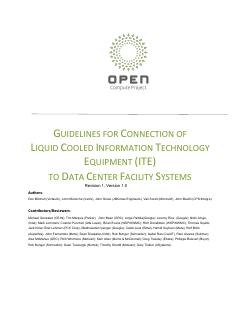
Guidelines for Connection of Liquid Cooled Information Technology Equipment (ITE) to Data Center Facility Systems, Revision 1, Version 1.0 (April 2022)

Place standard tap-off points with isolation valves, vent/drain/flush connections and strainers at every rack or CDU connection in liquid cooling layouts, sized from Q = flow x delta T x cp so future kW per position is explicit.

  • Keeping FWS liquid above dew point avoids condensation; the ASHRAE recommended dew point limit for air-cooled classes A1-A4 is 15 C.

All content and rights belong to the respective authors and publishers. SoSo CAD provides only the citation, its own summary and a link to the source, and is not responsible for the sources' content.

Monthly newsletter · free

Keep your reading list current

Once a month: new library sources, changes to Turkish regulations and upcoming data centre events.